
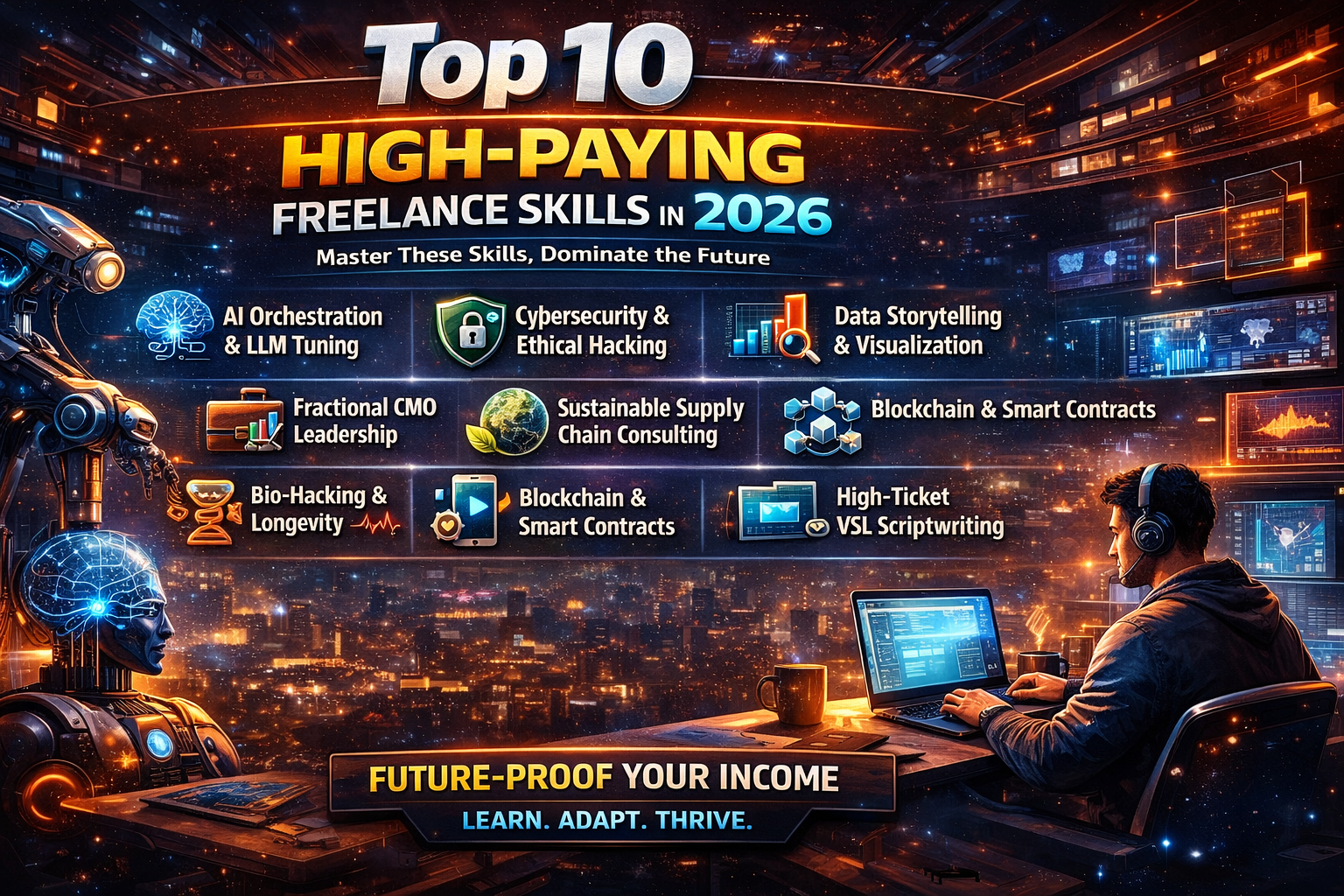
Top 10 High-Paying Freelance Skills to Master in 2026: The Ultimate Guide
Top 10 High-Paying Freelance Skills to Master in 2026: The Ultimate Guide
Let’s be honest with each other for a minute.
You’ve probably heard the same advice over and over again: “Learn coding.” “Get a degree.” “Work hard and wait your turn.” And for years, that actually made sense. But here’s the thing—2026 is not 2016. It’s not even 2022. The rules have changed. And honestly? They’ve changed in your favor.
Here’s what most people won’t tell you:
You no longer need a fancy degree, a decade of experience, or a connection in a big company to earn a life-changing income.
Sounds like a dream, right? It’s not. It’s the reality of the “Skill Economy” in 2026.
Think about it. Some of the highest-paid freelancers in the world today don’t have MBAs or engineering degrees. They have something far more valuable: specialized skills that businesses are desperate for.
In 2026, the global workforce is no longer defined by rigid 9-to-5 jobs or traditional corporate ladders. The rise of remote work, AI-driven tools, and the “Skill Economy” has shifted earning potential from degrees and tenure to specialized, high-value skills. Freelancers today—sometimes referred to as “Solopreneurs”—can out-earn corporate executives by mastering the right niche, positioning themselves effectively, and leveraging modern technologies.

If your goal is to future-proof your career and command premium rates, understanding the high-paying freelance skills of 2026 is critical. These skills are in massive demand across industries, including AI, cybersecurity, immersive experiences, and no-code development. In this guide, we’ll break down the top 10 freelance skills, explain why they are lucrative, and show you how to start earning at scale—even without a degree.
And here’s the even better news—many of these skills don’t require years to learn. With the right guidance, focus, and a few months of disciplined practice, you can go from a complete beginner to earning premium rates. From a small room in Lahore, Karachi, Multan, or even a village in rural Pakistan. With nothing more than a laptop and an internet connection.
Quick Reference: FAQs at a Glance
| Question | Short Answer |
|---|---|
| Most in-demand skill in 2026? | AI Orchestration & Custom LLM Tuning |
| Need a degree? | No. Portfolio > Degree |
| Top expert earnings? | 150,000–250,000+ annually |
| Easiest skill for beginners? | No-Code Development or VSL Scriptwriting |
| Will AI replace these skills? | No—they require human judgment |
| How long to master? | 6–24 months, depending on skill |
| Free learning resources? | YouTube, Coursera (audit), Google Digital Garage |
| Best for non-technical? | VSL Scriptwriting, Fractional CMO |
| Biggest beginner mistake? | Trying to learn too many skills at once |
| Can Pakistanis succeed? | Yes. Thousands already are |
Why 2026 Is Different (And Why That’s Great for You)
Let’s rewind just a little. Back in 2020, freelancing was still seen as a “side hustle” or a “backup plan” in Pakistan. Fast forward to 2026, and freelancing has become one of the most respected, scalable, and lucrative career paths available.
Why? Because the global workforce has shifted permanently.
Companies are no longer asking “where do you live?” They’re asking “what can you do?”
A business in New York, London, or Sydney doesn’t care if you’re sitting in a high-rise office or a small room in Gujranwala. They care about results. They care about skills. They care about whether you can solve their problems faster, better, and more affordably than someone else.
And that’s where you come in.
In 2026, the freelance economy is expected to grow to over 12billioninPakistanalone. Thousands of Pakistani freelancers are already earning 1,000–5,000+permonth. Some have crossed 10,000 monthly. These aren’t “gurus” selling courses. These are real people—students, mothers, fresh graduates, and even retired professionals—who mastered one high-income skill and took action.
The Death of the “Generalist” and the Rise of the Specialist
Here’s a hard truth that most people don’t want to hear:
Being “okay” at many things will not make you rich in 2026.
The days of offering “I can do anything” freelancing services are over. Why? Because AI tools have made basic, generalist skills incredibly cheap. Anyone with ChatGPT can write a basic article. Anyone with Canva can make a basic design.
So where’s the opportunity?
The opportunity lies in becoming a specialist. Someone who solves specific, high-value problems that generalists and AI can’t easily handle.
Let me give you an example:
| Generalist Service | Specialist Service | Rate Difference |
|---|---|---|
| “I will write blog posts.” | “I will write SEO-optimized SaaS blog posts that drive organic traffic.” | 3x–5x higher |
| “I will design logos.” | “I will design complete brand identity systems for e-commerce stores.” | 4x–6x higher |
| “I will manage social media.” | “I will run LinkedIn lead generation campaigns for B2B founders.” | 5x–10x higher |
See the difference? Specialists don’t compete on price. They compete on results. And businesses happily pay premium rates for results.
What This Guide Will Teach You (No Fluff, Just Action)
We’ve written this guide for one type of person: someone who wants real, practical, actionable information—not theory, not motivational speeches, not “just follow your passion” nonsense.
By the time you finish reading, you will know exactly:
✅ Which 10 freelance skills are paying the highest rates in 2026 (and will continue growing through 2027–2028)
✅ Why each skill is in demand – Not just hype, but real market reasons
✅ How long it takes to learn – Honest timelines, not “become an expert in 7 days” lies
✅ Where to learn these skills for free or cheap – No expensive courses required
✅ How to find your first clients – Even with zero experience or portfolio
✅ What to charge – Real rates for beginners, intermediate, and advanced freelancers in Pakistan
✅ How to scale from 100/month to 3,000+ months – Step-by-step
And we’re going to do this without pretending it’s easy. It’s not. Mastering a high-income skill takes effort, consistency, and a willingness to be bad before you become good.
But here’s the beautiful part: Millions of people will read this guide and do nothing. A smaller group will start but quit after two weeks of no clients. And a tiny, disciplined group will follow through, learn deeply, market themselves consistently, and transform their financial future.
That last group? That can be you.
A Quick Reality Check (Because We Keep It Honest)
Let’s address the elephant in the room.
You’ll see Instagram ads and YouTube videos promising: “Make $10,000 in 30 days with this one secret skill!” We both know that’s nonsense. Real freelancing doesn’t work like that.
Here’s what actually works:
Month 1–3: You learn the skill. You practice. You create samples. You might earn 100–300 total. It feels slow. You question if it’s worth it.
Month 4–6: You land your first 2–3 regular clients. You earn 300–800 monthly. You start believing it’s possible.
Month 7–12: You raise your rates. You get referrals. You earn 800–2,000+ monthly. You look back and realize the initial struggle was worth every moment.
Year 2 and beyond: You’re a specialist. Clients come to you. You earn 3,000–8,000+ monthly. You have financial freedom, flexibility, and control over your time.
Does that sound less exciting than “get rich quick”? Maybe. But it’s honest. And more importantly, it’s achievable. Thousands of freelancers in Pakistan are living this exact journey right now.
Who Is This Guide For? (Spoiler: Probably You)
This guide is for you if:
🔹 You’re a student in Pakistan who wants to earn while studying—without disturbing your class schedule
🔹 You’re a recent graduate tired of hearing “we need 2–3 years of experience” for entry-level jobs
🔹 You’re a stay-at-home parent who wants to contribute financially but needs flexible hours
🔹 You’re a 9-to-5 employee who dreams of quitting and working for yourself
🔹 You’re a freelancer already earning 100–500 monthly but stuck and want to break into higher-paying skills
🔹 You’re a complete beginner who doesn’t know where to start but has a burning desire to learn
If any of the above sounds like you, take a deep breath. You’re in the right place. And you’re about to discover skills that can literally change your life.
What Makes a Skill “High-Paying” in 2026?
Before we dive into the top 10 skills, let’s get clear on what “high-paying” actually means.
In 2026, a high-paying freelance skill typically has three characteristics:
1. High demand, low supply – Businesses need this skill, but few freelancers offer it at a professional level.
2. Results-driven – The skill directly impacts a business’s revenue, costs, or growth. Companies pay for outcomes, not activities.
3. AI-resistant or AI-augmented – The skill requires human judgment, creativity, strategy, or emotional intelligence—things AI cannot fully replicate.
If a skill meets these three criteria, you can charge premium rates. In some niches, experienced freelancers earn 100–300 per hour. Yes, per hour. From Pakistan.
The One Mindset Shift That Changes Everything
Here’s the single most important mental shift you need to make:
Stop asking: “What skill is easiest to learn?”
Start asking: “What skill solves a painful problem for businesses?”
Because here’s the secret that separates 5freelancersfrom500 freelancers: Businesses don’t pay for skills. They pay for problems solved.
A client doesn’t wake up thinking, “I need a React developer.” They wake up thinking, “My website is slow and I’m losing customers.” The React developer is just the solution to that problem.
So as you read through this list of high-paying skills, don’t just ask “Can I learn this?” Ask “What problem does this solve?” and “How badly do businesses need this problem solved?”
That’s where the real money is.
A Note for Pakistani Freelancers (Your Hidden Advantage)
Before we start, let me remind you of something important.
As a freelancer in Pakistan, you have three massive advantages that most global freelancers don’t:
1. Cost advantage – Your cost of living is lower. You can charge 20–50 per hour and live like a king compared to local jobs. A freelancer in the US needs 100–150 per hour for the same lifestyle.
2. English proficiency – Pakistan is one of the largest English-speaking freelancing nations. Most high-paying global clients work in English. That’s your natural edge.
3. Work ethic and adaptability – Pakistani freelancers are known for being hardworking, resourceful, and quick learners. Use that reputation to your advantage.
Don’t undervalue yourself. But also don’t overcharge before you have the skills to back it up. Find the sweet spot: deliver US-quality work at Pakistan-friendly rates. That’s how you win.
1. AI Orchestration & Custom LLM Tuning
AI Orchestration has emerged as one of the most valuable freelance skills in 2026. Businesses no longer want generic AI solutions—they require tailored workflows that integrate multiple AI agents to handle complex operations. Freelancers in this space design systems where AI handles tasks like customer service, market research, content generation, and data analysis simultaneously, while maintaining brand consistency.
Custom LLM (Large Language Model) Tuning is a closely related skill. Companies want AI trained on proprietary datasets and brand guidelines. Freelancers capable of this skill often charge $150–$300 per hour, as they bridge the gap between raw AI power and business-specific outcomes.
Why It Pays: Businesses save thousands in operational costs, improve efficiency, and gain a competitive edge—making AI orchestration a premium service.
2. Cybersecurity & Ethical Hacking for SMEs
With every business going digital, cybersecurity threats are increasing exponentially. While large corporations have dedicated IT security teams, small and medium enterprises (SMEs) often lack expertise, making them lucrative targets for cyberattacks.
Freelance cybersecurity experts perform tasks such as:
- Vulnerability assessments
- Ethical hacking simulations
- Security audits for web applications
- Implementation of encrypted frameworks
Advanced skills in cybersecurity, penetration testing, and ethical hacking command high hourly rates, sometimes exceeding $200 per hour. In an age of phishing, ransomware, and deepfakes, freelancers in this niche act as the “digital bodyguard” for businesses.
3. Advanced Data Storytelling & Visualization
In 2026, data alone isn’t enough. Business decisions are now judged by the clarity of insights, not the volume of data. This has given rise to a new freelance specialty: Data Storytelling.
Using tools like Tableau, Power BI, Python, and custom dashboards, data storytellers turn complex datasets into compelling visual narratives. They help executives understand market trends, operational inefficiencies, or sales fluctuations at a glance.
Why This Skill Pays: Companies rely on these insights to make multi-million-dollar decisions. If your visualizations directly influence revenue, your value skyrockets, making this skill one of the top-paying freelance services.
4. Immersive Experience Design (AR/VR/MR)
The metaverse is no longer hype—it’s a business reality. Freelancers who can create immersive experiences in AR (Augmented Reality), VR (Virtual Reality), or MR (Mixed Reality) are in huge demand.
Applications include:
- Virtual property tours for real estate
- AR-based shopping experiences
- Interactive educational simulations
- Medical or surgical training environments
Skills required include Unity, Unreal Engine, spatial UX/UI, and 3D modeling. Immersive experience designers are now commanding premium rates, especially in sectors like luxury retail, healthcare, and educational tech.
5. Fractional Digital Marketing Leadership
The era of generalist marketers is over. Companies prefer Fractional CMOs, highly experienced freelancers who work part-time for multiple businesses.
Services include:
- Building comprehensive growth strategies
- Managing ad campaigns and brand positioning
- Leading teams on a contract basis
With minimal weekly hours, Fractional CMOs can earn six-figure incomes annually, while offering companies executive-level expertise without hiring full-time staff.
6. Sustainable & Ethical Supply Chain Consulting
Sustainability is no longer optional—it’s mandatory. Freelancers who can help companies redesign their supply chains to meet environmental and ethical standards are highly sought after.
Expertise includes:
- Green logistics
- Ethical sourcing practices
- Circular economy implementation
- Regulatory compliance for global supply chains
Because of the high barrier to entry and specialized knowledge required, these freelancers can charge premium consulting fees, often exceeding $150 per hour.
7. Bio-Hacking & Longevity Coaching for Executives
In 2026, health is wealth. High-performing entrepreneurs are willing to invest thousands to optimize sleep, nutrition, mental focus, and physical performance. Freelancers in this niche use wearable devices, biometric data, and personalized coaching to design bespoke health protocols.
Skills Required:
- Data analysis from wearables (heart rate, VO2 max, glucose)
- Nutrition and exercise planning
- Lifestyle coaching for performance optimization
High-ticket retainers are common, making this one of the most lucrative niches for freelancers with a science-meets-coaching skillset.
8. Blockchain Architecture & Smart Contract Audit
Blockchain has moved beyond cryptocurrency speculation. In 2026, smart contracts and DAOs (Decentralized Autonomous Organizations) will be used in the legal, real estate, and finance industries. Freelancers in blockchain architecture design these systems and ensure their security and efficiency.
Smart contract auditing is particularly valuable. A single coding bug can cost millions, so companies pay high premiums for security assurance. Freelancers in this space often charge $150–$500 per hour, depending on project complexity.
9. High-Ticket Video Sales Letter (VSL) Scriptwriting
The attention economy is stronger than ever. A top-performing VSL scriptwriter knows how to hook audiences, convey emotional triggers, and convert viewers into buyers.
Unlike traditional content writing, this skill blends psychology, storytelling, and marketing strategy. Many freelancers negotiate performance-based fees, taking a percentage of sales generated, which can lead to uncapped income.
Why It Pays: Effective VSLs can generate millions in revenue, making the writer a strategic partner rather than just a service provider.
10. No-Code/Low-Code App Development
The demand for functional apps continues to grow, but many business owners lack coding expertise. Freelancers skilled in Bubble, FlutterFlow, Zapier, and other no-code tools can deliver fully functional apps in weeks rather than months.
Benefits of No-Code Freelancing:
- Rapid MVP development
- Cost-effective solutions for startups
- Ability to integrate AI and automation workflows
By mastering these tools, freelancers can provide enterprise-level solutions without traditional programming, commanding premium fees.
How to Master High-Paying Freelance Skills in 2026
The secret isn’t a degree—it’s deep work, practical experience, and strategic positioning. Follow this roadmap:
- Pick a Niche: Specialize. For example, instead of “digital marketing,” become a “Growth Strategist for AI Startups.”
- Build a Portfolio: Show real results. Case studies, GitHub projects, and live client work speak louder than a CV.
- Leverage AI Tools: Automate low-level tasks like research, scheduling, and email outreach. Focus on strategy and creative execution.
- Network Digitally: Your next high-paying client is likely on LinkedIn, specialized Discord servers, or industry-specific forums—not a local job board.
- Continuous Learning: Stay updated on tools, regulations, and technologies to maintain a competitive edge.
Conclusion
Let’s take a real moment here. Not the typical “you can do it” fluff. Not the fake motivational speech. Let’s talk honestly about what it actually takes to succeed as a freelancer in 2026.
You’ve just gone through ten high-paying skills. Some of them probably felt intimidated. Others might have felt surprisingly achievable. But here’s what almost everyone misses when they read guides like this:
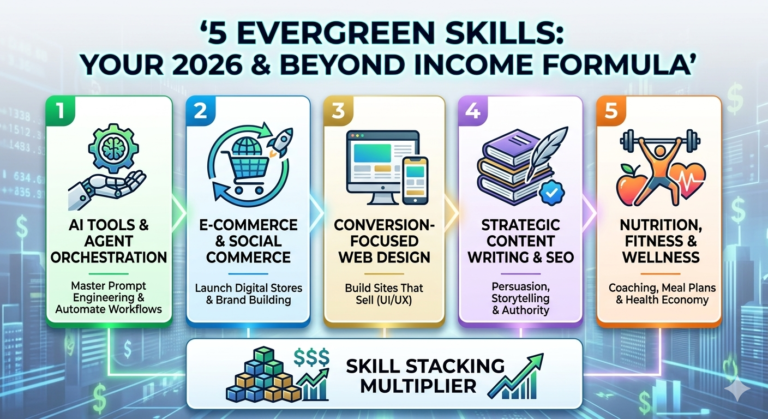
The skill itself is only half the battle. The other half is how you stack it.
Let me explain.
The freelance landscape in 2026 is both challenging and rewarding. The highest earners are those who combine technical mastery with human-centric skills—the so-called “Skill-Stackers.” Mastering niches like AI orchestration, cybersecurity, immersive design, or blockchain architecture allows you to command premium rates, work globally, and scale your income faster than ever.
By focusing on specialized, high-value skills and leveraging AI for efficiency, you can future-proof your career and join the ranks of top-earning freelancers worldwide.
The Rise of the “Skill-Stacker” (Your Secret Weapon)
Here’s a truth that separates 500/month freelancers from 5,000/month freelancers:
The highest earners in 2026 are not the ones who master just one skill. They are the ones who stack complementary skills together.
Think of it like this:
| Single Skill Freelancer | Skill-Stacker Freelancer |
|---|---|
| “I write blog posts.” | “I write SEO-optimized blog posts + create AI-generated visuals + repurpose content for LinkedIn.” |
| “I design logos.” | “I design brand identities + create brand guidelines + build simple no-code websites.” |
| “I run Facebook ads.” | “I run Facebook ads + set up conversion tracking + write email sequences for follow-ups.” |
See the difference? The skill-stacker offers a solution, not just a service. And solutions are what businesses pay premium rates for.
In 2026, the most successful freelancers in Pakistan are combining:
-
Technical mastery (the hard skill that solves a specific problem)
-
Human-centric skills (communication, empathy, project management, client psychology)
-
AI leverage (using tools to work 3–5 times faster)
They’re not just freelancers. They’re solopreneurs. One-person agencies delivering results that used to require a team of five.
The Two Paths Forward (Choose Wisely)
After reading this guide, you have two choices. And honestly, both are valid—but only one leads to a high-income future.
Path One: The Generalist – You learn a little bit of everything. You offer “anything” services. You compete on price with thousands of other freelancers. You constantly struggle to find clients. Your income is unstable, and burnout is high.
Path Two: The Specialist Skill-Stacker – You pick one high-income niche from this list. You go deep—not wide. You learn complementary skills that make your core service more valuable. You position yourself as an expert, not a commodity. You charge premium rates. Clients come to you. You work less and earn more.
The choice seems obvious, right? Then why do most freelancers choose Path One?
Because Path One feels safer. It feels like you have more options. But in reality, being “okay” at ten things makes you replaceable. Being exceptional at one thing makes you indispensable.
The Formula That Actually Works in 2026
After studying hundreds of successful freelancers in Pakistan, here’s the formula that keeps showing up:
Niche Down + Stack Skills + Leverage AI + Deliver Results = High-Income Freelancing
Let’s break that down:
| Component | What It Means | Example |
|---|---|---|
| Niche Down | Pick a specific industry or problem | “I help SaaS startups” not “I do marketing” |
| Stack Skills | Add complementary abilities | SEO + Content Writing + Email Marketing |
| Leverage AI | Use tools to work faster and better | ChatGPT + Surfer SEO + Canva AI |
| Deliver Results | Focus on outcomes, not activities | “Increased traffic by 150%” not “Wrote 20 articles” |
This formula works from a small room in Pakistan. It works without a degree. It works even if you’re starting from zero. But it requires one thing that most people don’t have: discipline over motivation.
A Realistic Look at What You Can Achieve
Let’s not play games. No fake “make $10,000 in your first month” nonsense. Here’s what real freelancers in Pakistan are earning with high-income skills in 2026:
| Experience Level | Monthly Earnings (USD) | Monthly Earnings (PKR) | Lifestyle Impact |
|---|---|---|---|
| Beginner (0–6 months) | 100–500 | 28,000 – 140,000 | Covers basic expenses, builds confidence |
| Intermediate (6–18 months) | 600–2,000 | 168,000 – 560,000 | Beats most local salaries, financial breathing room |
| Advanced (18 months – 3 years) | 2,500–6,000+ | 700,000 – 1,680,000+ | Life-changing. Savings, investments, family support |
| Expert (3+ years, niche specialist) | 7,000–15,000+ | 2 million – 4.2 million+ | Top 1% of earners in Pakistan. Full financial freedom |
These numbers are real. They’re achievable. But they’re not automatic. They come from:
✅ Choosing the right skill (one from this guide)
✅ Going deep instead of wide (specialization)
✅ Stacking complementary skills (becoming a solopreneur)
✅ Consistent marketing and client outreach (no one finds you by accident)
✅ Delivering exceptional results (over-delivering every single time)
The timeline might feel long. But here’s the question that actually matters:
Where do you want to be in December 2026?
You can be exactly where you are today—just one year older. Or you can be earning 2,000–5,000 per month, working from anywhere, with complete control over your time.
The difference between those two futures is not talent. It’s not luck. It’s the decision you make today.
One Final Truth (From Someone Who’s Been There)
Here’s something no “guru” will tell you about freelancing:
The first 3–6 months are brutal.
You will send proposals and hear nothing back. You will work for low rates that feel embarrassing. You will question if you made a mistake. You will see others succeeding and wonder why you are not.
This is normal. This is the “freelancer’s filter.” Most people quit here.
But here’s what happens if you don’t quit:
Month 6–12: You get your first few testimonials. Your confidence grows. You raise your rates slightly. You start getting repeat clients.
Year 2: You have a reputation. Clients find you. You can pick and choose projects. You’re earning more than most of your friends in traditional jobs.
Year 3 and beyond: You’re an expert. You charge premium rates. You work fewer hours. You have freedom, flexibility, and financial security.
The freelancers who make it are not the smartest or most talented. They are simply the ones who refused to quit during the brutal first months.
Your Next Steps (Starting Today)
You’ve read the guide. You understand the skills. Now comes the only part that matters: action.
Here’s your no-excuses, 30-day launch plan:
Week 1 – Choose & Learn
-
Pick ONE skill from the top 10 list (not two, not three—one)
-
Spend 1–2 hours daily watching free YouTube tutorials
-
Complete 2–3 small practice projects
Week 2 – Build Your Portfolio
-
Create 3–5 sample projects (real or mock client work)
-
Package them into a simple portfolio (Google Docs or Canva works fine)
-
Write case studies: “Problem → My Approach → Results.”
Week 3 – Create Your Profiles
-
Set up optimized profiles on Fiverr and Upwork
-
Use a professional photo and a clear, niche-focused headline
-
Write a bio that focuses on client problems, not your life story
Week 4 – Get Your First Clients
-
Send 10 proposals daily on Upwork (personalized, not copy-paste)
-
Create 2–3 gigs on Fiverr with competitive pricing
-
Join 3–5 Facebook freelancing groups and offer value (not spam)
Month 2–3 – Refine & Scale
-
Collect testimonials from first clients
-
Raise prices slightly after every 3–5 projects
-
Start stacking complementary skills
This plan works. But only if you execute. Reading without doing is just entertainment.
The Bottom Line (No Fluff)
The freelance landscape in 2026 is more exciting than ever—but also more demanding. The days of earning a good living with basic, generic skills are fading. AI and global competition have raised the bar.
But here’s the beautiful part: The bar being higher is actually great news for you.
Why? Because when the bar is low, everyone competes on price. When the bar is high, fewer people compete, and those who do get paid well.
The highest earners in 2026 are not the luckiest or most connected. They are the ones who:
✅ Mastered specialized, high-value skills from this guide
✅ Stacked complementary abilities to become solopreneurs
✅ Leveraged AI to work faster without sacrificing quality
✅ Focused on delivering results, not just completing tasks
✅ Refused to quit during the difficult first months
That can be you.
From a small room in Karachi, Lahore, Multan, Peshawar, or a village in rural Pakistan. With nothing more than a laptop and an internet connection. You can build a freelancing career that offers financial freedom, flexibility, and a future you control.
One Last Thing (Read This Twice)
You might be thinking: “This sounds great, but I don’t have enough time.” Or “I’ll start once exams are over.” Or “I need to save money for a better laptop first.”
Stop.
Those are not reasons. Those are excuses dressed up as reasons.
The truth is, there will never be a perfect time. There will always be one more commitment, one more excuse, one more reason to wait until “someday.”
But here’s what successful freelancers know that unsuccessful ones don’t:
Someday is not a day of the week.
So here’s my final, honest advice to you:
Pick one skill from this list today. Spend 30 minutes learning it tonight. Create one small practice project tomorrow. And by the end of this week, take one scary step—publish a gig, send a proposal, or post your portfolio online.
Will it be perfect? No.
Will you make mistakes? Absolutely.
Will you face rejection? Probably.
But here’s what nobody tells you: Every successful freelancer has a graveyard of failed proposals, rejected projects, and embarrassing early work. That’s not failure. That’s tuition. That’s how you learn.
The only real failure is never starting.
So close this tab. Open ChatGPT, YouTube, or your freelancing platform of choice. And take one small step today.
Because in 2026, the freelancers who win are not the ones with the most talent. They are the ones who start before they’re ready.
Now go make it happen.
Quick Summary: Key Takeaways
| Do This | Avoid This |
|---|---|
| Pick ONE niche and go deep | Trying to learn everything at once |
| Stack complementary skills | Staying a single-skill generalist |
| Leverage AI to work faster | Ignoring AI or relying on it blindly |
| Focus on client results | Focusing only on completing tasks |
| Start before you feel ready | Waiting for the “perfect time” |
| Stay consistent for 6–12 months | Quitting after 2–3 weeks of no orders |
| Charge value-based prices | Competing only on low price |
Breaking into the digital workforce has never been easier for those starting their professional journey from scratch. Explore our curated list of 10 remote jobs for beginners in 2026 to find high-potential opportunities that require no formal degree or prior experience.
In the rapidly evolving gig economy, leveraging the right technology is essential for staying competitive and maximizing your hourly earnings. Discover the best AI tools for freelancers in 2026 that allow you to automate complex tasks and streamline your workflow without needing any coding skills.
The demand for experts who can bridge the gap between business needs and artificial intelligence is creating one of the most lucrative freelance niches today. Our complete guide to freelancing in 2026 provides a strategic roadmap for anyone looking to establish themselves as a high-earning AI automation consultant.
Mastering the mechanics of platform discovery is the secret to moving past the plateau of low view counts and building a dedicated audience. Learn how the YouTube Algorithm in 2026 prioritizes engagement and find out how small creators can realistically scale to 100K subscribers.
A compelling narrative is the most critical factor in keeping your viewers hooked and boosting your overall audience retention. Follow our step-by-step guide for 2026 to master the art of using ChatGPT to craft viral YouTube scripts that drive massive engagement and growth.
Frequently Asked Questions (FAQs)
1. Which freelance skill will be most in demand in 2026?
Great question. Based on current market trends, client demand, and future projections, AI Orchestration & Custom LLM Tuning is shaping up to be the most in-demand skill in 2026. Why? Because every business—from small startups to large enterprises—is trying to figure out how to use AI effectively. They don’t just want generic ChatGPT. They want custom AI workflows tailored to their specific business needs.
Right behind AI orchestration, Cybersecurity & Ethical Hacking is also exploding in demand. As more businesses move online, cyber threats increase. Small and medium enterprises (SMEs) are particularly vulnerable and willing to pay premium rates for protection.
Honorable mentions: Immersive Experience Design (AR/VR) and Blockchain Architecture are also growing fast, especially in real estate, gaming, and finance sectors.
2. Can I learn these high-paying skills without a degree?
Absolutely. And we mean this with complete confidence.
Here’s the reality in 2026: Clients care about proof of work, not pieces of paper. A portfolio with real results beats a degree every single time.
Think about it. If you were hiring someone to secure your company’s website from hackers, would you care more about their computer science degree or the fact that they’ve successfully audited 20 websites and found critical vulnerabilities? The answer is obvious.
What actually matters:
-
Practical portfolios (samples of your work)
-
Case studies showing real results
-
Client testimonials and reviews
-
Certifications from recognized platforms (Google, HubSpot, Coursera)
-
GitHub projects or live demos
What doesn’t matter as much:
-
Traditional university degrees
-
Your grades or GPA
-
Which school you attend
That said, some skills like Bio-Hacking & Longevity Coaching might benefit from recognized certifications. But for most technical and digital skills on this list, your work speaks louder than any degree.
3. How much can a high-level freelancer really earn in 2026?
Let’s be honest and specific. No vague “unlimited potential” nonsense.
Here’s the real earning breakdown for top-tier freelancers in high-income niches:
| Skill | Beginner (0–6 months) | Intermediate (6–18 months) | Expert (2+ years) |
|---|---|---|---|
| AI Orchestration | $20–50/hour | $75–150/hour | $150–300+/hour |
| Cybersecurity | $25–60/hour | $80–175/hour | $175–500+/hour |
| Blockchain Auditing | $30–70/hour | $100–200/hour | $200–500+/hour |
| Immersive Design | $20–45/hour | $60–120/hour | $120–250+/hour |
| Fractional CMO | $500–2,000/month | $3,000–8,000/month | $10,000–25,000+/month |
| Data Storytelling | $20–40/hour | $60–100/hour | $100–200+/hour |
Annual potential for top-tier experts: 150,000–250,000+ per year. Yes, from Pakistan. Yes, working remotely. Yes, it’s possible—but only for the top 1–5% who master their craft and position themselves correctly.
For most dedicated freelancers, realistic annual earnings after 2–3 years are 40,000–80,000 (approximately PKR 1.1 crore – 2.2 crore). That’s still life-changing money in Pakistan.
4. Which skill is easiest for a complete beginner to learn?
If you’re starting from absolute zero with no technical background, here’s the honest ranking from easiest to hardest:
Easiest (3–6 months to competency):
-
No-Code/Low-Code App Development – Tools like Bubble and FlutterFlow are visual and intuitive. No programming required.
-
High-Ticket VSL Scriptwriting – If you’re good with words and psychology, this can be learned relatively quickly.
-
Data Storytelling & Visualization – Tools like Tableau and Power BI have gentle learning curves.
Medium (6–12 months to competency):
4. Fractional Digital Marketing Leadership – Requires understanding of marketing fundamentals, but no coding.
5. AI Orchestration – Requires comfort with AI tools and basic logic, but not deep programming.
6. Cybersecurity (entry-level) – Can start with ethical hacking basics and certification paths.
Hardest (12–24+ months to competency):
7. Blockchain Architecture – Requires a deep understanding of cryptography and smart contracts.
8. Immersive Experience Design – Requires 3D modeling, game engines (Unity/Unreal), and spatial design.
9. Bio-Hacking & Longevity Coaching – Requires a science background and recognized certifications.
Our advice for absolute beginners: Start with No-Code Development or VSL Scriptwriting. You can be earning within 3–4 months with consistent effort.
5. Will AI replace freelancers in these high-paying niches?
This is the million-dollar question. Here’s the honest answer:
AI will replace some freelancers, but not the ones who master high-income skills.
Let’s break it down by skill type:
| Skill Type | AI Threat Level | Why? |
|---|---|---|
| Basic content writing | 🔴 High | AI can generate passable content |
| Basic graphic design | 🔴 High | AI tools like Canva and MidJourney |
| AI Orchestration | 🟢 Very Low | You’re the one controlling the AI |
| Cybersecurity | 🟢 Very Low | Requires human judgment and ethics |
| Blockchain Auditing | 🟢 Very Low | Complex, high-stakes, requires human oversight |
| Immersive Design | 🟡 Low-Medium | AI assists but can’t replace creative direction |
| Fractional CMO | 🟢 Very Low | Strategy, leadership, and human relationships |
The pattern: The more a skill requires human judgment, creativity, strategy, ethics, and client relationships—the safer it is from AI replacement.
The freelancers who will struggle are those offering generic, low-skill, easily replicable services. The freelancers who will thrive are those mastering specialized, high-judgment, results-driven skills.
6. How do I find clients for these high-paying skills?
This is where most freelancers get stuck. You can have the best skill in the world, but if no one knows about you, you won’t earn a rupee.
Here’s a proven client-getting strategy for high-income skills in 2026:
For Beginners (0–6 months):
-
Fiverr & Upwork – Start with competitive pricing. Your goal is testimonials, not maximum profit.
-
LinkedIn Outreach – Find business owners in your niche. Send personalized messages (not templates).
-
Facebook Groups – Join “Freelancers Pakistan,” “SEO Experts,” or niche-specific groups. Offer value before asking for work.
For Intermediate (6–18 months):
-
Referrals – Your best clients will come from past clients. Ask every happy client for a referral.
-
Content Marketing – Write LinkedIn posts or blog articles showcasing your expertise. Clients find you.
-
Cold Email – Build a list of 100 potential clients. Send 10 personalized emails daily.
For Advanced (18+ months):
-
Inbound Marketing – Clients come to you through your reputation, content, and referrals.
-
Premium Platforms – Toptal, Arc, or other curated platforms for top-tier freelancers.
-
Direct Contracts – Long-term retainer agreements with 3–5 key clients.
Pro tip for Pakistani freelancers: Don’t ignore the local market entirely. Pakistani businesses are increasingly hiring freelancers. Rates are lower (PKR-based), but it’s easier to get your first testimonials.
7. How long does it realistically take to master a high-income skill?
Let’s be completely honest here. No “become an expert in 7 days” nonsense.
Here’s a realistic timeline based on studying hundreds of successful freelancers:
| Skill Level | Time Investment | What You Can Do |
|---|---|---|
| Basic competency | 2–4 months (5–10 hours/week) | Complete small projects, basic client work, low rates ($10–30/hour) |
| Intermediate proficiency | 6–12 months (10–15 hours/week) | Handle complex projects, higher rates ($40–100/hour), repeat clients |
| Advanced mastery | 18–24 months (15–20 hours/week) | Premium rates ($100–300+/hour), inbound clients, expert status |
| World-class expertise | 3–5+ years | Top 1% of earners, chosen by reputation alone |
The good news: You don’t need to be “world-class” to earn a great living. Most successful freelancers reach intermediate or advanced levels and earn 3,000–8,000+ monthly. That’s already life-changing money in Pakistan.
The honest truth: The timeline depends entirely on your consistency. Someone who practices 20 hours a week will progress 4x faster than someone practicing 5 hours a week. There are no shortcuts, but there is leverage through focused effort.
8. Can I learn these skills for free or cheap?
Yes. And we strongly recommend you do NOT spend thousands of dollars on expensive courses until you’ve exhausted free resources.
Free Resources (Start Here):
| Platform | Best For | Cost |
|---|---|---|
| YouTube | Everything. Seriously, everything. | Free |
| Coursera | University-level courses (audit mode) | Free (no certificate) |
| Google Digital Garage | Marketing, data, AI fundamentals | Free + certificate |
| HubSpot Academy | Marketing, sales, content | Free + certificate |
| GitHub | Code, blockchain, AI projects | Free |
| LinkedIn Learning | Professional skills (1-month free trial) | Free trial |
| FreeCodeCamp | Coding, blockchain, data | Free |
Low-Cost Resources (10–50):
-
Udemy – Wait for sales (every other week). Courses for 10–20.
-
Coursera (paid) – Certificates for 40–60 per month.
-
DataCamp – Data visualization and analytics.
What to avoid: Instagram “gurus” selling 500–2,000 “mastery courses.” Most of the information is available for free on YouTube. Only buy advanced courses after you’ve exhausted free resources and are already earning.
9. Which skill is best for someone with no technical background?
If coding, programming, or complex math makes you nervous, here are the best high-income skills that don’t require technical expertise:
Top picks for non-technical freelancers:
-
High-Ticket VSL Scriptwriting – If you’re good with words, psychology, and storytelling. No tech skills required.
-
Fractional Digital Marketing Leadership – Requires marketing knowledge, not coding. Can be learned through free resources.
-
Data Storytelling & Visualization – The tools (Tableau, Power BI) are visual and intuitive. Basic Excel skills are enough to start.
-
Sustainable Supply Chain Consulting – More about process knowledge and regulations than tech skills.
-
Bio-Hacking & Longevity Coaching – Requires science and coaching skills, not programming.
Skills to avoid (if non-technical):
-
Blockchain Architecture (requires coding)
-
Immersive Experience Design (requires 3D modeling and game engines)
-
Advanced Cybersecurity (requires deep technical knowledge)
Our recommendation: Start with VSL Scriptwriting or Fractional CMO. Both have high earning potential and gentle learning curves for non-technical learners.
10. How do I know if a skill is right for me?
This is such an important question. Because even if a skill pays well, if you hate doing it, you won’t stick with it.
Here’s a simple self-assessment framework:
Ask yourself three questions:
-
Does this skill genuinely interest me? – Can you see yourself spending hundreds of hours learning and practicing this? If the answer is no, move on.
-
Does this match my natural strengths? – Are you analytical? Creative? A people person? Technical? Choose skills that align with who you already are.
-
Is there a clear market for this skill? – Are businesses actually paying for this? Check Fiverr, Upwork, and LinkedIn to validate demand.
Quick alignment guide:
| If You Are… | Best Skills For You |
|---|---|
| Analytical, love data | Data Storytelling, AI Orchestration |
| Creative, love design | Immersive Design, VSL Scriptwriting |
| Technical, love coding | Blockchain, Cybersecurity |
| Strategic, love business | Fractional CMO, Supply Chain |
| Science-minded, love health | Bio-Hacking, Longevity Coaching |
Don’t force yourself into a skill just because it pays well. The best skill for you is the one you’ll actually stick with for 6–12 months.
11. Do I need to know English to succeed in these skills?
Short answer: Yes, for most global clients. But let’s be specific.
Skills that require strong English:
-
VSL Scriptwriting (you’re literally writing scripts in English)
-
Fractional CMO (you’ll communicate strategy)
-
Data Storytelling (you’ll present insights)
Skills where English is less critical:
-
No-Code Development (visual tools, code-like logic)
-
Blockchain Auditing (code-focused, not language-focused)
-
Cybersecurity (technical documentation can be learned)
The honest truth: Most high-paying global clients work in English. You don’t need perfect, native-level English. But you do need clear, understandable English. Tools like Grammarly (free) can help tremendously.
For Pakistani freelancers: Your English is already better than you think. Most of us grew up with English-medium education. Don’t let imposter syndrome stop you. Practice, use Grammarly, and improve over time.
12. What’s the biggest mistake beginners make when trying to learn high-income skills?
One mistake kills more freelancing careers than any other:
Trying to learn too many skills at once.
Here’s what happens: A beginner gets excited. They start learning AI orchestration. Then they hear blockchain pays more. So they switch. Then they see a YouTube video about no-code development. Three months later, they’re “intermediate” at nothing and expert at zero.
The fix: Pick ONE skill. Just one. Go deep for 6–12 months. Become genuinely good at it. Start earning. THEN consider adding complementary skills.
Think of it like digging a well. If you dig ten holes that are two feet deep, you’ll never find water. If you dig one hole that’s twenty feet deep, you’ll hit it every time.
Second biggest mistake: Waiting to feel “ready” before starting. You will never feel ready. Start before you’re ready. Learn by doing. Make mistakes. Fix them. Improve. That’s the real path to mastery.
13. Can I learn these skills while working a full-time job or studying?
Absolutely. In fact, most successful freelancers in Pakistan started exactly this way.
Here’s a realistic schedule that works:
If you have 1–2 hours daily:
-
Week 1–4: Learn fundamentals (YouTube tutorials)
-
Month 2–3: Practice and build portfolio (30 mins daily)
-
Month 4–6: Start freelancing (1 hour daily for proposals + client work)
If you have 3–4 hours on weekends only:
-
Months 1–3: Learn fundamentals
-
Month 4–6: Build portfolio
-
Month 7–9: Start freelancing
Real-life example: A university student in Lahore learned No-Code Development over summer break (2 months, 4–5 hours daily). By month 3, she had her first client. By month 6, she was earning $500 monthly while attending classes.By month 12, 2,000+ monthly, enough to cover tuition and support her family.
The key is consistency over intensity. One hour daily beats ten hours once a month, every single time.
14. How do I build a portfolio with no experience?
This is the classic chicken-and-egg problem. You need experience to get clients, but you need clients to get experience.
Here’s how to break the cycle:
Method 1: Mock Projects (Easiest)
-
Pick a fake business (e.g., “ABC Tech, a SaaS startup”)
-
Create a project as if it were a real client
-
Document your process: problem → approach → solution → results
-
Add to your portfolio as “sample work.”
Method 2: Free Work for Non-Profits (Ethical)
-
Offer your service for free to a legitimate non-profit or charity
-
Get a testimonial and permission to use the work in your portfolio
-
Everyone wins
Method 3: Discounted Work for Real Clients (Fastest)
-
Offer your service at 70–80% below market rates
-
Be upfront: “I’m building my portfolio, so I’m offering a steep discount for my first 5 clients.”
-
Deliver exceptional quality. Get testimonials. Raise prices.
Method 4: Personal Projects (Most Authentic)
-
Build something for yourself. A website, a dashboard, a security audit of your own systems.
-
Document everything. Use it as proof of your skills.
Within 4–6 weeks, you can have a portfolio of 3–5 solid projects. That’s enough to start charging real rates.
15. Is freelancing in these high-income skills really possible from Pakistan?
Yes. 100% yes. And thousands of Pakistanis are already doing it.
Here’s proof:
-
AI Orchestration: Pakistani freelancers on Upwork are earning $50–150/hour working with US and European clients.
-
Cybersecurity: Pakistani ethical hackers are hired by international companies for penetration testing.
-
No-Code Development: Pakistani developers on Fiverr are earning $2,000–5,000+ monthly building MVPs for startups.
-
Data Storytelling: Pakistani analysts are creating dashboards for global e-commerce brands.
The only real barriers are your own mindset and consistency. Not your location. Not your degree. Not your internet speed (if you have a basic connection).
Yes, you’ll face challenges. Power outages, internet fluctuations, and payment withdrawal hurdles. But every successful Pakistani freelancer has found ways around these. So will you.
16. Which platform is best for these high-income skills?
Different skills perform better on different platforms. Here’s a quick guide:
| Platform | Best For | Why |
|---|---|---|
| Upwork | AI, Cybersecurity, Blockchain, Data | Professional clients, long-term contracts, higher rates |
| Toptal | Top-tier developers, designers, and finance experts | Curated, highest rates ($100–200+/hour), hard to get in |
| Fiverr Pro | No-code, VSL scripts, marketing | Good for packaged services ($500–5,000+ per gig) |
| Fractional CMO, consulting, coaching | Professional network, direct client relationships | |
| Specialized platforms | Immersive design, blockchain | Look for niche job boards (e.g., CryptoJobs, AR/VR Jobs) |
For beginners in Pakistan: Start with Upwork or Fiverr. Build your profile, get reviews, then expand to LinkedIn direct outreach and niche platforms.
17. How do I price my services as a beginner?
Pricing is scary. Charge too high, no clients. Charge too low, you look cheap and burn out.
Here’s a simple, proven pricing strategy:
Phase 1 – Portfolio Builder (First 3–5 clients):
-
Charge 50–70% below market rates
-
Example: If the market rate is 50/hour, charge 15–25/hour
-
Goal: Testimonials, not profit
Phase 2 – Market Rate (After 5–10 reviews):
-
Charge 80–100% of market rates
-
Example: $40–50/hour
-
Goal: Consistent income, build confidence
Phase 3 – Premium Rate (After 20+ reviews, strong portfolio):
-
Charge 120–150% of market rates
-
Example: $60–75/hour
-
Goal: Fewer clients, higher income, better work
Phase 4 – Value-Based Pricing (Expert level):
-
Charge by project value, not hours
-
Example: “I will increase your conversion rate by 20% for $5,000.”
-
Goal: Uncapped income, strategic partnerships
Pro tip: Never compete on price alone. Compete on value. Show clients examples of your work. Explain how you’ll solve their specific problem. Price becomes secondary when value is clear.
18. What if I fail? What if I never find clients?
Let’s address this fear directly because almost every beginner has it.
First, redefine failure. Sending 50 proposals and getting 0 responses is not a failure. It’s data. It’s telling you to improve your proposals. A project that went badly is not a failure. It’s a learning experience. The only real failure is quitting before you’ve given yourself a fair chance (at least 6–12 months of consistent effort).
Second, know the numbers. Most successful freelancers sent 50–200 proposals before their first client. Most had 2–3 months of silence before their first order. This is normal. This is the filter that separates those who succeed from those who don’t.
Third, have a backup plan. Don’t quit your job or drop out of university to freelance full-time on day one. Start small. Freelance on the side. Build your income gradually. When freelancing consistently earns 2–3x your job salary for 3–6 months, then consider going full-time.
Finally, remember this: The worst-case scenario is you spend 6 months learning a valuable skill, trying to find clients, and it doesn’t work out. You’re still smarter, more skilled, and more experienced than before. That’s not a loss. That’s growth.
19. Should I learn one skill deeply or multiple skills at once?
We’ve said it before, but it’s worth repeating emphatically:
Learn ONE skill deeply first. Then stack complementary skills.
Here’s why this works better:
| Approach | Outcome |
|---|---|
| One skill deeply (6–12 months) | You become in the top 10% in that skill. Clients seek you out. Premium rates. |
| Multiple skills shallowly (6–12 months) | You’re average at everything. Competing with thousands. Low rates. Burnout. |
The proven path:
-
Month 0–6: Master ONE core skill
-
Months 6–12: Start earning with that skill
-
Month 12–18: Add 1–2 complementary skills (e.g., cybersecurity expert adds blockchain basics)
-
Month 18–24: Become a skill-stacker solopreneur
Example of skill-stacking:
-
Core skill: AI Orchestration
-
Stacked skill 1: Data Storytelling (to visualize AI insights)
-
Stacked skill 2: No-Code Development (to build AI-powered apps)
Now you’re not just an AI freelancer. You’re a full-service AI solutions provider. And you can charge accordingly.
20. What’s the one thing I should do today after reading this guide?
Just one thing. Don’t try to do everything at once.
Pick ONE skill from this list. Right now. In the next 60 seconds.
Don’t overthink it. Don’t research for three more hours. Don’t ask five friends for their opinion.
Just pick one.
Then take one small action:
-
If you picked AI Orchestration: Open ChatGPT and watch a 10-minute tutorial on custom instructions
-
If you picked Cybersecurity: Sign up for a free ethical hacking course on YouTube
-
If you picked No-Code Development: Create a free Bubble.io account and build a simple to-do app
-
If you picked VSL Scriptwriting: Watch one video on “direct response copywriting” on YouTube
That’s it. That’s the one thing.
The difference between people who succeed and people who don’t is talent, intelligence, or luck. It’s simply this:
One group starts today. The other group waits for “someday.”
Be the first group.

6 Comments