
Top 10 High-Paying Remote Jobs Without a Degree in 2026 (Earn in Dollars from Home)
Top 10 High-Paying Remote Jobs Without a Degree in 2026 (Earn in Dollars from Home)
Introduction: The Rise of Skill-Based Income in 2026
Let me tell you something that would have sounded crazy ten years ago.
You don’t need a college degree to earn a living anymore. I know. It still feels weird to say out loud. We grew up hearing the same message over and over: get good grades, go to college, get a degree, find a stable job. That was the script. That was the “safe path.” But here’s the thing no one told us. That script is outdated.
The Old Way vs. The New Way
Let me break this down simply.
| The Old Way (2010) | The New Way (2026) |
|---|---|
| Get a degree first | Learn a skill first |
| Spend 4 years in college | Spend 4 months learning online |
| Accumulate student debt | Zero debt, start earning quickly |
| Compete locally | Compete globally |
| Work for one company | Work for many clients |
| Ask for permission | Be your own boss |
The shift isn’t small. It’s massive.
And it’s happening right now.
What Changed?
Two things.
First, businesses got smarter.
Companies realized something obvious. A degree doesn’t guarantee you can do the job. It never did. It was just an easy way to filter candidates when there were too many applicants. But now? Businesses care about results. Can you write? Can you design? Can you manage social media? Can you solve problems? They don’t care where you learned. They care that you can actually do it.
Second, the internet leveled the playing field.
Twenty years ago, if you lived in a small town or a developing country, your opportunities were limited. You could only work with local businesses. You could only earn local wages. Today? You can sit in a small apartment in Lahore, Karachi, or a tiny village, and work for a client in New York who pays $50 an hour. That’s not a dream. That’s happening right now. Millions of people are doing it.
In 2026, the way people earn money has undergone a complete transformation, shifting from traditional degree-based careers to a more flexible, skill-driven digital economy where results matter far more than qualifications. The outdated belief that a college degree is the only path to financial stability has been replaced by a more practical reality—companies and clients now prioritize real-world skills, problem-solving ability, and consistency over formal education. This shift has opened the doors for millions of individuals across the globe who want to earn in dollars from home without spending years in universities or accumulating student debt.
The growth of remote work, freelancing platforms, and online business models has made it easier than ever to start earning from anywhere with just a laptop and an internet connection. Whether you are a student, unemployed, or simply looking to escape the limitations of a traditional 9–5 job, the digital space offers countless opportunities to build a stable and scalable income. The key advantage of remote jobs is not just earning potential, but also flexibility, independence, and global access to high-paying clients. If approached correctly, these opportunities can turn into long-term careers that provide both financial freedom and lifestyle flexibility.
Why Remote Jobs Without a Degree Are Booming
The Truth About Degrees in 2026
Let me be completely honest.
I’m not saying degrees are worthless. For some fields – medicine, law, engineering – they’re absolutely necessary.
But for most online work? Writing, design, virtual assistance, AI editing, social media, customer support?
A degree is just a piece of paper.
What actually matters:
-
Can you communicate clearly?
-
Can you meet deadlines?
-
Can you solve problems without someone holding your hand?
-
Can you learn new skills quickly?
These things are not taught in universities. They’re learned by doing.
And you can start doing it today.
Why Remote Jobs Without a Degree Are Exploding Right Now
Here’s what’s happening behind the scenes.
Businesses are under pressure. Costs are rising. They need to do more with less.
Hiring a full-time local employee costs:
| Expense | Cost (USA) |
|---|---|
| Salary | 4,000−6,000/month |
| Benefits | 500−1,000/month |
| Office space | 500−1,500/month |
| Taxes | 500−1,000/month |
| Total | 5,500−9,500+/month |
Hiring a remote freelancer from anywhere in the world?
| Expense | Cost |
|---|---|
| Project rate | 500−2,000 |
| Monthly retainer | 1,000−3,000 |
| Total | Fraction of full-time cost |
See the difference?
Businesses save money. You earn in dollars. Everyone wins.
The Platforms That Made This Possible
You don’t need connections. You don’t need a fancy portfolio. You don’t need to know someone who knows someone.
You just need to sign up.
| Platform | Best For | Degree Required? |
|---|---|---|
| Upwork | Freelancing (any skill) | No |
| Fiverr | Selling services starting at $5 | No |
| Professional remote jobs | Sometimes (but not always) | |
| Freelancer | Small to medium projects | No |
| Remote.co | Curated remote positions | No |
| We Work Remotely | Tech and creative roles | No |
These platforms don’t ask for your diploma. They ask for your skills.
The Skills That Pay (No Degree Required)
Here’s what’s actually in demand right now:
| Skill | Learning Time | Monthly Potential |
|---|---|---|
| AI content editing | 2-4 weeks | 1000−3000 |
| Virtual assistance | 1-2 weeks | 800−2500 |
| Social media management | 2-3 weeks | 1000−3000 |
| Basic graphic design (Canva) | 2 weeks | 500−2000 |
| Customer support | 1 week | 800−2000 |
| Data entry (specialized) | 1 week | 500−1500 |
| Video scriptwriting | 3-4 weeks | 1000−4000 |
Notice something?
None of these requires a degree. None requires years of experience. None requires expensive equipment.
Just time, effort, and consistency.
Real Stories, Real People
I’ve seen students earning $2000 a month while still in university.
I’ve seen stay-at-home parents building full-time incomes during nap time.
I’ve seen people who never set foot in a college classroom out-earn their friends with master’s degrees.
This isn’t luck. It’s not a special talent.
It’s picking a skill, getting good at it, and showing up every day.
What You Actually Need to Succeed
Forget the degree. Here’s what really matters:
1. One marketable skill
Pick one thing. Get good at it. Stop jumping around.
2. Basic English communication
You don’t need to be a poet. You just need to be clear and professional.
3. Consistency
Show up every day. Send proposals. Complete work. Improve slowly.
4. Patience
Your first month might be slow. That’s normal. Keep going.
5. A laptop and internet
That’s it. Nothing fancy.
The demand for remote jobs without a degree has increased rapidly because businesses are focusing on efficiency and cost-effectiveness. Hiring remote workers allows companies to access global talent while reducing expenses like office space and operational costs. At the same time, digital platforms such as Fiverr, Upwork, LinkedIn, and Freelancer have simplified the hiring process, allowing skilled individuals to connect directly with clients worldwide.
Another major factor behind this shift is the rise of digital content, e-commerce, and online services, all of which require skilled individuals rather than degree holders. From content creation to technical services, the internet economy runs on practical skills that can often be learned faster and more effectively through online resources. This has created an environment where beginners can enter the market, build experience, and gradually increase their income without any formal education.
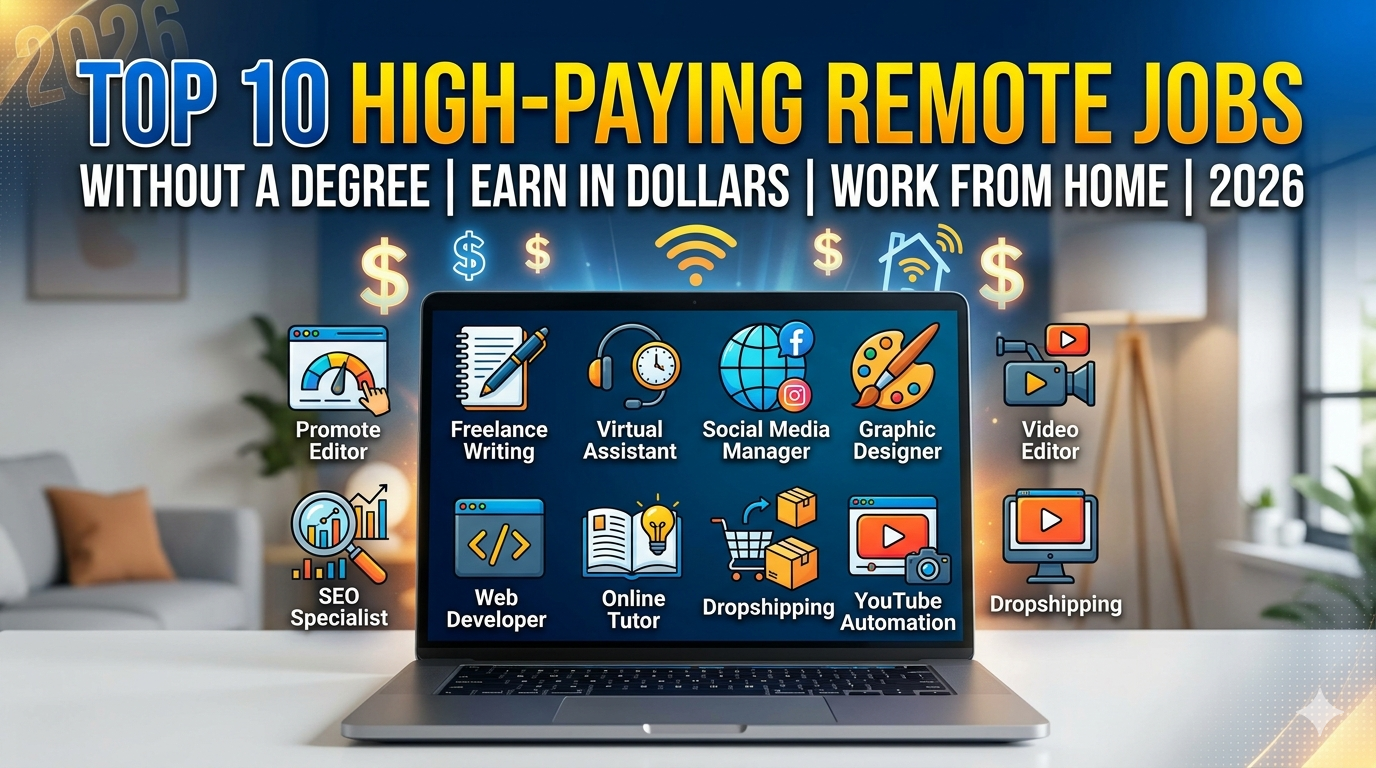
1. Freelance Content Writing
Freelance content writing remains one of the most accessible and high-paying remote jobs in 2026, especially for beginners who want to start earning quickly without needing technical expertise. Every online business relies heavily on written content to attract traffic, engage users, and convert visitors into customers. This includes blog posts, website content, product descriptions, email campaigns, and marketing materials, all of which create a constant demand for skilled writers.
What makes content writing particularly attractive is that you can start with basic language skills and improve over time through practice and exposure. As you gain experience, you can specialize in high-paying niches such as finance, technology, health, or SaaS, where clients are willing to pay premium rates for quality work. Additionally, learning SEO (Search Engine Optimization) significantly increases your value, as businesses prefer writers who understand how to create content that ranks on Google. With consistency and a few long-term clients, freelance writing can easily generate a stable monthly income in dollars.
2. Virtual Assistant (VA)
Virtual assistance is one of the most reliable remote career options for individuals who are organized, detail-oriented, and comfortable handling administrative tasks. As a virtual assistant, you provide remote support to entrepreneurs, startups, and businesses by managing tasks such as email handling, scheduling, data entry, customer support, and document management.
The demand for virtual assistants continues to grow because businesses prefer outsourcing routine tasks instead of hiring full-time employees. This creates opportunities for beginners to enter the market without needing specialized skills. Over time, virtual assistants can upgrade their services by learning advanced tasks such as social media management, CRM handling, or project coordination, which significantly increases their earning potential. Many VAs work with multiple clients simultaneously, allowing them to scale their income beyond the basic level.
3. Social Media Manager
Social media has evolved into one of the most powerful marketing tools in the digital world, making social media management a high-demand and high-paying remote job in 2026. Businesses rely heavily on platforms like Instagram, TikTok, LinkedIn, and Facebook to build brand awareness, engage audiences, and drive sales. However, most business owners lack the time or expertise to manage their accounts effectively, which creates opportunities for skilled individuals.
A social media manager is responsible for creating content strategies, designing posts, scheduling content, responding to comments, and analyzing performance metrics. This role requires creativity, consistency, and a good understanding of audience behavior. The best part is that you do not need a degree to start—practical knowledge and experience matter far more. Once you build a strong portfolio and gain a few clients, you can manage multiple accounts and earn a significant monthly income.
4. Graphic Design
Graphic design is one of the most valuable skills in the online marketplace, as every business requires visual content to communicate its message effectively. From logos and branding materials to social media graphics and advertisements, the demand for designers continues to grow across all industries. This makes graphic design one of the most profitable remote jobs without a degree.
Beginners can start with user-friendly tools like Canva, which allows them to create professional designs without advanced skills. As they progress, they can learn professional software like Adobe Photoshop and Illustrator to work on high-end projects. Building a strong portfolio is essential in this field, as clients judge your skills based on your previous work. With experience and creativity, graphic designers can attract international clients and charge premium rates.
5. Video Editing
Video content dominates the internet in 2026, making video editing one of the most in-demand remote skills. From YouTube creators to online businesses, everyone needs high-quality video content to capture attention and engage audiences. This has created a massive demand for skilled video editors who can transform raw footage into polished, professional content.
Even basic editing skills can help you start earning, especially if you target beginner creators who need affordable services. Over time, you can learn advanced techniques such as motion graphics, storytelling, and color grading, which significantly increase your value. Video editing is a skill-based job, meaning your earnings grow as your expertise improves, making it a highly scalable career option.
6. SEO Specialist
Search Engine Optimization (SEO) is one of the highest-paying digital skills because it directly impacts a business’s visibility and revenue. Companies are constantly looking for experts who can help them rank higher on Google and attract organic traffic.
An SEO specialist works on keyword research, content optimization, website performance, and link building. Although it may seem complex initially, it becomes easier with practice and real-world application. The biggest advantage of SEO is that it offers long-term earning potential, as clients often pay monthly retainers for ongoing work.
7. Web Development
Web development is a future-proof skill that offers some of the highest-paying opportunities in the remote job market. Businesses need websites to establish their online presence, and skilled developers are in high demand to build and maintain these websites.
You can start with basic technologies like HTML, CSS, and JavaScript, or use platforms like WordPress to create websites without coding. As you gain experience, you can work on advanced projects such as e-commerce stores and custom web applications. With a strong portfolio, web developers can earn substantial income by working with international clients.
8. Online Tutoring
Online tutoring is a flexible and rewarding way to earn money from home, especially for individuals who enjoy teaching. You can teach academic subjects, languages, or even practical skills like design or coding.
The demand for online education has increased significantly, creating opportunities for tutors worldwide. This job allows you to set your own schedule and work with students from different countries, making it both flexible and profitable.
9. Dropshipping and E-commerce
E-commerce continues to grow rapidly, and dropshipping is one of the easiest ways to start an online business without inventory. You simply create an online store, list products, and fulfill orders through suppliers.
Although it requires effort and marketing skills, the earning potential is extremely high. With the right strategy, dropshipping can become a scalable business that generates consistent income.
10. YouTube Automation
YouTube automation is an emerging opportunity where you manage a content channel without appearing on camera. Instead, you outsource tasks like scriptwriting, voiceovers, and editing while focusing on strategy and growth.
Over time, your channel can generate income through ads, sponsorships, and affiliate marketing. Although it requires patience, it can become a powerful source of passive income.
Why 2026 Is the Best Year to Start
Timing matters.
Right now, we’re in a unique window.
-
Demand for remote workers is at an all-time high
-
Companies are actively looking for freelancers
-
AI has created new roles that didn’t exist before
-
Platforms are competing for talent (good for you)
-
The old “degree or nothing” mindset is finally fading
If you wait, competition will increase. Rates might stabilize.
But right now? The door is wide open.
The Only Thing Standing Between You and Remote Work
Let me be blunt.
It’s not your lack of a degree. It’s not your location. It’s not your experience.
It’s an action.
You can read this guide ten times. You can watch fifty YouTube videos. You can take notes until your hand hurts.
None of that earns money.
What earns money is opening a platform, creating a profile, and sending your first proposal.
Imperfect. Messy. Scary.
But real.
And that’s all it takes to start.
Your First Step (Right Now)
Stop reading. Open a new tab.
Choose one platform from the list above. Create a profile. Write two sentences about what you can offer.
It doesn’t have to be perfect. It just has to be done.
Because done is better than perfect. And done is what gets you paid.
Conclusion: Build Skills, Not Degrees
Let me leave you with something important.
For years, we were told the same lie. Get a degree. Get a good job. Work hard for someone else. Retire at 65. That was the plan. That was the only “safe” path.
But here’s what they didn’t tell you.
That path was designed for a different era. An era when information was hard to find. When skills couldn’t be learned online. When remote work wasn’t possible.
That era is over.
The New Rule for 2026
Your income is no longer defined by your educational background.
Let me say that again because it’s important.
Your income is no longer defined by your educational background.
It’s defined by:
-
Your ability to learn new skills
-
Your willingness to adapt when things change
-
Your consistency when nobody is watching
-
Your value to clients who need help
Not a single one of those requires a degree.
What Actually Matters Now
I’ve seen people with master’s degrees struggle to find work online.
I’ve seen high school dropouts build six-figure freelancing businesses.
The difference wasn’t intelligence. It wasn’t luck.
It was action. It was choosing a skill and getting good at it. It was showing up every day, even when it felt hard.
That’s what works in 2026.
The Digital Economy Doesn’t Care About Your Diploma
Think about this.
When a client needs a blog post written, do they ask for your degree? No. They ask to see your writing samples.
When a business needs a logo designed, do they ask where you studied? No. They ask to see your portfolio.
When a company needs help managing its social media, do they request your transcript? No. They want to know if you understand their audience.
Degrees open some doors. But skills open many more.
And skills are free to learn. YouTube, free blogs, trial versions of software – everything you need is already available.
The Only Question That Matters
I’ve given you the methods. The strategies. The platforms.
Now it comes down to one question.
Are you ready to start?
Not “ready” as in perfect. Not “ready” as in having everything figured out.
Just ready to take the first step.
Because the opportunity is real. Thousands of people are earning high-paying remote incomes without degrees right now. They’re not smarter than you. They’re not more talented.
They just started before they felt ready.
What Your Future Could Look Like
Twelve months from now, you could be:
-
Working from home in your comfortable clothes
-
Earning in dollars while living where costs are lower
-
Choosing clients instead of begging for jobs
-
Building a career on your own terms
Or you could be exactly where you are now.
Still reading. Still planning. Still waiting.
The difference is one decision. Made today.
Final Words (Read This Twice)
You don’t need a degree to earn a living anymore.
You need a skill. You need consistency. You need to start.
Everything else is just noise.
The digital economy has created endless opportunities for people willing to learn and adapt. That includes you.
Not because you’re special. Because you’re willing to try.
And trying is all it takes to begin.
One Last Thing Before You Go
Close this guide. Open a new tab.
Pick one skill from this article. Spend 30 minutes learning something about it.
That’s it. That’s your only task today.
Because small actions, repeated daily, lead to massive results.
You’ve got this. Now go build your remote career. 🚀
In 2026, your income is no longer defined by your educational background but by your ability to learn, adapt, and deliver value. The digital economy has created endless opportunities for individuals who are willing to take action and stay consistent. By choosing one skill, building experience, and improving over time, you can create a stable and high-paying remote career without a degree. The opportunity is real—the only question is whether you are ready to start.
Frequently Asked Questions (FAQs)
1. Can I really get a high-paying remote job without a degree in 2026?
Yes, in 2026, it is absolutely possible to secure a high-paying remote job without having a college degree, because most companies and clients now focus more on your practical skills, experience, and ability to deliver results rather than your educational background. The digital economy has shifted hiring trends toward performance-based work, where your portfolio, past projects, and communication skills matter far more than formal qualifications. Many successful freelancers and remote workers are earning in dollars by providing services such as content writing, graphic design, video editing, and SEO, all without holding a degree. As long as you are willing to learn and improve continuously, you can build a strong and sustainable career from home.
2. Which remote job is best for beginners with no experience?
For beginners who have little to no experience, some of the best remote jobs to start with include freelance content writing, virtual assistance, and social media management, because these roles require basic skills that can be learned quickly through free online resources. These jobs allow you to start small, gain confidence, and gradually build your expertise while earning at the same time. The key is to focus on one skill instead of trying multiple things at once, practice consistently, and create sample work to showcase your abilities. Over time, as you gain experience and client trust, you can move into higher-paying opportunities within the same field.
3. How long does it take to start earning money from remote jobs?
The time it takes to start earning depends largely on your consistency, learning speed, and effort, but most beginners can begin making money within one to three months if they actively practice their chosen skill and apply for jobs regularly. Some individuals may achieve results faster by dedicating more time daily or targeting high-demand services, while others may take slightly longer if they are working part-time. The important thing to understand is that remote work is not an overnight success model, but a process that rewards patience, persistence, and continuous improvement.
4. Do I need to invest money to start working online?
No, one of the biggest advantages of remote jobs is that most of them require little to no financial investment to get started. In most cases, all you need is a basic laptop, a stable internet connection, and the willingness to learn. There are countless free resources available online, including tutorials, blogs, and courses, that can help you develop the necessary skills without spending money. While investing in premium tools or courses can accelerate your growth later, it is not mandatory in the beginning, making remote work highly accessible for everyone.
5. Which remote job pays the highest in 2026?
In 2026, some of the highest-paying remote jobs include SEO specialists, web developers, video editors, and advanced graphic designers, as these roles directly impact business growth and revenue. However, it is important to understand that income is not determined by the job title alone but by your level of expertise, experience, and ability to deliver results. Even a content writer or virtual assistant can earn a high income if they specialize in a niche and provide exceptional value to clients. Therefore, focusing on skill development and consistency is more important than chasing a specific job title.
6. How can I find clients for remote jobs?
Finding clients for remote jobs has become easier with the availability of freelancing platforms and professional networks. You can start by creating profiles on platforms like Fiverr, Upwork, Freelancer, and PeoplePerHour, where clients actively look for skilled individuals. Additionally, LinkedIn is a powerful platform for connecting with businesses and showcasing your expertise. You can also join Facebook groups, online communities, and forums related to your niche to find opportunities. Direct outreach, where you contact potential clients with a personalized message, is another effective strategy for building long-term relationships.
7. Is freelancing better than a full-time remote job?
Freelancing and full-time remote jobs both have their own advantages, and the better option depends on your personal goals and preferences. Freelancing offers flexibility, independence, and unlimited earning potential, allowing you to work with multiple clients and scale your income over time. On the other hand, full-time remote jobs provide stability, fixed income, and structured work environments, which can be beneficial for individuals who prefer consistency. Many people start with freelancing and later transition into full-time remote roles or combine both to maximize their income.
8. Can I do multiple remote jobs at the same time?
Yes, many remote workers successfully manage multiple income streams by working with different clients or offering various services, but it is important to start with one skill and master it before expanding. Handling multiple jobs requires strong time management, discipline, and the ability to deliver consistent quality work. If managed properly, this approach can significantly increase your monthly income and provide financial security. However, taking on too much work too soon can lead to burnout and reduced quality, so it is important to grow gradually.
9. What are the biggest challenges in remote work?
Some of the most common challenges in remote work include finding your first client, staying motivated without supervision, managing time effectively, and dealing with inconsistent income in the beginning. However, these challenges can be overcome with discipline, proper planning, and continuous learning. Building a routine, setting clear goals, and improving your communication skills can make a significant difference. Over time, as you gain experience and build a strong client base, these challenges become easier to manage.
10. Is remote work a long-term career option in 2026 and beyond?
Yes, remote work is not just a temporary trend but a long-term shift in how businesses operate globally. As technology continues to advance and companies seek more flexible and cost-effective solutions, the demand for remote professionals will continue to grow. This makes remote work a stable and future-proof career option for individuals who are willing to adapt and upgrade their skills regularly. By staying updated with industry trends and focusing on delivering value, you can build a successful and long-lasting career from home.

It’s very trouble-free to find out any matter on net as compared to textbooks, as I found this article
at this site.
I was recommended this website by my cousin. I’m not positive whether or not this post is written by way of
him as nobody else recognise such distinctive about my problem.
You’re amazing! Thank you!
You are so interesting! I do not think I have read through anything
like this before. So great to discover another person with some original thoughts on this subject matter.
Seriously.. thanks for starting this up. This site is something that’s needed on the internet, someone
with some originality!