
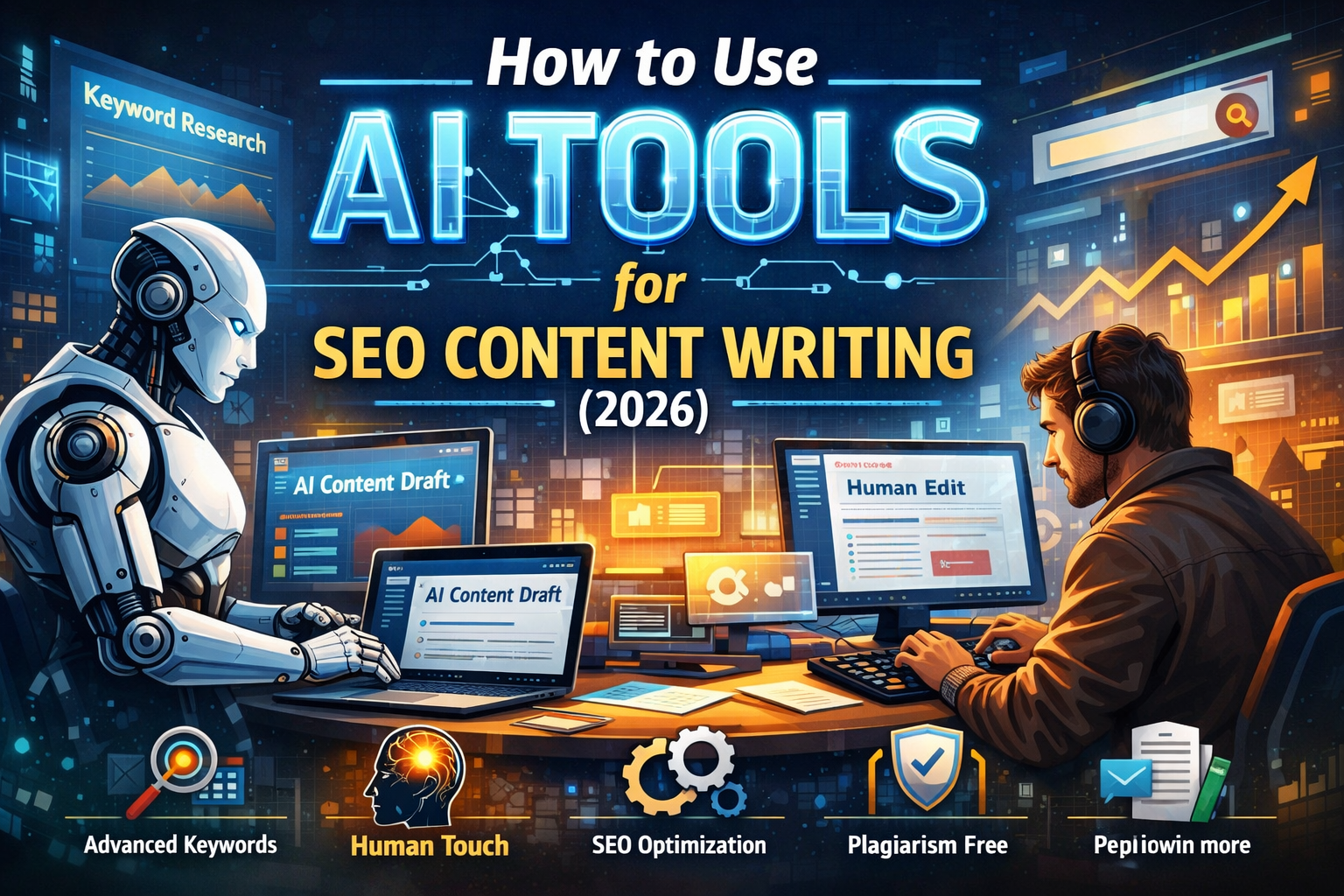
How to Use AI Tools for SEO Content Writing (2026): The Ultimate Guide
How to Use AI Tools for SEO Content Writing in 2026: The Ultimate Step-by-Step Guide
Let’s be real for a moment. You’ve probably seen them—those articles that clearly sound like a robot wrote them. You know the ones. Overly formal. Weirdly repetitive. Packed with keywords that feel forced, like someone stuffed them in with a shovel. And worst of all? They don’t actually help anyone.
Here’s the hard truth that most “SEO gurus” won’t tell you in 2026:
Google has gotten really, really smart.
Back in 2022 or 2023, you could feed a basic prompt into ChatGPT, copy-paste the output directly onto your blog, and watch it rank. Those days? Gone. Finished. Never coming back.
Why? Because search engines now care about something far more important than just keywords. They care about real value. They care about human experience. They care about whether a real person reading your content actually feels helped, understood, and informed.
So where does AI fit in? Isn’t AI supposed to make SEO content writing easier?
Yes—absolutely. But not in the lazy way most people think.
Think of it this way. In 2026, AI is not your replacement. It’s your research assistant, your outline generator, your first-draft writer, and your data cruncher. But you—the human—are still the editor, the storyteller, the fact-checker, and the voice that makes content actually worth reading.
The magic happens when you stop treating AI as a shortcut and start treating it as a collaborator.
In 2026, the digital content landscape will have completely transformed. The days of generating generic AI articles and expecting them to rank on Google are long gone. Search engines now prioritize human intent, personal experience, and high-value insights over plain keyword stuffing. Today, creating high-ranking content is about collaboration between humans and AI—leveraging the speed, research, and data capabilities of AI while adding the creativity, nuance, and emotional intelligence only humans can provide.

If you want to dominate SEO in 2026, mastering AI Tools for SEO Content Writing is no longer optional—it’s a must-have skill. This comprehensive guide will teach you how to combine AI efficiency with human expertise, ensuring your content ranks, engages, and converts. By the end, you will know exactly how to write SEO content that performs better than generic AI articles while saving hours of effort.
Why Most AI Content Fails in 2026 (And How You Can Succeed)
Let’s not sugarcoat it. The internet is drowning in low-quality AI content. Every day, thousands of freelancers and businesses publish AI-generated articles that:
-
Repeat the same information across multiple paragraphs
-
Make up fake statistics and quotes (AI hallucinations)
-
Sounds like a boring textbook written by a sleep-deprived robot
-
Ignore the reader’s actual questions and concerns
And guess what? Google’s algorithms in 2026 are designed to punish exactly this kind of content. Low engagement, high bounce rates, and zero backlinks. That’s the graveyard where lazy AI articles go to die on page 10 of search results.
But here’s the good news—and it’s really good news.
The freelancers and businesses who master AI + human collaboration are absolutely crushing it.
They’re producing content 3–5 times faster than traditional writers. They’re ranking on the first page of Google. They’re getting repeat clients who happily pay premium rates because the quality is undeniable.
And most importantly, they’re doing it from anywhere. From a small room in Lahore, Karachi, or even a village in Punjab. Because AI levels the playing field. You don’t need a fancy degree or years of experience. You just need the right strategy.
Quick Reference: AI SEO Writing FAQs at a Glance
| Question | Short Answer |
|---|---|
| Does Google penalize AI content? | No – if it’s high-quality and helpful |
| Best free AI tools to start? | ChatGPT + Perplexity AI |
| How to humanize AI text? | Read aloud, add stories, vary sentences |
| Beginner rates in Pakistan? | 10–20 per 1,000 words |
| How long to see SEO results? | 3–6 months for meaningful traffic |
| Biggest mistake? | Publishing AI drafts without editing |
| Will AI replace writers? | No – but AI-augmented writers will replace others |
What This Guide Will Teach You (No Fluff, Just Action)
We’ve written this guide for one type of person: someone who wants real, practical, step-by-step instructions—not theory, not hype, not “just be creative” nonsense.
By the time you finish reading, you will know exactly how to:
✅ Use AI tools like ChatGPT, Jasper, Surfer SEO, and Frase.io to research, outline, and draft SEO content in minutes—not hours
✅ Add the human touch that Google’s E-E-A-T algorithm craves (Experience, Expertise, Authority, Trustworthiness)
✅ Fact-check AI outputs so you never publish fake statistics or embarrassing errors
✅ Optimize your content for Google’s 2026 search algorithms, including AI Overviews and SGE (Search Generative Experience)
✅ Build a repeatable workflow that saves you 70–80% of your writing time while delivering higher-quality results
✅ Turn AI-powered SEO writing into a profitable freelancing service or use it to grow your own website’s traffic
And we’re going to do this without pretending that AI is magic. It’s not. It’s a tool. A powerful tool, yes. But only as good as the human wielding it.
A Quick Reality Check (Because We Keep It Honest)
Here’s something you won’t hear from Instagram “gurus” selling $500 AI courses:
AI will not write a perfect article for you in one click. Anyone who promises that is lying.
What AI will do is:
-
Research a topic in 10 seconds that would take you 2 hours
-
Generate a solid outline that follows SEO best practices
-
Write a first draft that’s 70–80% of the way there
-
Suggest related keywords, questions, and topics you hadn’t considered
But you—the human—still need to:
-
Add your unique experiences and examples
-
Fact-check every claim and statistic
-
Inject personality, humor, and emotional connection
-
Optimize for readability and user intent
-
Polish the final draft until it actually sounds like a real person wrote it
Does that sound like more work than just copying and pasting? Yes. But that’s exactly why most people fail and a few succeed. The ones who succeed are willing to do the work that others are too lazy to do.
And here’s the beautiful part: When you combine AI’s speed with your human judgment, you still end up working 70–80% faster than traditional writing methods. You’re just not being lazy about it.
Who Is This Guide For? (Spoiler: Probably You)
This guide is for you if:
🔹 You’re a freelancer in Pakistan who wants to offer SEO content writing as a service—and charge premium rates because you use AI strategically, not lazily
🔹 You have your own blog or website and want to increase organic traffic without spending 10 hours on every article
🔹 You’re a digital marketing agency owner looking to scale content production without sacrificing quality
🔹 You’re a complete beginner who has never written SEO content before but wants to learn a high-income skill
🔹 You’ve tried AI content before, it didn’t rank, and you’re frustrated—wondering what you did wrong
If any of the above sounds like you, you’re in the right place. Take a deep breath. Open your laptop. And let’s fix your SEO content writing process—once and for all.
What Makes 2026 Different? (The Short Version)
Just so we’re on the same page, here’s what has changed in the SEO world over the last 2–3 years:
| Then (2023–2024) | Now (2026) |
|---|---|
| Google ranked basic AI content if it had keywords | Google actively demotes low-quality AI content |
| “Write 500 words with 2% keyword density” was a strategy | Keyword density is dead. Intent and value matter. |
| AI tools were new and impressive just for existing | AI tools are everywhere. Standing out requires human touch. |
| Google’s algorithm mostly looked at backlinks and keywords | Google’s E-E-A-T prioritizes real experience and authority |
| Search results showed 10 blue links | Search results include AI Overviews, videos, images, and rich snippets |
In short: The bar has been raised. And that’s actually great news for you. Because when the bar is low, everyone competes on price. When the bar is high, only skilled people compete—and they get paid well.
The One Mindset Shift That Changes Everything
Before we dive into the step-by-step process, you need to make one small mental shift.
Stop asking: “How can I use AI to write faster?”
Start asking: “How can I use AI to write better content faster?”
See the difference? The first question leads to shortcuts, laziness, and low-quality output that Google will punish. The second question leads to leverage, efficiency, and content that actually helps readers—which Google rewards.
AI is not your ghostwriter. AI is your co-pilot. You’re still the pilot. You’re still in control. You’re still responsible for where the plane lands.
Ready to take off? Good.
Let’s start with the first step: choosing the right AI tools for SEO content writing in 2026.
1. The 2026 SEO Shift: Why Generic AI Alone Fails
The biggest mistake content creators make in 2026 is relying solely on AI to generate content. With Google’s Search Generative Experience (SGE) and other AI-powered search engines, the internet is flooded with automated content. Generic AI articles are now considered low-value, often ranking poorly due to high similarity scores and low engagement metrics.
To succeed, you must use AI as your co-pilot, not your autopilot. Let AI handle repetitive tasks such as research, structure, and first drafts. Then, inject your insights, experience, and voice to create content that stands out. The most successful writers in 2026 blend human perspective with AI efficiency to produce work that is both comprehensive and authentic.
2. Advanced Keyword Research & Intent Mapping with AI
Keyword research in 2026 goes far beyond search volume. It is now about contextual intent and user experience. AI tools allow you to go deeper than ever before, identifying semantic clusters, related subtopics, and secondary questions your audience wants answered.
Semantic Clusters with AI:
Instead of focusing on a single keyword, leverage AI platforms like Perplexity AI or Gemini 2.0 to uncover groups of related terms and queries. For example, if you are writing about “AI tools for SEO,” your semantic cluster may include:
- AI content optimization
- AI keyword research tools
- Generative AI for link building
- AI-driven SEO audits
This approach allows you to cover topics in depth, which is a major ranking signal in 2026.
Topic Authority: AI can also help map content silos. Linking related articles like “AI for Video SEO” or “AI for Technical SEO” within your site establishes your expertise, signaling to Google that your site is authoritative in that niche.
3. Drafting a High-Performance Outline
One of the biggest mistakes is letting AI write the full article immediately. Instead, use AI to create a strategic outline that ensures your content is unique and better than your competitors’.
Socratic Prompting Method:
Instead of generic prompts, try:
“I am writing a 2000-word guide on AI tools for SEO. Analyze the top 5 ranking articles and suggest an outline including gaps they missed, such as [specific advanced technique].”
This ensures your outline covers unique angles, positions your content as authoritative, and provides a roadmap for both AI and human input.
4. Selecting the Right AI Stack for 2026
Not all AI tools are created equal. A proper “AI Stack” ensures efficiency without compromising quality:
- Generative Engines: ChatGPT-5, Claude 4, or Gemini 2.0 for brainstorming and drafting content.
- SEO Optimization: Surfer SEO or Rank Math Content AI for keyword integration, LSI terms, and on-page optimization.
- Fact-Checking: Perplexity AI or Wolfram Alpha for verifying statistics, data, and sources.
- Humanization: Quillbot or specialized “humanizer prompts” to remove repetitive patterns and enhance readability.
Using the right stack allows you to combine speed with accuracy, ensuring high-quality, SEO-friendly content.
5. Writing Content with the Human-AI Hybrid Workflow
The Human-AI Hybrid Workflow is the secret to high-performing SEO content:
Step A: Human Introduction
Start your article with a unique hook or story. Avoid generic AI openings. Personal observations or bold claims grab attention and establish your voice.
Step B: AI Body Draft
Use AI to expand each outline section with data, examples, and structure. Prompt it for a conversational tone with professional language. For example:
“Write a 300-word section on AI content tools with real-world examples and actionable tips for SEO professionals.”
Step C: Human “Layer of Truth”
Edit AI output by adding:
- Personal anecdotes (“I tested Tool X and increased organic traffic by 40%”)
- Expert opinions or case studies
- Emotional nuance that AI cannot mimic
This hybrid approach ensures content is both informative and engaging.
6. Humanizing AI Text to Avoid Penalties
While Google does not penalize AI content directly, AI-sounding text reduces engagement, leading to lower rankings.
Techniques to Humanize:
- Vary sentence length: Alternate short, punchy sentences with longer, descriptive ones.
- Use idioms and metaphors: Example: “Optimizing your content is like planting a tree—you nurture it over time to see results.”
- Active voice: AI tends to overuse passive voice; active phrasing keeps the content dynamic.
Adding these elements increases reader retention and trust, which are critical ranking factors in 2026.
7. SEO Optimization: The Technical Layer
After finalizing the content, it’s time to optimize for search engines:
- LSI Keywords: Include natural variations and related terms. AI tools can help identify these efficiently.
- Internal Linking: Connect your new article to at least 3–5 existing articles to improve dwell time.
- External Authority: Link to authoritative sources like Google blogs, research papers, or industry reports.
Proper technical SEO ensures your humanized content ranks effectively without over-optimization.
8. Formatting for 2026 Readability
Content consumption is increasingly mobile-first, and AI-powered summaries are common. Make your content scannable:
- Use bullet points for easy readability
- Keep paragraphs short (3–4 sentences max)
- Bold key phrases for emphasis
- Include AI-generated visuals or charts to complement the text
Readable formatting increases engagement, reduces bounce rates, and boosts SEO.
9. Common Pitfalls to Avoid
- Copy-Paste Trap: Never use AI output without editing. Read it aloud and refine for tone.
- Fact Hallucinations: AI sometimes generates false stats or outdated info—always verify.
- Keyword Stuffing: 2026 SEO favors user satisfaction over keyword density. Focus on quality and intent.
Avoiding these mistakes ensures your AI-assisted content performs well and builds trust with readers.
10. Conclusion: Mastering the Million Dollar Skill of 2026
Using AI for SEO content writing is the ultimate Million Dollar Skill of 2026. The key is collaboration, not replacement. By guiding AI with your expertise and human touch, you can produce content that ranks higher, engages better, and converts more effectively than content created by AI or humans alone.
Let’s take a step back for a moment. You’ve just walked through an entire guide on using AI tools for SEO content writing. You’ve learned about the best tools, the step-by-step workflow, and the common mistakes that sink most beginners. But now comes the most important part—actually putting this into action.
Here’s the honest truth that separates successful freelancers from the ones who quit after two months:
Knowing how to use AI for SEO writing is not a skill. Actually doing it, consistently, and getting better every single week—that’s the real skill.
And here’s why this matters more in 2026 than ever before.
Why This Is the Million Dollar Skill of 2026
Let’s not be shy about calling it what it is. Mastering AI-powered SEO content writing is quite literally one of the most valuable skills you can learn right now. Not because it’s easy. Not because it’s a magic button. But because of the simple supply and demand.
Think about it.
Every business—from a small local bakery in Lahore to a billion-dollar e-commerce brand in New York—needs content. Blog posts. Product descriptions. Landing pages. Email newsletters. Social media captions. The list never ends.
But in 2026, businesses don’t just want “any content.” They want content that:
-
Ranks on the first page of Google
-
Actually answers their customers’ questions
-
Builds trust and authority
-
Converts readers into buyers
And here’s the opportunity sitting right in front of you: most freelance writers don’t know how to use AI strategically. They either ignore it completely (falling behind) or rely on it lazily (producing garbage that Google penalizes).
The writers who succeed are the ones in the middle—the ones who use AI for speed and scale but add human expertise, personal experience, and real value.
That can be you.
From a small room in Karachi, Lahore, Multan, Peshawar, or even a village in rural Pakistan. With nothing more than a laptop and an internet connection. You can offer a service that global clients are desperately searching for.
And yes, you can charge premium rates for it. Because when you deliver content that ranks, that engages, and that converts—clients don’t ask how long it took you. They ask how soon you can start their next project.
The Formula That Actually Works (No Secrets, Just Discipline)
After everything we’ve covered, here’s the simple, repeatable formula that works in 2026:
AI-Generated Draft + Human Editing + Personal Experience + Fact-Checking = Content That Ranks
That’s it. No hidden algorithm hack. No secret ChatGPT prompt that magically prints money. Just a disciplined workflow that combines the best of both worlds.
Let’s break down why each piece matters:
| Component | Why It Matters |
|---|---|
| AI-Generated Draft | Saves you 70–80% of time. Gives you structure, research, and a solid starting point. |
| Human Editing | Adds personality, fixes awkward phrasing, ensures natural flow, and removes robotic language. |
| Personal Experience | Google’s E-E-AAT craves this. Share your real stories, case studies, and unique insights that AI cannot invent. |
| Fact-Checking | AI hallucinates. You verify. Your credibility depends on accuracy. |
Skip any of these pieces, and your content will underperform. Do all four consistently, and you will outrank 90% of the competition.
A Realistic Look at What You Can Achieve
Let’s be practical. No fake “make $10,000 in a week” nonsense. Here’s what real freelancers in Pakistan are earning with AI-powered SEO writing in 2026:
| Experience Level | Monthly Earnings (USD) | Monthly Earnings (PKR approx.) |
|---|---|---|
| Beginner (0–3 months) | 100–300 | 28,000 – 84,000 |
| Intermediate (3–12 months) | 400–1,000 | 112,000 – 280,000 |
| Advanced (1–2 years) | 1,200–3,000+ | 336,000 – 840,000+ |
These numbers are real. They’re achievable. But they’re not automatic. They come from consistent effort, continuous learning, and a commitment to quality over shortcuts.
The difference between the beginner and the advanced freelancer isn’t luck. It’s not talent. It’s simply: the advanced freelancer kept going when the beginner quit.
One Final Reminder: The Human Touch Is Your Superpower
We’ve said it multiple times in this guide, but it deserves one more mention because it’s that important.
AI can generate 1,000 words in 10 seconds. But AI cannot:
-
Share what it felt like when you landed your first client after two months of rejection
-
Explain how you solved a specific problem for a client using creative thinking
-
Laugh at your own mistakes and show vulnerability
-
Build a genuine emotional connection with a reader
These things sound “soft” or “fluffy.” But in 2026, they’re what separates content that ranks from content that gets ignored. Google’s algorithms are getting better at detecting and rewarding authenticity. And readers have always been able to smell fake, robotic writing from a mile away.
So don’t hide behind your AI tools. Use them proudly—but always, always add yourself. Your voice. Your experiences. Your unique perspective.
That’s something no AI can ever replicate.
Your Next Steps (Starting Today)
You’ve read the guide. You understand the concepts. Now comes the only part that actually matters: action.
Here’s your 7-day launch plan:
Day 1: Choose one AI writing tool (ChatGPT free tier is perfectly fine to start). Spend 30 minutes playing with it. Learn how it responds to different prompts.
Day 2: Pick a topic you know something about—anything. Your hobby, your freelancing experience, your favorite recipe, whatever. Use AI to generate an outline and first draft.
Day 3: Edit that draft. Read it aloud. Fix awkward sentences. Add one personal story or example. Fact-check any claims or numbers.
Day 4: Open a free account on Medium or create a simple blog on WordPress.com. Publish your article. Yes, publicly. Yes, even if it’s not perfect.
Day 5: Share your article on LinkedIn, Facebook groups, or WhatsApp. Ask for honest feedback. Learn from what people say.
Day 6: Create a freelancing profile on Fiverr or Upwork. Start with one gig: “I will write SEO-optimized blog posts using AI + human editing.”
Day 7: Send 5–10 proposals or publish your gig. Price low for your first 3 clients (5–15 per article). Your goal is reviews and testimonials, not maximum profit yet.
Then repeat. Every week. For 3 months.
Will it be easy? No. Will you face rejection? Yes. Will you sometimes want to quit? Absolutely.
But here’s what happens if you don’t quit: You will look back in December 2026 and realize that the decision to start today changed your entire financial future.
The Bottom Line (No Fluff)
Let’s close with absolute honesty.
AI tools for SEO content writing are not a get-rich-quick scheme. They’re not magic. They won’t do the work for you.
But they are the single most powerful leverage tool available to freelancers in 2026. They take a skill that used to require years to master and make it accessible to anyone willing to learn.
The opportunity is massive. The barriers are low. And the timing—right now, in 2026—is perfect.
Because while most people are still debating “should I use AI or not,” you could already be building your portfolio, landing your first clients, and earning your first dollars.
So here’s the only question that matters:
Are you going to be someone who reads about success? Or someone who goes out and creates it?
The tools are waiting. The clients are out there. And this guide has given you everything you need to start.
Now close this tab. Open ChatGPT. Write your first prompt. And take the first step toward mastering the million dollar skill of 2026.
You’ve got this.
Quick Summary: Key Takeaways
| Do This | Avoid This |
|---|---|
| Use AI for research, outlines, and first drafts | Copy-pasting AI output without editing |
| Add personal experiences and case studies | Publishing fake stats or unverified claims |
| Fact-check every number and claim | Keyword stuffing (it’s 2026, not 2016) |
| Read your content aloud to check tone | Writing like a robot or textbook |
| Start before you feel ready | Waiting for the “perfect time” |
| Charge premium rates once you have reviews | Undervaluing your AI + human hybrid skill |
If you are just starting your digital career and feel overwhelmed by technical requirements, there is no need to worry. You can explore 10 Remote Jobs for Beginners 2026 (No Degree, No Experience Needed) to find accessible roles that perfectly match your current skill level.
To maximize your productivity and stay ahead of the competition, choosing the right software is essential for every modern professional.We have curated a comprehensive list of the Best AI Tools for Freelancers 2026 (No Coding Required) to help you automate repetitive tasks and focus on high-value creative work.
For those looking to transition from basic freelancing to high-ticket specialized services, mastering automation is the definitive path forward. Check out our AI Automation Consultant: A Complete Guide to Freelancing in 2026 to learn how to build complex, efficient workflows for global clients.
Success in the digital space isn’t just about services; it’s about building a powerful personal brand through strategic video content.
Understanding the YouTube Algorithm 2026: How Small Channels Can Reach 100K Subscribers is a total game-changer for anyone wanting to diversify their traffic and income sources.
Creating engaging, high-retention videos starts with a powerful narrative, and AI can significantly accelerate this creative process. Follow our step-by-step guide on How to Write Viral YouTube Scripts with ChatGPT in 2026 to produce professional-quality content in half the time.
Frequently Asked Questions (FAQs)
1. Does Google penalize AI-written content in 2026?
Let’s clear this up once and for all because there’s so much confusion out there.
Short answer: No, Google does not automatically penalize AI-written content. But yes, Google penalizes low-quality content—whether a human wrote it OR an AI.
Here’s the official stance from Google in 2026: They care about EEAAT (Experience, Expertise, Authority, Accuracy, and Trustworthiness). If your AI-generated content is accurate, helpful, original, and adds real value, Google will rank it. If your AI content is generic, factually wrong, or just rehashes what’s already out there, Google will bury it.
So don’t worry about “AI detection.” Worry about quality detection. Focus on creating content that actually helps your reader, and you’ll be fine.
2. What are the best AI tools for SEO content writing in 2026?
Great question. Here’s our honest, tested recommendation based on what’s actually working for freelancers in 2026:
| Tool | Best For | Free Tier? |
|---|---|---|
| ChatGPT-5 | Brainstorming, outlines, first drafts | ✅ Yes (limited but usable) |
| Claude 4 | Most human-like writing, long-form content | ✅ Yes (generous free tier) |
| Gemini 2.0 | Research, fact-checking, and real-time data | ✅ Yes |
| Surfer SEO | Keyword optimization, content scoring | ❌ Paid (worth it for pros) |
| Perplexity AI | Fact-checking, source verification | ✅ Yes |
| Frase.io | Content briefs, competitor analysis | ❌ Paid (good for agencies) |
Pro tip for beginners: Start with ChatGPT (free) + Perplexity AI (free). That’s enough to get your first 10–20 clients. Upgrade to paid tools once you’re earning consistently.
3. How do I make AI-generated content sound more human?
This is the #1 question we get, and honestly, it’s the difference between content that ranks and content that flops.
Here are 5 specific techniques that work in 2026:
1. Read it aloud. If it sounds like a robot speaking, rewrite it. Simple as that.
2. Add personal stories. AI can’t say “Last month, I tested this strategy and traffic jumped 40%.” Only you can. Add one personal example per 500 words.
3. Vary your sentence length. AI loves writing medium-length sentences. Mix in short ones. Punchy ones. And occasionally, longer, more descriptive sentences that paint a picture.
4. Use contractions. Write “don’t” instead of “do not.” “It’s” instead of “it is.” “We’re” instead of “we are.” This one change alone makes text 70% more human.
5. Start with a hook. AI loves starting with “In today’s digital landscape…” Boring! Start with “Look,” “Here’s the thing,” or a bold question.
Try these techniques on your next draft, and you’ll immediately feel the difference.
4. How long should my SEO content be in 2026?
The old “longer is better” rule is dead. In 2026, Google cares about comprehensiveness, not word count.
Here’s what actually works:
| Content Type | Recommended Length |
|---|---|
| Blog post (standard) | 1,500 – 2,500 words |
| Ultimate guide | 3,000 – 5,000 words |
| Product review | 800 – 1,200 words |
| News/update post | 500 – 800 words |
| Landing page | 1,000 – 1,800 words |
But here’s the real secret: Cover the topic completely, then stop. Don’t add fluff to hit a word count. Don’t cut important information to save space. Write as much as needed, no more, no less. Google’s algorithms in 2026 are smart enough to recognize when you’re padding.
5. Can I use AI to write content for my clients without telling them?
This is a tricky one, and we’re going to give you honest advice, not what sounds good.
Legally and ethically, you should always be transparent with clients about using AI. Most clients in 2026 don’t mind AI—they just want quality results. But hiding it damages trust.
Practically: Many clients actually prefer freelancers who use AI strategically because it means faster turnaround and lower costs. So why hide it? Frame it as a strength: “I use AI to handle research and first drafts, then I add my human expertise to make it exceptional.”
The exception: Some high-end clients (think Fortune 500 companies) may have strict “no AI” policies. Respect that. Don’t risk your reputation.
Bottom line: Be honest. It’s simpler, safer, and frankly, better for business.
6. How much can I charge for AI-powered SEO content writing in Pakistan?
Let’s talk real numbers. Not the fake “charge $500 per article” advice from Instagram gurus. Real, sustainable rates for freelancers in Pakistan in 2026:
| Experience Level | Price per 1,000 words (USD) | Price per 1,000 words (PKR) |
|---|---|---|
| Beginner (0–3 months) | 10–20 | 2,800 – 5,600 |
| Intermediate (3–12 months) | 25–50 | 7,000 – 14,000 |
| Advanced (1–2 years) | 60–120 | 16,800 – 33,600 |
| Expert (2+ years, niche specialty) | 150–300+ | 42,000 – 84,000+ |
How to increase your rates:
-
Don’t sell “AI writing.” Sell “SEO-optimized content that ranks.” Different framing, different value.
-
Bundle services: article + social media captions + email newsletter = higher package price.
-
Get testimonials. One good review allows you to double your rates overnight.
7. How do I fact-check AI content effectively?
AI hallucinates. That’s just a fact. It confidently generates false information. So fact-checking isn’t optional—it’s essential.
Here’s your 3-step fact-checking workflow:
Step 1 – Identify claims that need verification. Statistics, dates, names, quotes, historical events, and any specific numbers or percentages.
Step 2 – Use Perplexity AI or Google. Paste the claim into Perplexity AI (it shows sources) or search Google. Look for at least 2–3 reputable sources confirming the same information.
Step 3 – Remove or label unverified claims. If you can’t verify it in 2 minutes, delete it or clearly label it as “unverified” or “user discretion advised.”
Pro tip: Build a habit of adding [SOURCE NEEDED] in brackets while editing. Then do all your fact-checking in one batch at the end. It’s faster and more systematic.
8. What’s the difference between ChatGPT, Claude, and Gemini for SEO writing?
Great question. They’re not the same, and choosing the right one matters.
| Feature | ChatGPT-5 | Claude 4 | Gemini 2.0 |
|---|---|---|---|
| Best for | Versatile, all-purpose writing | Long-form, human-like content | Research, real-time data |
| Writing style | Professional, slightly formal | Warm, conversational, natural | Factual, data-driven |
| Context window | 128K tokens | 200K tokens (best for long articles) | 1M tokens (huge) |
| Free tier | Yes (limited) | Yes (generous) | Yes (good) |
| Fact-checking ability | Moderate | Good | Excellent (Google integration) |
Our recommendation: Use Claude 4 for first drafts (most human-like). Use Gemini 2.0 for research and fact-checking. Use ChatGPT-5 for editing, rewriting, and brainstorming. Yes, using all three is a power move.
9. Can AI write content in Urdu or other Pakistani languages?
Yes, but with important limitations.
What works well:
-
ChatGPT and Gemini can generate decent Urdu content
-
Basic blog posts, social media captions, and product descriptions work fine
-
Good for local Pakistani clients targeting Urdu-speaking audiences
What doesn’t work well:
-
Technical or specialized content (AI messes up terminology)
-
Literary or poetic Urdu (sounds robotic)
-
SEO optimization for Urdu (tools like Surfer SEO don’t support Urdu well)
Honest advice: If you’re targeting global clients who pay in dollars, stick to English. The market is 100x larger, and rates are significantly higher. If you have local clients paying in PKR, Urdu AI content can work—but charge accordingly (lower rates).
10. How do I avoid the copy-paste trap?
The copy-paste trap is when you generate AI content and publish it without any editing. In 2026, this is a guaranteed way to fail.
Here’s your anti-copy-paste checklist:
✅ Run every AI draft through Grammarly (fixes grammar and awkward phrasing)
✅ Read it aloud – If you stumble or cringe, rewrite that section
✅ Add at least 3 personal elements per 1,000 words – A story, an example, an opinion, a case study, or a lesson learned
✅ Change the opening paragraph completely – AI openings are terrible. Write your own hook.
✅ Check for repetition – AI loves saying the same thing in three different ways. Cut the fluff.
Do these five things, and your content will instantly go from “obviously AI” to “professionally written.”
11. What is Google E-E-A-T, and why does it matter for AI content?
E-E-A-T stands for Experience, Expertise, Authority, and Trustworthiness. It’s how Google evaluates content quality in 2026.
Here’s what each means and how AI fits in:
| Factor | What It Means | Can AI Provide It? |
|---|---|---|
| Experience | First-hand knowledge. “I tried this tool and here’s what happened.” | ❌ No – Only humans have lived experience |
| Expertise | Deep knowledge of the subject. Formal or informal credentials. | ⚠️ Partially – AI knows theory but not applied expertise |
| Authority | Your site/brand is recognized as a go-to source. Backlinks, mentions. | ❌ No – Built over time through quality |
| Trustworthiness | Accurate, transparent, secure content. No fake claims. | ⚠️ Partially – AI can help with accuracy if fact-checked |
The bottom line: AI can help with Expertise (by providing information) and Trustworthiness (if fact-checked). But AI cannot fake Experience or Authority. That’s where you add value. Always include personal experience in your content.
12. How long does it take to see SEO results from AI content?
Let’s be realistic. SEO is not a slot machine. You don’t publish and win the next day.
Here’s a real timeline:
| Timeframe | What to Expect |
|---|---|
| 1–2 weeks | Google indexes your content. You might see a few impressions. |
| 1–3 months | If content is good, you’ll start seeing clicks and positions 20–50. |
| 3–6 months | Quality content climbs to positions 10–20. Some articles may reach page 1. |
| 6–12 months | Consistent publishing + quality = steady traffic growth. First page rankings for target keywords. |
The secret: Publish consistently. One great article per week for 6 months beats 30 mediocre articles published in a month. Google rewards websites that show ongoing commitment, not one-off bursts.
13. Can a beginner with no SEO knowledge follow this guide?
Absolutely. That’s exactly why we wrote it this way.
If you’re a complete beginner, here’s your simplified roadmap:
Week 1: Ignore everything except ChatGPT. Learn to write basic prompts. Get comfortable.
Week 2: Learn the difference between a keyword and a topic. Watch 2–3 YouTube videos on “SEO basics for beginners.”
Week 3: Follow the hybrid workflow in this guide. Write your first practice article on a topic you know well.
Week 4: Publish your article on Medium or a free blog. Share it. Ask for feedback.
Month 2: Start offering your service for free or very low cost to 2–3 people in exchange for testimonials.
Month 3: Create your Fiverr/Upwork profile and start charging 10–20 per article.
You don’t need to be an SEO expert to start. You just need to start. The expertise comes from doing.
14. What are the most profitable niches for AI SEO writing in 2026?
Not all niches pay the same. Here’s what’s hot right now:
| Niche | Demand | Average Rate (per 1,000 words) | Difficulty |
|---|---|---|---|
| AI tools & technology | 🔥 Very High | 60–150 | Medium |
| Digital marketing | 🔥 High | 50–120 | Low-Medium |
| Personal finance | 🔥 High | 70–200 | High (needs expertise) |
| Health & wellness | ⚠️ Medium | 40–80 | High (YMYL restrictions) |
| Real estate | 📈 Growing | 40–90 | Low |
| E-commerce product descriptions | 🔥 Very High | 30–60 | Very Low |
| B2B SaaS | 💰 Premium | 100–300+ | High (needs technical knowledge) |
Our advice for beginners: Start with e-commerce or digital marketing. Low barrier to entry, plenty of clients. Once you have 6–12 months of experience, move into B2B SaaS or finance for premium rates.
15. How do I find clients for AI SEO writing services?
Here’s a practical client-getting strategy that works in 2026:
Platform Method (Best for beginners):
-
Create a Fiverr gig titled “I will write SEO-optimized blog posts using AI + human editing”
-
Price at 10–15 for your first 5 orders
-
Deliver exceptional quality and ask for reviews
-
Raise prices after each 5 reviews
Outreach Method (Best for higher rates):
-
Find small businesses on LinkedIn or Google Maps (local shops, consultants, agencies)
-
Check if they have a blog (many don’t)
-
Send a polite message: “I noticed you don’t have a blog. I help businesses like yours get traffic through SEO content. Here’s a free sample related to your industry.”
-
Convert free samples into paid contracts
Referral Method (Best for long-term):
-
Deliver amazing work to your first 5 clients
-
Ask: “Do you know anyone else who needs SEO content?”
-
Offer a small discount for referrals
Consistency beats intensity. Send 5–10 proposals or messages every single day. Within 4–6 weeks, you’ll have clients.
16. Can I do this on my phone, or do I need a laptop?
You can start on a phone, but honestly, you’ll hit limits quickly.
What works on mobile:
-
ChatGPT mobile app (excellent)
-
Basic editing in Google Docs
-
Replying to client messages
What’s painful on mobile:
-
Using Surfer SEO or Frase.io (desktop-only features)
-
Managing multiple tabs for research
-
Formatting articles with proper headings, images, and links
-
Fact-checking efficiently
Our recommendation: A basic laptop (even a used one for PKR 30,000–50,000) is a worthwhile investment. It will pay for itself in your first 1–2 months of freelancing.
17. How do I price my first AI SEO writing project as a beginner?
This is where most beginners get stuck. Here’s a simple, proven formula:
Step 1 – Start with a “portfolio builder” price. Offer your first 3–5 articles at 5–15 per 1,000 words. Your goal is NOT money. Your goal is reviews, testimonials, and samples.
Step 2 – After 5 reviews, double your price. Now charge 15–30 per 1,000 words.
Step 3 – After 20 reviews, charge market rates. Research what established freelancers in your niche charge and price slightly below (you’re still building a reputation).
Step 4 – Once you have a full calendar, raise prices again. Every time you’re fully booked for 2+ weeks, raise rates by 20–30%.
Pro tip: Never compete on price alone. Compete on value. Show clients samples of your work. Explain how your AI + human hybrid approach delivers better results than cheap competitors.
18. What’s the single biggest mistake beginners make with AI SEO writing?
One mistake kills more freelancing careers than any other:
Publishing the first draft without editing.
Here’s what happens: A beginner gets excited. They generate an article with ChatGPT. It looks good at a glance. They publish it or send it to a client. The client (or Google) immediately notices it’s generic, repetitive, and shallow. They never come back.
The fix is simple but requires discipline: Always add the human layer.
-
Read it aloud
-
Add one personal story
-
Fact-check three claims
-
Rewrite the introduction
-
Break up long paragraphs
-
Add a unique insight or opinion
This takes an extra 20–30 minutes per article. But it transforms your content from “trash” to “treasure.” And in 2026, that’s the difference between freelancers who earn 10perarticleandthosewhoearn100+.
19. Will AI replace SEO content writers by 2030?
Let’s give you an honest, no-BS answer.
Will AI replace some writers? Yes. Specifically, writers who only offer basic, low-skill, copy-paste services. If your only value is typing words into a document, AI can already do that better and faster.
Will AI replace skilled SEO content writers? No. Here’s why AI cannot replace:
-
Strategic thinking about content that serves business goals
-
Emotional intelligence to understand what readers truly need
-
Personal experience that builds trust and authority
-
Creative connections between unrelated ideas
-
Judgment about what to include, what to exclude, and what to emphasize
The future: AI will handle 70–80% of the mechanical work. Humans will handle the 20–30% that requires judgment, creativity, and emotional connection. The best writers will be AI-augmented, not AI-replaced.
So don’t worry about AI taking your job. Worry about another freelancer who knows how to use AI better than you taking your job. Keep learning. Keep adapting. You’ll be fine.
20. What’s the one thing I should do today after reading this guide?
Just one thing. Don’t try to do everything at once.
Open ChatGPT (or Claude, or Gemini) right now.
Type this exact prompt:
*”I want to practice SEO content writing. Give me a 500-word outline for an article titled ‘[YOUR TOPIC HERE]’ that follows 2026 SEO best practices, including E-E-A-T, semantic clustering, and user intent.”*
Then spend 15 minutes playing. See how the AI responds. Try different prompts. Make mistakes. Learn.
That’s it. That’s the one thing.
The difference between people who succeed and people who don’t is not talent, education, or luck. It’s simply this: one group starts today. The other group waits for “someday.”
Be the first group.



3 Comments