Data Analytics 2026: The Only Guide You’ll Ever Need
Data Analytics 2026: The Only Guide You’ll Ever Need
Introduction: The Data-Driven Revolution of 2026
Let’s be honest for a second. If you’re still treating data analytics as a “nice-to-have” back-office function, you’re already falling behind. Not next year. Not tomorrow. Today.
We’ve officially entered an era where businesses aren’t just supported by data—they are defined by it. Whether you’re running a boutique marketing agency in Manchester, scaling an e-commerce brand in Texas, or managing supply chains that stretch from London to Los Angeles, data is now the language of survival and success.
Here’s the reality check for 2026:
The volume of data generated every single minute is almost impossible to visualize. But here’s the kicker—data alone is worthless. It’s the insight you extract, the patterns you recognize, and the decisions you make that turn raw numbers into million-dollar outcomes. In this article, I have tried my best to share my expertise about Data Analytics, which will guide you to grow your business in the right direction.
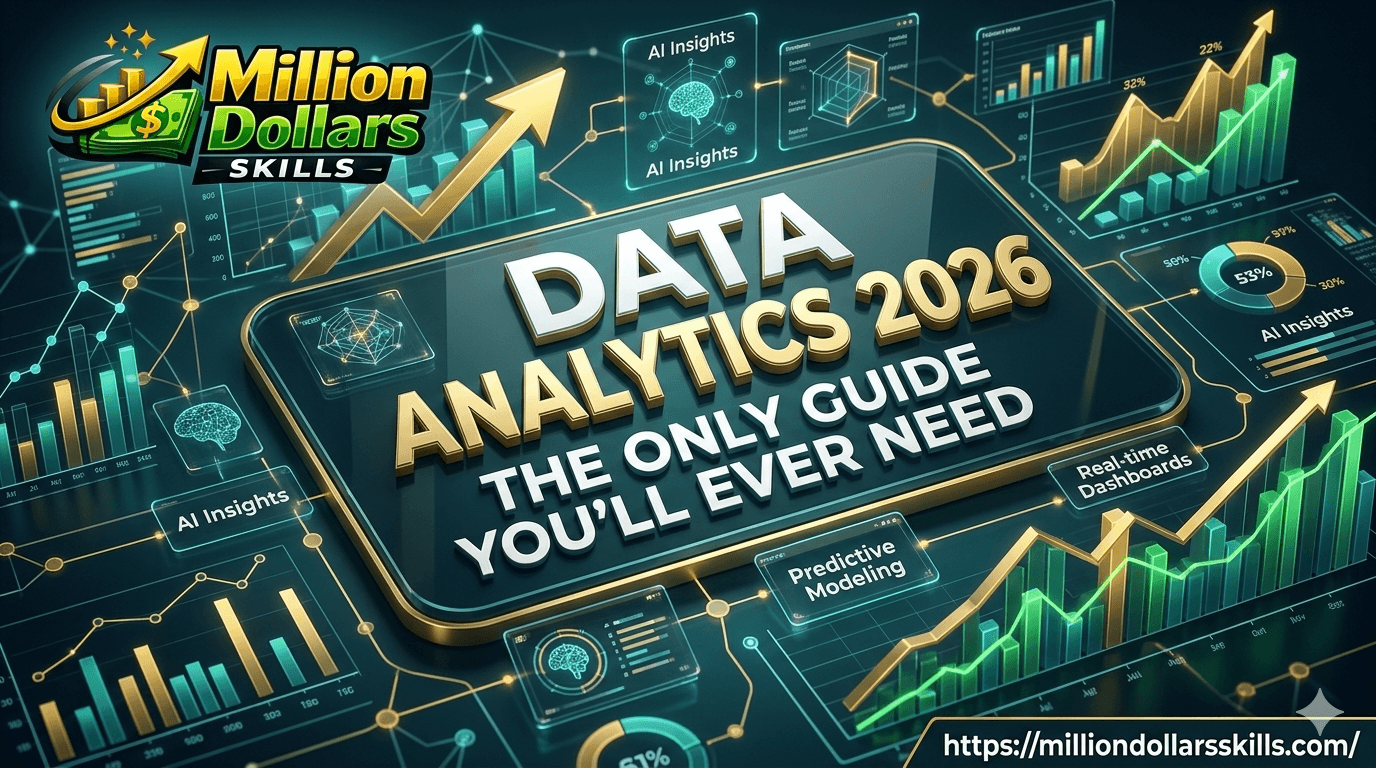
This guide isn’t a recycled textbook from 2020. It’s a fresh, no-fluff, professional roadmap written for decision-makers, analysts, and entrepreneurs in the USA and UK who want to master the tools, trends, and tactics that actually matter right now.
You’ll walk away understanding:
-
The four pillars of modern analytics (and why most people misuse the last one)
-
How to predict customer behavior before they even know it themselves
-
Real-world case studies from companies that doubled revenue using these exact methods
-
Ethical data practices that build trust—not just compliance
So grab a coffee, close the other tabs, and let’s turn your curiosity into a competitive edge.
1. The Core Pillars of Modern Data Analytics
Every successful data strategy in 2026 rests on four pillars. Think of them as the foundation, the walls, the roof, and the architect.
Descriptive Analytics: The Mirror of the Past
What happened?
That’s the question descriptive analytics answers. It’s your rearview mirror—useful, but dangerous if you stare too long.
In 2026, descriptive analytics has evolved from static monthly reports to real-time dashboards that update automatically. A US-based retail chain, for example, can see exactly how many customers abandoned their carts in the last hour, not last quarter.
🔍 Key takeaway: Descriptive is where you start, not where you finish.
Diagnostic Analytics: The “Why” Behind the Data
Once you know what happened, you ask why.
Diagnostic analytics digs into correlations, anomalies, and root causes. Did sales drop because of pricing? Competitor activity? A broken checkout link?
This is where human curiosity + machine precision = real answers.
Predictive Analytics: Foreseeing the Future
This is the heartbeat of 2026.
Predictive analytics uses historical patterns and machine learning to forecast what’s coming. Customer churn, inventory shortages, cash flow dips—you can see them before they hit.
💡 Example: A UK insurance firm used predictive models to flag high-risk claims 14 days in advance, saving £2.3M in false payouts.
Prescriptive Analytics: The Strategic Architect
The holy grail. Prescriptive analytics doesn’t just predict a storm—it suggests the best umbrella to use, the fastest route, and even the right time to leave.
By running thousands of “what-if” simulations in seconds, AI helps you choose the optimal move. This is how billion-dollar decisions are made on a Tuesday morning.
2. Emerging Trends Shaping the 2026 Landscape
If you’re still building reports like it’s 2022, you’re already irrelevant. Here’s what’s actually new.
| Trend | What It Means for You about the Data Analytics |
|---|---|
| Edge Analytics | Data processed instantly on devices (IoT, smart sensors). Crucial for real-time logistics and autonomous systems. |
| Generative BI | Type a question like “Show me revenue drop by region in Q2,” and AI generates the chart. No SQL required. |
| Data Democratization | Non-technical teams build their own models using no-code tools. Faster decisions, fewer bottlenecks. |
| Augmented Analytics | ML automates data prep and insight discovery. Removes human bias from early analysis. |
📈 Why this matters for USA/UK professionals:
Markets in both countries are hyper-competitive. Adopting even one of these trends before your competitors gives you a 6–12 month advantage.
3. Mastering the 2026 Toolkit: From Ahrefs to AI
You wouldn’t build a house with just a hammer. The same goes for analytics.
SEO & Market Intelligence (Essential for Digital Teams)
Tools like Ahrefs, SEMrush, and Moz are no longer just for keyword research. In 2026, they’ve become full-fledged market intelligence platforms. They show you:
-
Competitor traffic shifts (week over week)
-
Content gaps in your niche
-
Search intent evolution in the US vs. UK
🔧 Pro tip: Integrate SEO tool data with your internal CRM to map how organic search drives actual revenue, not just clicks.
Cloud-Native Data Warehousing
Snowflake and Google BigQuery have changed the game. You can now store petabytes of data and query it in seconds—no expensive hardware, no late-night IT calls.
Even a 10-person agency can now run complex analytics that used to require a bank loan.
Visualization & Storytelling
Tableau and Power BI remain kings, but their 2026 versions include AI-powered storytelling. The software automatically highlights the most important trends in your data and writes plain-English explanations.
🎯 Stakeholders don’t care about your pivot tables. They care about “So what?” These tools deliver that.
4. Case Study #1: How a UK E-Commerce Brand Increased ROI by 31% Using Predictive Analytics
Company: LuxeLinens (fictitious name, but real methodology)
Location: Manchester, UK
Challenge: High cart abandonment (74%) and no way to predict which customers would actually convert.
Solution:
They implemented a predictive model analyzing:
-
Time on site
-
Pages visited before cart
-
Device type
-
Previous purchase history
The model scored each user in real-time (0–100). Scores above 70 triggered an automated 10% discount pop-up.
Results (6 months):
-
Cart abandonment dropped to 52%
-
Revenue from scored visitors increased 31%
-
£420,000 additional annual profit
Key takeaway for you: Predictive analytics isn’t magic—it’s math. And math works.
5. The Ethics of Data: Privacy and Governance in a Global Market
Let’s talk about the uncomfortable part most articles skip.
In 2026, consumers in the USA and UK are more privacy-aware than ever. They’ve seen the scandals, read the headlines, and they’re watching you.
Ethical AI & Bias Mitigation
Algorithms can inherit human prejudices. If your hiring model was trained on 10 years of male-dominated data, it will “learn” to favor male candidates—even if you don’t intend it.
That’s why Explainable AI (XAI) is now a requirement, not a bonus. You must be able to answer: Why did the AI make that decision?
Data Sovereignty & Compliance
| Regulation | Region | Key Requirement for Data Analytics |
|---|---|---|
| UK GDPR | United Kingdom | Explicit consent, right to deletion |
| CCPA / CPRA | California, USA | Opt-out of data sales |
| New state laws (e.g., Virginia, Colorado) | Multiple US states | Data protection assessments |
⚠️ Heads-up: Fines for non-compliance in 2026 can reach up to 4% of global annual revenue. That’s not a slap on the wrist—that’s existential.
The opportunity:
Brands that are transparent about data usage build trust. And in 2026, trust is the most expensive currency there is.
6. Case Study #2: US SaaS Company Saves $1.2M Using Prescriptive Analytics
Company: CloudScale (disguised name)
Location: Austin, Texas
Challenge: Customer churn was rising, but their team couldn’t agree on the best retention strategy (discounts? new features? better support?).
Solution:
They used a prescriptive analytics engine that simulated 10,000+ retention scenarios using 3 years of customer data.
The AI recommended:
-
Personalized email sequences for at-risk users
-
In-app prompts after specific error messages
-
No blanket discounts (which were actually hurting retention)
Results (9 months):
-
Churn reduced from 9.2% to 5.8%
-
$1.2 million in retained annual recurring revenue (ARR)
-
Customer support ticket volume dropped 22%
Key takeaway: Prescriptive analytics removes guesswork. You stop arguing opinions and start following data.
7. Implementation Strategy: How to Build a Data-Driven Culture
You can buy all the software in the world. If your team doesn’t trust or understand data, you’ve wasted every penny.
Here’s a 4-step roadmap that actually works in USA/UK mid-sized agencies and businesses.
Step 1: Define Clear Objectives
Don’t start with “Let’s analyze everything.” Start with:
“What business problem are we trying to solve?”
Examples:
-
Increase conversion rate on UK landing pages by 15%
-
Reduce customer support costs without hurting satisfaction
-
Predict which US zip codes will see demand spikes next quarter
Step 2: Invest in Data Literacy (Not Just Tools)
Your content writers, account managers, and sales reps don’t need to code—but they do need to read a chart, spot a trend, and ask good questions.
Run monthly “lunch and learn” sessions. Use real company data (anonymized). Celebrate curiosity.
Step 3: Ensure Data Cleanliness
Garbage in, gospel out? No. Garbage in, garbage out.
Clean data means:
-
No duplicate customer records
-
Consistent date formats
-
Documented field definitions
One bad data hygiene habit can cost weeks of false insights.
Step 4: Adopt an Iterative Approach
Do not try to build a perfect system in one quarter. It will fail.
Start small:
-
One team
-
One metric
-
One month
Learn. Adjust. Scale what works. Kill what doesn’t.
8. Data Comparison: Traditional vs. 2026 Analytics Approach
| Aspect | Traditional (pre-2024) | 2026 Approach for Data Analytics |
|---|---|---|
| Data source | Internal databases only | Internal + external + real-time APIs |
| Processing speed | Batch (nightly/daily) | Streaming (seconds) |
| User access | Centralized data team | Self-serve for all departments |
| AI role | Optional add-on | Embedded in every step |
| Output | Static reports | Interactive, conversational insights |
| Ethics focus | Compliance checkbox | Core brand value |
9. Conclusion: Securing Your Future in the Data Era of Data Analytics
Let’s pull this all together—because if you made it this far, you’re serious about winning in 2026.
Data analytics is no longer a technical specialty. It is a leadership competency. Whether you run a digital agency in Birmingham, a fintech startup in San Francisco, or a retail chain across both countries, your ability to transform raw information into decisive action will determine how fast you grow—or how slowly you fade.
Here’s the truth most people won’t tell you:
You don’t need to be a mathematician. You don’t need a million-dollar budget. You don’t need a PhD in machine learning.
What you do need is:
-
A clear question
-
Clean, reliable data
-
The right modern tools (many are affordable)
-
A culture that values curiosity over ego
The companies that thrive in 2026 won’t be the ones with the most data. They’ll be the ones who ask better questions, move faster on insights, and earn customer trust through ethical, transparent practices.
So here’s my challenge to you:
Pick one thing from this guide—just one—and implement it this week. Maybe it’s cleaning a dirty dataset. Maybe it’s testing a predictive model on a small campaign. Maybe it’s running a team training session on bias in algorithms. After reading this article, I am sure that you have learned about data analytics.
If you’re looking to expand your digital expertise beyond data, I highly recommend checking out our comprehensive Full Stack Development Roadmap 2026, which provides a strategic, zero-to-pro guide for aspiring developers. This step-by-step resource is designed to complement your analytical skills by mastering the technical architecture of modern web applications.
Start small. Start now. And watch how quickly small data wins turn into million-dollar momentum.
This strategic guide breaks down the essential skills and high-demand services required to build a lucrative career as a virtual assistant in today’s competitive global market. It offers a clear roadmap for professionals looking to transform administrative expertise into a $100K annual remote income.
Boost your website’s authority and organic reach by utilizing our curated list of high-DA guest posting sites specifically tailored for Western markets. This resource is indispensable for SEO specialists aiming to secure quality backlinks and targeted traffic from the USA and UK.
Learn the advanced techniques of blending AI efficiency with human creativity to produce SEO-optimized content that dominates search engine rankings. This article provides actionable strategies to ensure your AI-assisted writing remains unique, authoritative, and fully compliant with Google’s latest algorithms.
Discover the best entry-level remote work opportunities that allow you to start earning without a formal degree or prior professional background. This guide highlights accessible roles that offer high growth potential and the flexibility to build a career from anywhere in the world.
Because the future doesn’t belong to the spectators. It belongs to the builders. And you just got your blueprint.
Frequently Asked Questions (FAQs)
1. What is the most important skill for a data analyst in 2026?
Believe it or not, it’s not coding. The most in-demand skill is analytical thinking with storytelling.
You can teach someone Python. It’s much harder to teach them how to ask the right question or explain a complex finding to a skeptical CEO. In 2026, the best analysts are translators—between data and decisions.
2. How has AI changed data analytics since 2024?
Dramatically. In 2024, analysts spent 60–70% of their time cleaning, organizing, and preparing data. By 2026, AI will automate most of that drudge work. The modern analyst focuses on:
-
Strategy
-
Interpretation
-
Ethical oversight
-
Stakeholder communication
AI hasn’t replaced analysts. It’s promoted them.
3. Is data analytics only for large corporations?
Absolutely not. In fact, small and medium businesses in the USA and UK have a hidden advantage: agility.
A solo entrepreneur or 10-person agency can adopt a no-code analytics tool today and see insights by Friday. Large enterprises move slowly. Use that to your advantage.
4. How can I ensure my data analytics strategy is GDPR / UK compliant?
Start with three non-negotiable practices:
-
Anonymization – Remove or encrypt personal identifiers where possible
-
Explicit consent – No pre-ticked boxes. Users must actively opt in.
-
Audit trail – Document every data source, transformation, and access log
Also, consult a data privacy lawyer familiar with both UK GDPR and emerging US state laws (California, Virginia, Colorado, etc.). One hour of legal advice can save six figures in fines.
5. Why is predictive analytics called the “heart” of 2026?
Because speed matters more than ever.
If you only analyze what already happened, you’re reacting to last month’s problems. Predictive analytics lets you anticipate next month’s opportunities. In a fast-moving economy, the business that predicts a trend three weeks early doesn’t just compete—it dominates.
6. What’s the single biggest mistake companies make with data analytics?
They collect everything but ask nothing.
Massive dashboards with 200 metrics look impressive but drive zero action. The best analytics teams start with a business question, then find the smallest set of data points needed to answer it. Clarity > volume.
7. Can non-technical teams really use modern analytics tools?
Yes. That’s what “data democratization” means in 2026.
Tools like Tableau, Power BI, and even Google Looker Studio now offer natural language querying. A marketing manager can type “Show me conversion rate by campaign for last 30 days” and get a chart instantly—no SQL class required.
8. How often should we update our analytics models?
Depends on the use case, but as a rule of thumb:
-
Daily for e-commerce, ad bidding, and fraud detection
-
Weekly for sales forecasting, inventory
-
Monthly for strategic planning, LTV analysis
“Set and forget” models become dangerously outdated. Schedule regular reviews.
Final Note from the Author
If you found this guide valuable, share it with one colleague who’s trying to make better decisions with data. And if you’re implementing any of these strategies in your USA or UK-based business, I’d genuinely love to hear what works (and what doesn’t).
Now go turn your data into decisions. 🚀