
11 Revolutionary AI Tools for Business in 2026 (Proven Use Cases)
11 Revolutionary AI Tools for Business in 2026 (Proven Use Cases)
Artificial Intelligence is no longer an emerging technology or optional upgrade for businesses—it has become the central engine driving productivity, innovation, and competitive advantage in 2026. Across industries, organizations are rapidly adopting AI-powered tools to automate workflows, enhance decision-making, improve customer experiences, and reduce operational costs. What once required entire departments can now be accomplished in minutes through intelligent systems that learn, adapt, and execute tasks with remarkable precision.
In today’s fast-moving digital economy, businesses that effectively integrate AI are not only operating more efficiently but also scaling faster and responding more intelligently to market changes. From startups to global enterprises, AI tools are reshaping how work is done, how decisions are made, and how value is created.
In this comprehensive guide, we’ll explore the best AI tools for business in 2026, their practical applications, and strategic insights to help organizations unlock maximum value.
Why AI Tools Matter for Businesses in 2026
The adoption of AI in business is accelerating because it delivers measurable impact across every operational layer. One of the most important advantages is automation, where repetitive and time-consuming tasks are handled by intelligent systems, allowing human teams to focus on strategic work.
AI also plays a critical role in data-driven decision-making. Modern businesses generate vast amounts of data every day, and AI tools are capable of analyzing this information instantly to extract insights that would otherwise take weeks or months to uncover. This leads to faster decisions, better forecasting, and improved business agility.
Additionally, AI significantly enhances customer engagement. Through personalization engines and predictive systems, businesses can now deliver tailored experiences that improve satisfaction, loyalty, and conversion rates. At the same time, operational costs are reduced as AI optimizes workflows, minimizes errors, and improves efficiency across departments.
Top AI Tools for Business in 2026
Below are high-impact AI tools across major business functions — productivity, collaboration, content creation, analytics, marketing, and more — that are shaping business strategy in 2026.
1. ChatGPT – The All-Purpose Business Intelligence Assistant
ChatGPT remains one of the most versatile AI tools in 2026, widely used across industries for writing, automation, customer support, research, and workflow optimization. Businesses rely on it to generate emails, reports, marketing content, and even assist in coding and strategic brainstorming.
Its integration capabilities through APIs and third-party platforms make it a powerful backbone for digital transformation. From startups automating communication to enterprises streamlining internal workflows, ChatGPT has become a universal productivity engine.
Key business impact includes:
It reduces manual workload, improves communication efficiency, and enhances content generation speed while maintaining high-quality output across multiple use cases

Key Benefits:
-
Generates human-like text for blogs, emails, and reports
-
Enhances customer service via chat automation
-
Offers coding assistance and workflow automation
2. Google Gemini – AI-Powered Workspace Intelligence
Google Gemini is deeply integrated into Google Workspace tools such as Docs, Sheets, Gmail, and Drive, transforming them into intelligent productivity systems. It assists with writing, summarizing, analyzing data, and generating insights in real time.
Businesses benefit from its seamless ecosystem integration, which allows teams to collaborate more efficiently while leveraging AI-powered suggestions and automation directly within their daily tools.
Why It Matters:
-
Seamless integration with Google tools for real-time productivity
-
Useful for drafting content, data interpretation, and automated insights
3. Jasper AI – Advanced Content and Marketing Engine
Jasper AI is widely used by marketing teams to create SEO-optimized content at scale. It generates blog posts, ad copy, landing pages, product descriptions, and social media content while maintaining brand consistency.
In 2026, Jasper AI is especially valuable for businesses focused on content marketing and organic growth, as it significantly reduces production time while improving SEO performance.

Key Benefits:
-
High-quality, on-brand content generation
-
SEO templates and optimization features
-
Support for multiple languages
4. Notion AI – Smart Workspace and Knowledge Management System
Notion AI transforms traditional project management and documentation into an intelligent workspace. It can summarize notes, generate task lists, organize knowledge bases, and streamline collaboration.
For remote teams and startups, Notion AI acts as a central operating system for planning, documentation, and workflow coordination.
Advantages:
-
Automated summaries, task generation, and planning
-
Centralized workspace for documentation and team collaboration
5. Fireflies AI – Automated Meeting Intelligence
Fireflies AI automatically records, transcribes, and analyzes meetings across platforms like Zoom, Google Meet, and Microsoft Teams. It extracts key insights, action items, and summaries to ensure nothing important is missed.
This tool is especially useful for organizations with frequent meetings, as it eliminates manual note-taking and improves accountability and follow-up efficiency.

Benefits:
-
Accurate transcription and summarization
-
Action item tracking
-
Supports multilingual transcriptions
6. ClickUp AI – Intelligent Project and Workflow Automation
ClickUp AI enhances project management by automating task creation, predicting delays, and optimizing team workflows. It helps organizations manage complex projects with greater visibility and efficiency.
By integrating AI-driven insights into task management, ClickUp improves productivity, reduces bottlenecks, and ensures better project execution.
Highlights:
-
Task automation and timeline predictions
-
Integration with existing tools and workflows
7. Synthesia – AI Video Creation Platform for Businesses
Synthesia enables companies to create professional-quality videos using AI-generated avatars and voiceovers. It eliminates the need for traditional video production teams, making content creation faster and more cost-effective.
In 2026, it is widely used for training videos, product demonstrations, internal communication, and marketing campaigns across global organizations.

Synthesia enables businesses to create AI-generated professional videos using virtual avatars and voiceovers without needing video production expertise. In 2026, features such as multilingual narration and voice cloning make it essential for modern communication.
8. HubSpot AI – Smart CRM and Marketing Automation
HubSpot AI enhances customer relationship management by automating marketing campaigns, predicting customer behavior, and improving lead conversion strategies.
It helps businesses personalize communication at scale, resulting in stronger customer engagement and higher revenue generation.
HubSpot’s AI modules enhance CRM capabilities by providing predictive insights, automating workflows, and improving customer engagement through personalized interactions. Its integration with sales and marketing platforms makes it a comprehensive solution for growing businesses.
9. Replit AI – AI-Powered Software Development Assistant
Replit AI accelerates software development by assisting with code generation, debugging, and real-time collaboration. It significantly reduces development time and improves coding accuracy.
For startups and tech companies, Replit AI improves engineering efficiency and supports faster product deployment cycles.
Replit AI accelerates coding workflows by suggesting code, fixing bugs, and facilitating real-time collaboration for developers — helping teams build and deploy applications more efficiently.
0. Tableau with Einstein GPT – Advanced Analytics and Forecasting
The integration of Tableau with Einstein GPT allows businesses to perform advanced data analysis using natural language queries. It transforms complex datasets into visual insights and predictive models.
This combination empowers executives and analysts to make faster, more informed strategic decisions based on real-time data interpretation.
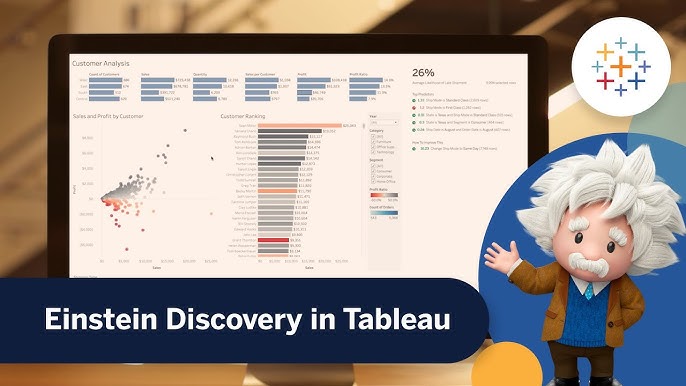
Tableau’s integration with Salesforce’s Einstein GPT empowers data analysts to ask natural language questions and generate predictive visualizations instantly. This blend of AI analytics and visualization helps leaders make data-driven decisions confidently.
11. SEMrush AI – Competitive Intelligence and SEO Strategy
SEMrush AI helps businesses analyze competitors, track keyword performance, and identify SEO opportunities. It plays a critical role in digital marketing strategy by improving visibility and search rankings.
With AI-powered insights, businesses can adapt quickly to market trends and maintain a strong online presence.
How to Choose the Right AI Tools for Your Business
Selecting the right AI tools requires a strategic approach based on business objectives and operational needs. Companies should begin by identifying their biggest challenges, such as marketing inefficiency, customer support overload, or workflow delays.
Integration is another key factor, as AI tools must work seamlessly with existing systems such as CRMs, communication platforms, and project management software. Scalability is equally important to ensure long-term usability as the business grows.
Before full deployment, organizations should run pilot programs to measure performance, productivity improvements, and return on investment. This ensures informed decision-making and smooth adoption across teams.
AI Business Trends in 2026
AI adoption is evolving rapidly, and several key trends are shaping the future of business operations:
AI agents are becoming capable of performing complex tasks autonomously with minimal human supervision.
AI is being deeply integrated into enterprise workflows across communication, analytics, and operations.
Hyper-personalization systems are transforming both customer experience and internal productivity.
These trends indicate a shift toward fully AI-driven business ecosystems where automation and intelligence work together seamlessly.
Conclusion: AI Is Redefining Business Success in 2026
AI tools in 2026 are not simply productivity enhancers—they represent a fundamental transformation in how businesses operate and compete. From automation and content creation to advanced analytics and customer engagement, AI is enabling organizations to scale faster, operate smarter, and reduce inefficiencies across all levels.
Businesses that strategically adopt AI tools today are positioning themselves for long-term success in an increasingly competitive digital landscape. Whether it is improving workflow efficiency, enhancing customer experience, or driving innovation, AI has become the most powerful business advantage of the modern era.
Frequently Asked Questions (FAQs)
1. What are the best AI tools for business in 2026?
The most effective AI tools in 2026 include ChatGPT, Google Gemini, Jasper AI, Notion AI, HubSpot AI, ClickUp AI, and SEMrush AI. These platforms help businesses automate operations, improve marketing performance, streamline communication, and enhance decision-making.
2. How do AI tools help small businesses grow?
AI tools help small businesses by automating repetitive tasks, reducing operational costs, improving marketing efficiency, and enhancing customer support. This allows small teams to compete effectively with larger enterprises using limited resources.
3. Are AI tools expensive for startups?
No, many AI tools offer free plans or affordable subscription models. Startups can begin with basic versions of tools like ChatGPT, Notion AI, and Canva AI before scaling to premium features as their business grows.
4. Which AI tools are best for marketing and SEO?
Top AI tools for marketing and SEO include Jasper AI, SEMrush AI, SurferSEO, and Rank tracking platforms. These tools help with keyword research, content creation, optimization, and performance tracking.
5. Can AI replace human employees?
AI is designed to assist rather than replace humans. It handles repetitive and data-heavy tasks, allowing employees to focus on creativity, strategy, and decision-making.
6. Is it safe to use AI tools for business data?
Most reputable AI tools follow strict security and compliance standards. However, businesses should always avoid sharing sensitive information and ensure platforms meet privacy and regulatory requirements.
7. How do I choose the right AI tool for my business?
Start by identifying your main challenge, then select tools that integrate with your current systems. Always test tools through pilot programs before full implementation.
8. Will AI improve business productivity in 2026?
Yes, AI tools can significantly improve productivity by 30–60% by automating workflows, accelerating decision-making, and reducing operational errors.


3 Comments