
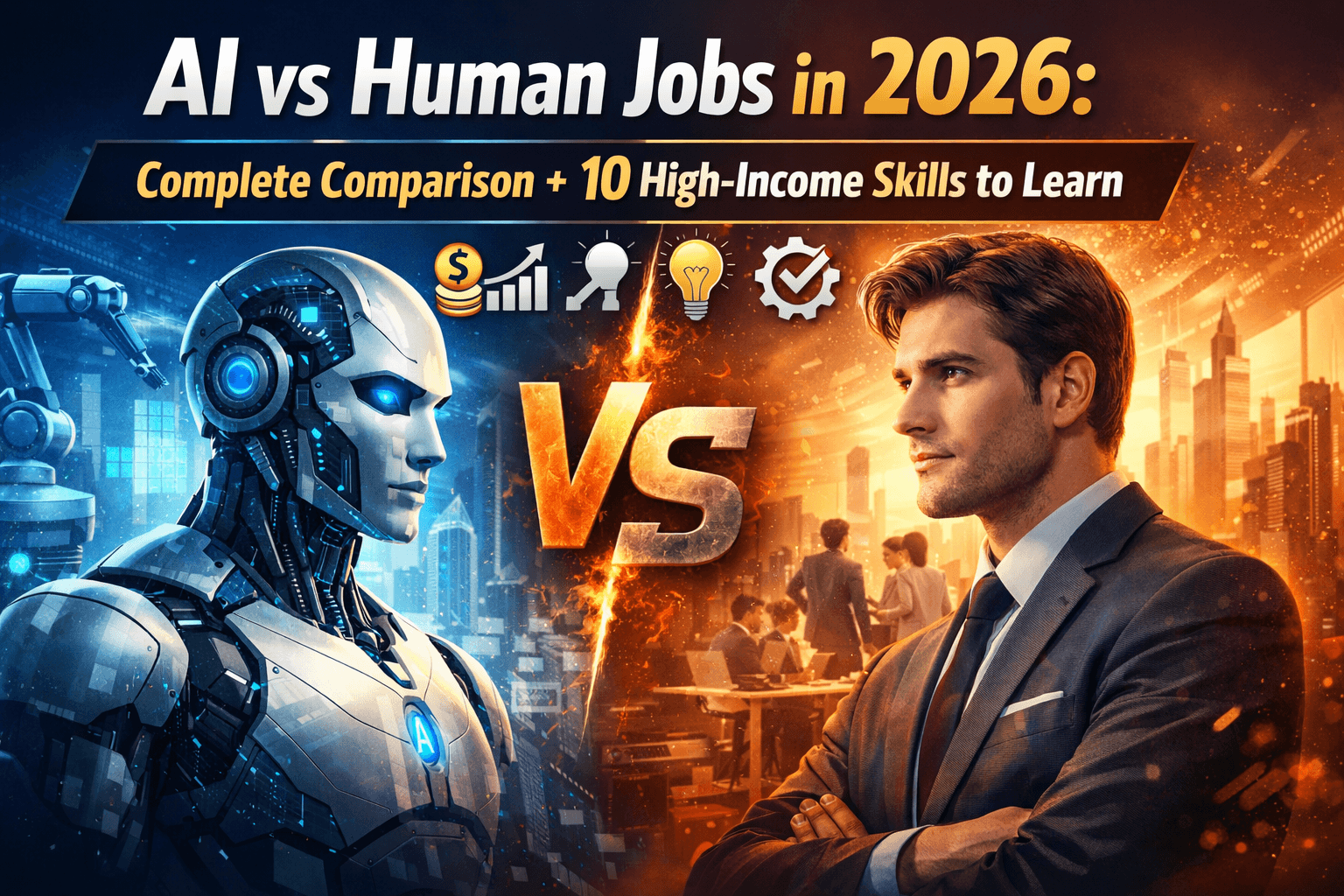
AI vs Human Jobs in 2026: Shocking Comparison + 10 Best High-Income Skills
AI vs Human Jobs in 2026: Shocking Comparison + 10 Best High-Income Skills
Introduction: The Future of Work Has Already Begun
“Will AI eventually take my job?” This is no longer just a headline in tech magazines; it is a genuine concern echoing in the minds of students, freelancers, and seasoned professionals alike. As we move deeper into 2026, Artificial Intelligence has transitioned from a futuristic novelty into the very backbone of our digital economy. However, there is a fundamental truth that many overlook: AI isn’t coming for your job—it’s coming for the tasks that don’t require a human touch.
The conversation around artificial intelligence and human employment is no longer something reserved for the future—it is happening right now. By 2026, AI will have become deeply embedded in almost every industry, from healthcare and education to marketing, finance, manufacturing, and even creative fields. What once sounded like science fiction is now a normal part of daily business operations. After reading the Complete Article AI vs Human Jobs, you must learn the Given Skill for your future survival.
This rapid transformation has created both excitement and fear. On one hand, companies are becoming faster, more efficient, and more data-driven than ever before. On the other hand, workers across the world are asking an important question: Will AI replace human jobs completely?
The reality is more complex and far more interesting. AI is not simply replacing human workers—it is reshaping the nature of work itself. Some jobs are disappearing, many are evolving, and entirely new careers are emerging that did not exist a decade ago. In this new world, success depends less on competing with machines and more on learning how to work alongside them. The AI vs Human Jobs comparison is really amazing. Here is a detailed comparison for you to decide the right option for your future.
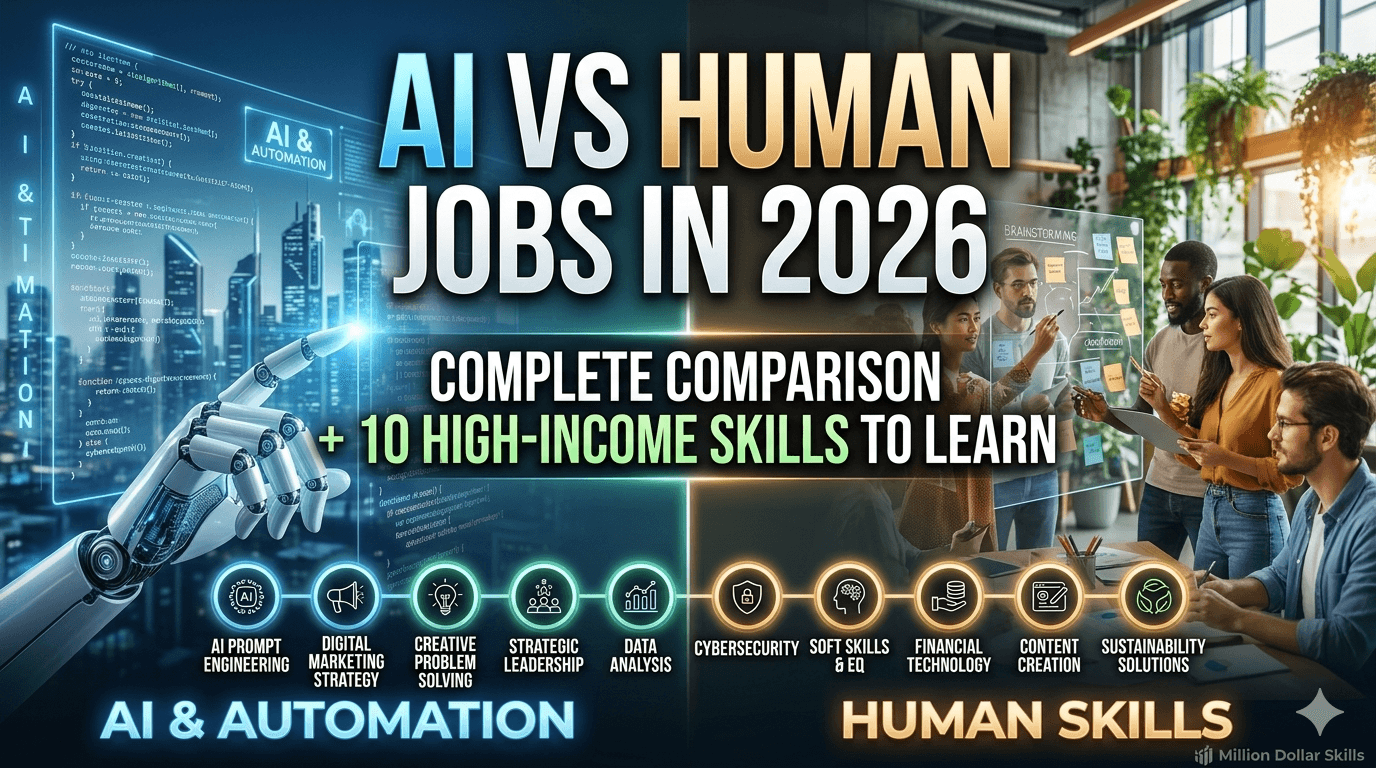
To understand what lies ahead, we need to carefully examine how AI and humans differ in the workplace, which jobs are most affected, and what skills will define high-income earners in 2026 and beyond.
Understanding AI vs Human Jobs in 2026
At its core, the comparison between AI and human jobs is not about superiority but about capability. Both bring unique strengths to the table, and both have limitations.
AI systems are designed to process large volumes of data, recognize patterns, and perform repetitive tasks with extreme accuracy. They do not get tired, emotional, or distracted. This makes them ideal for structured, rule-based environments where efficiency and speed matter most.
Humans, however, bring something far more complex into the workplace. We rely on creativity, emotional intelligence, intuition, and lived experience. These qualities cannot be fully replicated by algorithms, no matter how advanced they become.
In 2026, the workplace is increasingly defined by a combination of these strengths. AI handles the technical and repetitive aspects of work, while humans focus on strategy, innovation, relationships, and decision-making.
Rather than replacing humans entirely, AI is acting as a powerful assistant that enhances productivity and reduces workload.
How AI is Changing the Job Market: AI vs Human Jobs 2026
The influence of AI on the job market is visible across nearly every industry. Tasks that once required entire teams can now be completed in seconds using automated systems and intelligent software.
For example, in business operations, AI tools can analyze market trends, generate reports, and even predict customer behavior with impressive accuracy. In customer service, chatbots are handling millions of queries daily, reducing the need for large support teams. In manufacturing, robotics systems are increasing production speed while minimizing human error.
Even in creative industries such as writing, design, and video production, AI tools are being used to generate drafts, suggest ideas, and automate editing processes.
However, this does not mean humans are becoming irrelevant. Instead, the nature of human work is shifting toward oversight, creativity, and emotional depth. The job market is no longer about performing tasks manually—it is about managing intelligent systems and making strategic decisions based on AI-generated insights.
Jobs Most at Risk Due to AI Automation
While AI is not eliminating all jobs, it is significantly impacting roles that rely heavily on repetition and predictable processes. These include:
Administrative and Data Entry Roles
Jobs that involve typing, organizing, and processing structured data are increasingly being automated. Software can now perform these tasks faster and with fewer errors.
Customer Support Positions
AI chatbots and virtual assistants are now handling basic customer inquiries, reducing the need for large call center teams. Human agents are still required for complex issues, but routine support is largely automated.
Manufacturing and Assembly Line Jobs
Robotics and automated machines have replaced many manual labor roles in factories, especially those involving repetitive physical tasks.
Basic Content Writing and AI vs Human Jobs
AI tools can now generate simple articles, product descriptions, and marketing copy. While human writers are still needed for quality and creativity, entry-level writing jobs are becoming more competitive.
Retail and Cash Handling Jobs
Self-checkout systems, digital payments, and automated kiosks have significantly reduced the need for traditional cashier roles.
These changes do not necessarily mean job loss on a massive scale, but they do indicate a shift in the skills required to remain employable.
Jobs That Are Growing in the AI Era
While some roles are shrinking, others are experiencing rapid growth due to technological advancement. These jobs typically require analytical thinking, creativity, or technical expertise.
AI and Machine Learning Specialists
Professionals who design and train AI systems are in extremely high demand. Companies across all industries are investing heavily in AI development.
Data Scientists and Analysts
With more data being generated than ever before, organizations need experts who can interpret and turn data into actionable insights.
Cybersecurity Experts
As digital systems expand, cyber threats are also increasing. Security professionals play a crucial role in protecting sensitive information and systems.
Digital Marketing Strategists
Marketing has become highly data-driven, and professionals who can combine creativity with analytics are highly valuable.
Healthcare and Mental Health Professionals
Despite technological advances, human care remains irreplaceable in medicine, therapy, and emotional support.
These careers highlight an important trend: the more advanced technology becomes, the more valuable human expertise becomes in complex and sensitive areas.
AI vs Humans: Who Has the Advantage?
The question is not about who wins, but about where each performs best.
AI has the advantage in speed, accuracy, scalability, and data processing. It can complete tasks in seconds that might take humans hours or days.
Humans, however, excel in creativity, empathy, leadership, and ethical judgment. These qualities are essential in decision-making, especially in uncertain or complex situations.
In 2026, the most successful organizations are not those that rely solely on AI or humans, but those that integrate both effectively. The future workplace is collaborative, not competitive.
The Rise of Hybrid Careers
One of the most important developments in the modern job market is the rise of hybrid roles. These are jobs that require both technical understanding and human skills.
For example, a modern marketer is expected to use AI tools for data analysis while still creating emotionally compelling campaigns. A financial analyst might use machine learning models but still rely on human judgment for investment decisions.
This blending of skills is becoming the new standard. Professionals who can bridge the gap between technology and human understanding are becoming extremely valuable.
10 High-Income Skills to Learn in 2026
To succeed in this evolving job market, developing the right skills is essential. The following high-income skills are expected to remain in strong demand:
1. Artificial Intelligence and Machine Learning
Understanding how AI systems work and how to build them is one of the most valuable technical skills today.
2. Data Science and Analytics in AI vs Human Jobs
The ability to interpret large datasets and extract meaningful insights is crucial for modern decision-making.
3. Digital Marketing and SEO
Businesses rely heavily on online visibility, making SEO and digital marketing essential skills.
4. Cybersecurity
Protecting digital infrastructure is becoming increasingly important as cyber threats grow.
5. Software Development
Coding and programming remain foundational skills in the technology industry.
6. Content Strategy and Copywriting
Even with AI assistance, human storytelling and brand voice remain irreplaceable.
7. UX/UI Design
User experience design ensures that digital products are intuitive and user-friendly.
8. Sales and Negotiation
Persuasion and communication skills continue to generate high income across industries.
9. Leadership and Emotional Intelligence
Managing people and building strong teams requires emotional awareness and interpersonal skills.
10. Financial Literacy and Investing
Understanding how money works is essential for long-term wealth creation and stability.
How to Stay Relevant in an AI-Driven World
The key to surviving and thriving in 2026 is adaptability. Technology will continue to evolve, and the workforce must evolve with it.
Continuous learning is no longer optional. Professionals must regularly upgrade their skills and stay updated with industry trends. Combining technical knowledge with soft skills will provide a significant advantage in the job market.
It is also important to embrace AI rather than fear it. Those who learn how to use AI tools effectively will become more productive and competitive.
Conclusion: The Future Belongs to Adaptable Minds
The debate between AI and human jobs often creates unnecessary fear. In reality, the future is not about replacement but transformation. AI is reshaping industries, but humans remain at the center of innovation, creativity, and leadership.
The most successful individuals in 2026 will not be those who resist technology, but those who learn how to work with it. By developing high-income skills, you must know the basic comparison of AI vs Human Jobs in 2026 and stay adaptable; anyone can thrive in this new era of work.
The real competition in the modern marketplace isn’t actually AI vs. Human Jobs. Instead, it is a race between those who remain stagnant and those who learn to collaborate with technology. We are entering an era of the “AI-Augmented Professional,” where the goal isn’t to beat the machine, but to master it. In this comprehensive guide, we will strip away the hype and the fear to focus on what truly matters: the 10 high-income skills that will make you indispensable. Let’s explore how you can secure your career and thrive in a world redefined by automation.
The future does not belong to AI alone—it belongs to those who know how to use it wisely and know the real concept of AI vs Human Jobs AI vs Human Jobs in 2026
FAQs: AI vs Human Jobs in 2026
1. Will AI replace human jobs completely in 2026?
No, AI will not completely replace human jobs in 2026. Instead, it will automate repetitive and routine tasks while humans focus on creative thinking, decision-making, emotional intelligence, and leadership roles. Most industries are shifting toward a collaboration model where AI supports human work rather than replacing it entirely.
2. Which jobs are most at risk due to AI automation?
Jobs that involve repetitive, predictable tasks are the most affected. This includes data entry roles, basic customer support, administrative work, manufacturing line jobs, and simple content writing tasks. These roles are being increasingly automated through AI tools and robotics.
3. What types of jobs are safe from AI in 2026?
Jobs that require creativity, empathy, complex decision-making, and human interaction are much safer from automation. Examples include healthcare professionals, psychologists, teachers, leaders, software engineers, AI specialists, and strategic marketers.
4. How is AI creating new job opportunities?
AI is not only replacing tasks but also creating new career paths. Fields like machine learning engineering, data science, AI ethics, cybersecurity, and automation consulting are growing rapidly as companies adopt advanced technologies.
5. What are the best high-income skills to learn in 2026?
Some of the top high-income skills include artificial intelligence and machine learning, data analysis, digital marketing, cybersecurity, software development, UX/UI design, sales and negotiation, content creation, leadership, and financial literacy.
6. Can AI replace creative jobs like writing and design?
AI can assist in creative tasks, but it cannot fully replace human creativity. While AI can generate ideas or drafts, human writers and designers are still needed for originality, emotional depth, storytelling, and brand identity.
7. How can I stay relevant in the AI-driven job market?
To stay relevant, focus on continuous learning, improving both technical and soft skills, and adapting to new tools. Learning how to use AI as a productivity tool rather than seeing it as a threat is key to long-term success.
8. What is a hybrid job in the AI era?
A hybrid job is a role that combines technical knowledge with human skills. For example, a digital marketer using AI tools for analytics or a financial analyst using machine learning insights while making human-driven decisions.
9. Is it worth learning AI skills even if I am not a tech professional?
Yes, absolutely. AI skills are becoming valuable across almost every industry. Even basic knowledge of AI tools can improve productivity, job performance, and career opportunities in non-technical fields.
10. What is the future of work beyond 2026?
The future of work will be highly collaborative between humans and AI. Instead of replacing humans, AI will continue to enhance productivity, create new industries, and redefine how work is performed across all sectors.


2 Comments