
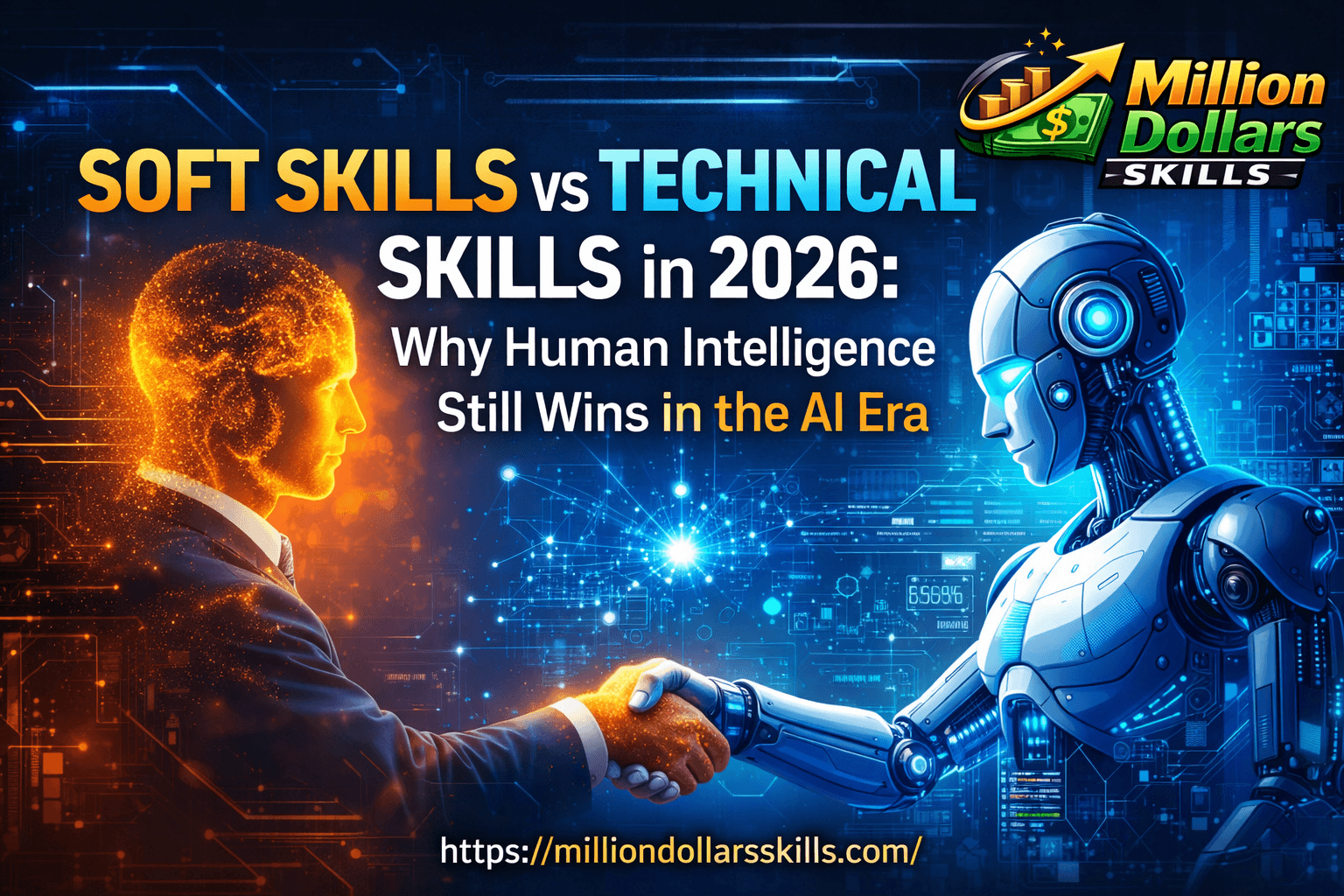
Soft Skills vs Technical Skills in 2026: Why Human Intelligence Still Wins in the AI Era
Soft Skills vs Technical Skills in 2026: Why Human Intelligence Still Wins in the AI Era
Introduction: The Shift That Is Redefining Success
The modern professional landscape is evolving faster than ever before, and at the heart of this transformation lies a crucial question: what truly defines success in 2026—technical skills or soft skills? With artificial intelligence rapidly advancing across industries, automating tasks, and even making decisions, the traditional understanding of “valuable skills” is being challenged. Careers that once relied heavily on technical expertise are now being reshaped by intelligent systems capable of performing complex operations with speed and precision.
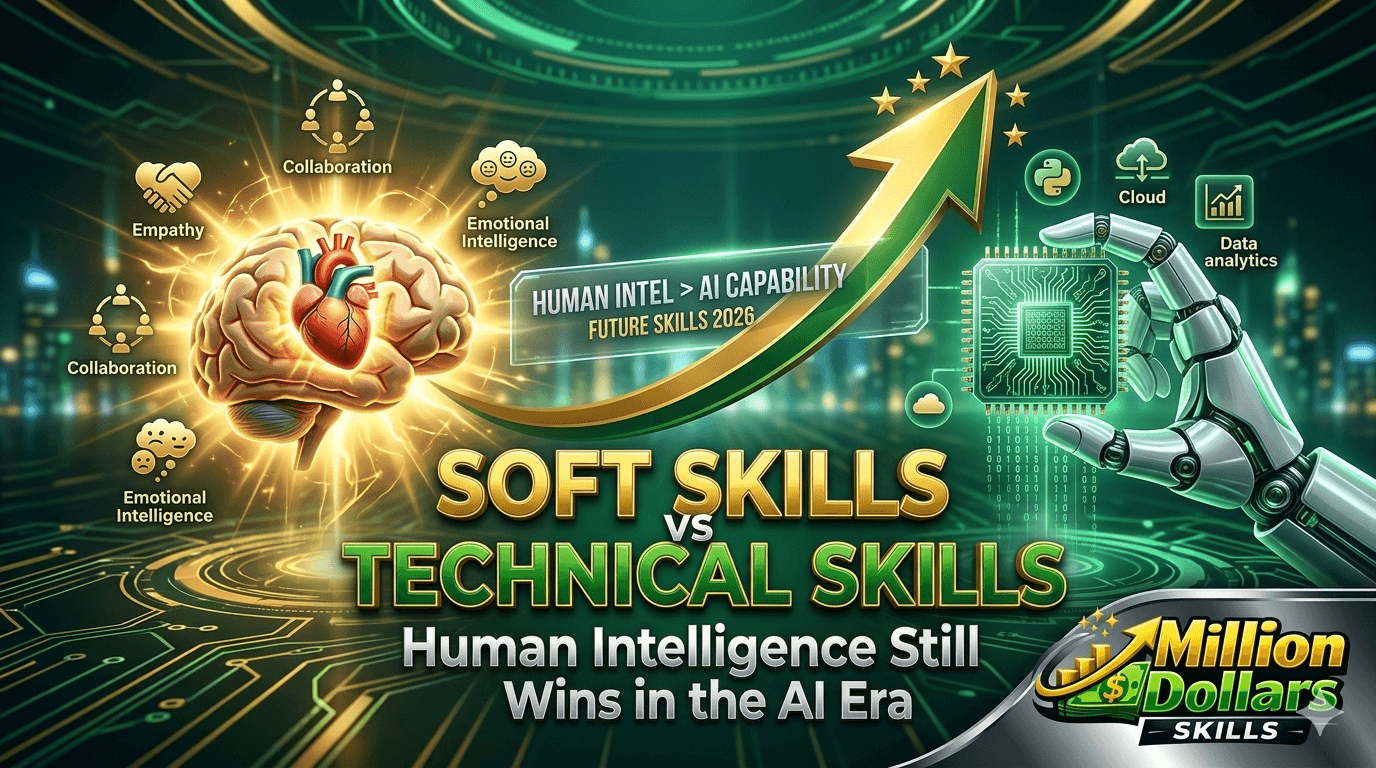
However, while AI continues to dominate in logic-driven environments, it is simultaneously highlighting the irreplaceable value of human intelligence. Skills such as communication, adaptability, emotional intelligence, and creativity are no longer considered secondary—they are becoming essential. In this AI-driven era, success is no longer about what you know alone, but how effectively you can apply, communicate, and evolve that knowledge in real-world situations.
Technical Skills in 2026: Still Important, But No Longer Enough
Technical skills, also known as hard skills, have traditionally been the foundation of professional competence. These include specialized abilities such as programming, data analysis, engineering, cybersecurity, and operating advanced systems. For decades, mastering these skills was seen as a direct path to career stability, high income, and long-term growth.
In 2026, technical skills still hold significant value, but their role has changed. Artificial intelligence and automation tools are now capable of performing many technical tasks that once required human expertise. From generating code to analyzing large datasets, AI systems are not only faster but often more accurate. This shift has reduced the exclusivity of technical skills, making them more accessible but less differentiating.
That said, technical knowledge is far from obsolete. Professionals still need these skills to understand, manage, and improve AI-driven systems. However, relying solely on technical expertise is no longer a sustainable strategy for long-term success. The modern workforce demands more than just technical proficiency—it requires a human touch.
The Rise of Soft Skills: The True Differentiator
As machines take over repetitive and logic-based tasks, soft skills have emerged as the true differentiators in the workplace. Soft skills include communication, emotional intelligence, leadership, problem-solving, creativity, and adaptability. Unlike technical skills, these abilities are deeply rooted in human behavior and cannot be easily replicated by machines.
In 2026, employers are increasingly prioritizing candidates who demonstrate strong interpersonal and cognitive abilities. The ability to communicate ideas clearly, collaborate with diverse teams, and navigate complex social dynamics is now considered essential. While AI can process information, it lacks the human capacity to empathize, inspire, and build trust.
This is where human intelligence proves its superiority. Soft skills enable individuals to connect, influence, and lead in ways that technology simply cannot match.
Human and AI Collaboration: The New Normal
The future of work is not about humans competing with AI—it is about humans collaborating with AI. Intelligent systems are becoming powerful tools that enhance productivity, streamline workflows, and provide valuable insights. However, these tools require human interpretation, decision-making, and ethical oversight.
For example, a business analyst may use AI to generate data insights, but it takes human judgment to interpret those insights and turn them into actionable strategies. Similarly, a content creator might use AI-generated drafts, but creativity and storytelling remain uniquely human strengths.
This hybrid work environment makes soft skills more important than ever. Professionals must be able to bridge the gap between technology and human needs, ensuring that AI is used effectively and responsibly.
Adaptability: The Skill That Ensures Survival
In a world where technology evolves rapidly, adaptability has become one of the most valuable skills. New tools, platforms, and systems are constantly emerging, and professionals must be willing to learn and evolve continuously. Technical skills can become outdated within a few years, but adaptability ensures long-term relevance.
Individuals who embrace change, remain curious, and actively seek new knowledge are better equipped to navigate uncertainty. Unlike AI, which relies on predefined data and algorithms, humans have the ability to think flexibly and respond to new challenges creatively.
In 2026, adaptability is not just an advantage—it is a necessity.
Creativity: A Uniquely Human Strength : Soft Skills vs Technical Skills
Despite significant advancements in AI, creativity remains a distinctly human capability. While AI can generate content, designs, and ideas based on patterns, it lacks true originality and intuition. Human creativity involves imagination, emotional depth, and the ability to connect unrelated concepts in meaningful ways.
In industries such as marketing, design, media, and innovation, creativity is a driving force behind success. Companies are actively seeking individuals who can think outside the box, challenge conventional ideas, and develop unique solutions.
This creative edge ensures that human intelligence continues to outperform machines in areas that require innovation and originality.
Emotional Intelligence: The Foundation of Leadership
Emotional intelligence has become a cornerstone of effective leadership in the modern workplace. As organizations become more diverse and often operate remotely, the ability to understand and manage emotions is critical.
Leaders with high emotional intelligence can build strong relationships, resolve conflicts, and create positive work environments. They can motivate teams, foster collaboration, and navigate challenges with empathy and understanding.
AI may assist with decision-making, but it cannot replace the human qualities that define great leadership. In 2026, emotional intelligence is not just a desirable trait—it is a fundamental requirement.
Balancing Soft Skills and Technical Expertise
While soft skills are gaining prominence, it is important to recognize that technical skills still play a vital role. The most successful professionals are those who can combine both skill sets effectively.
Technical skills provide the foundation for understanding complex systems, while soft skills enable individuals to apply that knowledge in meaningful ways. For instance, a developer who can communicate effectively will collaborate better with teams, while a manager with technical knowledge can make more informed decisions.
The key to success lies in achieving the right balance. It is not about choosing between soft skills and technical skills—it is about integrating them.
Changing Hiring Trends in 2026 Soft Skills vs Technical Skills
Employers are adapting to this shift by redefining their hiring priorities. Many companies now value soft skills as much as, if not more than, technical expertise. This is because technical skills can often be taught through training, while soft skills take time and experience to develop.
Organizations are investing in leadership programs, communication training, and personal development initiatives to build well-rounded teams. Candidates who demonstrate strong soft skills are more likely to stand out in a competitive job market.
This trend reflects a broader understanding that human intelligence is essential for long-term success.
Ethical Thinking in an AI-Driven World
The rise of AI has introduced complex ethical challenges, including data privacy, algorithmic bias, and the societal impact of automation. These issues cannot be solved by technology alone—they require human judgment and responsibility.
Professionals in 2026 are expected to think critically about the ethical implications of their work. They must ensure that AI is used in a way that is fair, transparent, and beneficial to society.
This further emphasizes the importance of soft skills, particularly critical thinking and ethical reasoning.
Education and the Future of Skills
Educational systems are evolving to meet the demands of the modern workforce. While technical education remains important, there is a growing emphasis on developing soft skills alongside academic knowledge.
Schools and universities are incorporating communication, teamwork, and problem-solving into their curricula. This holistic approach prepares students for a future where adaptability and emotional intelligence are just as important as technical expertise.
Conclusion: Why Human Intelligence Still Wins
In 2026, the debate between soft skills and technical skills is not about choosing one over the other—it is about understanding their evolving roles. Technical skills remain essential, but they are no longer the sole drivers of success. Soft skills, powered by human intelligence, are what truly set individuals apart in an AI-driven world.
As technology continues to advance, the value of being human becomes even more significant. The ability to think critically, communicate effectively, adapt to change, and connect with others will always be in demand. The major difference between Soft Skills vs Technical Skills is intellectualism.
Ultimately, human intelligence still wins—not by competing with AI, but by complementing it in ways that machines simply cannot replicate.



2 Comments