
How GEO is Replacing Traditional SEO in 2026: A Survival Guide
How GEO Will Replace SEO in 2026: Complete Survival Guide
For quite a long time, SEO has served as the backbone of digital marketing strategies across industries. Businesses, bloggers, and marketers have spent years refining their websites, carefully selecting keywords, building backlinks, and improving technical performance to secure top positions on search engine results pages. The goal was always straightforward: rank higher, gain visibility, and drive traffic. However, as we move deeper into 2026, this traditional approach is undergoing a major transformation. The rapid advancement of artificial intelligence, combined with shifting user behavior, is redefining how people search for information and how businesses must position themselves online to remain visible and competitive. But it is true that GEO is Replacing Traditional SEO.
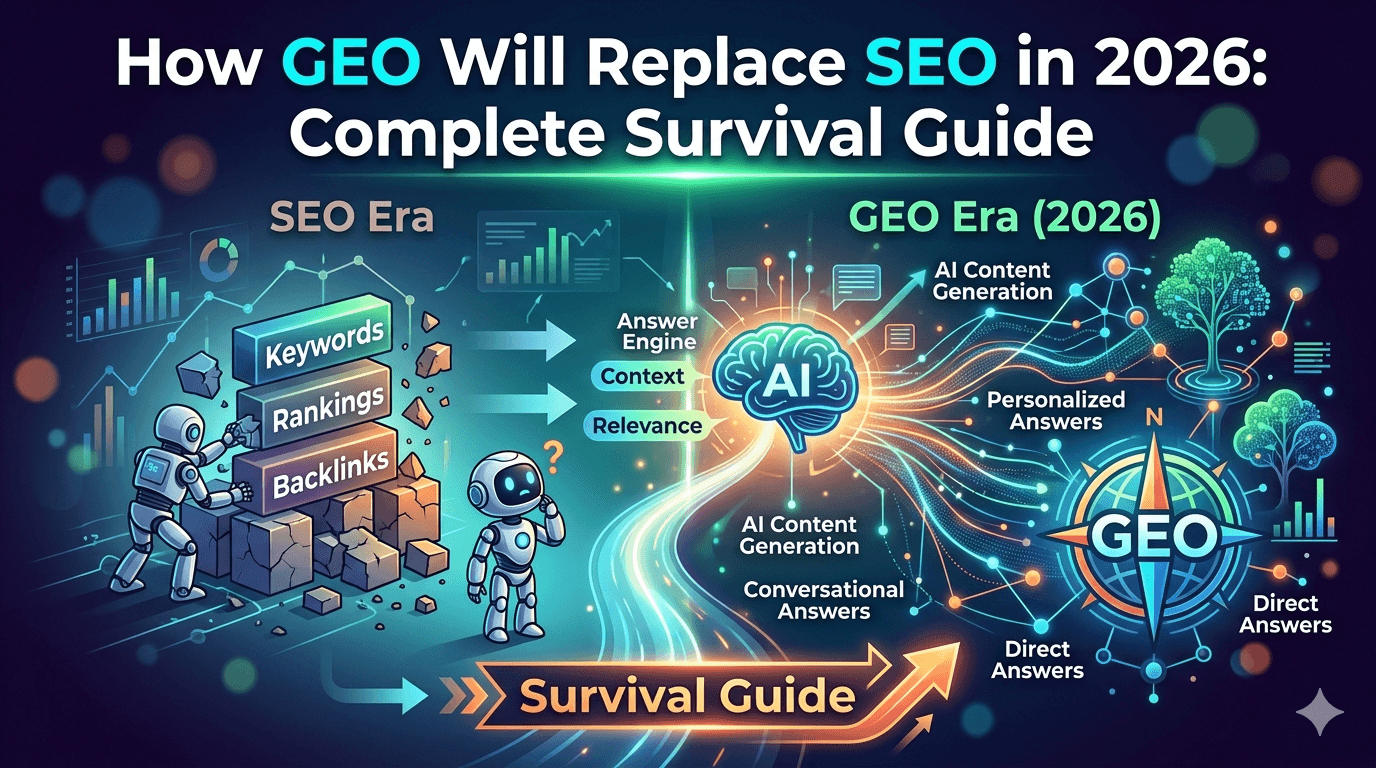
Search itself is no longer what it used to be. Instead of typing short keywords and browsing through multiple websites, users now expect to ask complete questions and receive direct, well-structured answers instantly. The search bar has evolved from a simple input field into the starting point of an AI-powered interaction. Platforms like ChatGPT, Google Gemini, and Perplexity are leading this change by analyzing massive amounts of data and delivering clear responses without requiring users to click through multiple links. This shift has fundamentally changed the rules of digital visibility and introduced a new concept that marketers can no longer ignore.
Understanding What Generative Engine Optimization (GEO) Really Means
Generative Engine Optimization, commonly referred to as GEO, represents the next stage in the evolution of digital marketing. Unlike traditional SEO, which focuses primarily on ranking web pages in search engine results, GEO is centered on optimizing content so that AI systems can understand it, trust it, and use it when generating answers. In this new environment, your content is no longer competing just for clicks—it is competing to become the source behind AI-generated responses. This changes the entire approach to content creation, requiring a stronger focus on clarity, depth, and real value.
What makes GEO particularly powerful is its alignment with how modern users consume information. People are no longer interested in scanning multiple articles to find what they need. They want immediate, accurate answers. AI systems deliver exactly that by summarizing and synthesizing content from multiple sources. If your content is structured and written effectively, it has the potential to become part of those answers, giving your brand visibility in a completely new way.
Why GEO Is Replacing Traditional SEO?
The rise of GEO is closely connected to the changing expectations of users. Today’s audience values speed, convenience, and accuracy above all else. Instead of spending time comparing different sources, users rely on AI tools to provide a single, reliable response. This behavior reduces the importance of traditional rankings and increases the importance of being recognized as a trustworthy source of information.
AI systems are capable of analyzing vast amounts of content within seconds, identifying the most relevant and reliable data, and presenting it in a simplified format. As a result, content that lacks depth, clarity, or credibility is less likely to be used, even if it previously ranked well in search engines. This shift forces marketers to move beyond outdated tactics and focus on creating meaningful, high-quality content that genuinely answers user questions.
Is SEO Still Relevant in 2026?
Despite the growing influence of GEO, SEO is far from obsolete. In fact, it still plays a critical role in ensuring that content can be discovered and indexed by search engines. Technical elements such as website speed, mobile responsiveness, proper indexing, and backlink profiles remain essential components of a strong online presence. Without these foundations, even the best content may struggle to gain visibility.
However, the role of SEO has changed. It is no longer the primary driver of success but rather the base upon which GEO strategies are built. To succeed in 2026, businesses must combine the technical strength of SEO with the content-focused approach of GEO. This combination allows them to not only appear in search results but also become trusted sources for AI-generated answers.
Key Principles of a Successful GEO Strategy
To thrive in the GEO era, content creation must evolve. One of the most important changes is shifting from keyword-focused writing to topic-focused content. Instead of targeting a single keyword, creators need to cover entire topics in depth, exploring different angles and providing comprehensive insights. This helps AI systems better understand the subject and increases the chances of the content being selected as a source.
Credibility is another crucial factor. The concept of E-E-A-T—Experience, Expertise, Authoritativeness, and Trustworthiness—has become central to content evaluation. Users and AI systems alike prefer information that comes from reliable, knowledgeable sources. Demonstrating expertise, using accurate data, and providing real-world insights all contribute to building this trust.
At the same time, the importance of citations is growing. While backlinks remain valuable, AI systems increasingly rely on content that includes unique insights, original data, and clearly presented information. Creating content that is informative, well-researched, and easy to reference significantly improves its chances of being used in AI-generated responses.
Writing style also plays a major role. Content should feel natural, conversational, and easy to understand. Overly complex language or robotic phrasing can reduce readability and make it harder for AI systems to interpret the information. Clear, human-centered writing not only improves user engagement but also enhances AI compatibility.
Finally, structure remains essential. Well-organized content with clear headings, logical flow, and properly formatted sections makes it easier for both readers and AI systems to process information. A strong structure improves readability, enhances user experience, and increases the likelihood of being featured in AI-generated answers.
SEO vs GEO: A Real-World Example
To better understand the difference between SEO and GEO, consider a website focused on home renovation. A traditional SEO approach might involve creating a short article targeting a keyword like “cheap kitchen tiles.” While this may generate some traffic, it only addresses a narrow topic and provides limited value.
In contrast, a GEO-focused approach would involve creating a comprehensive guide such as “Kitchen Remodeling Trends in 2026.” This type of content would cover multiple aspects, including design ideas, cost breakdowns, material comparisons, and sustainability considerations. When a user asks an AI system a question like “How can I renovate my kitchen on a budget in 2026?”, the AI is far more likely to use the detailed guide as a source because it offers a complete and structured answer. This clearly illustrates how GEO shifts the focus from ranking for keywords to becoming a trusted authority.
How to Adapt to the GEO Era
Adapting to GEO requires a strategic and forward-thinking approach. One of the most important steps is keeping content updated, as outdated information is less likely to be used by AI systems. Regular updates ensure accuracy and maintain relevance in a rapidly changing digital environment.
Implementing structured data is another effective strategy. It helps AI systems better understand the content and improves the chances of it being selected as a source. Additionally, diversifying traffic sources reduces dependence on traditional search engines and creates more opportunities for visibility.
Understanding user intent is equally important. Instead of focusing solely on keywords, creators should anticipate what users are really looking for and address those needs directly. Including answers to potential follow-up questions within the content makes it more comprehensive and valuable, increasing its usefulness for both users and AI systems.
The Human Advantage in an AI-Driven World
Despite the rapid growth of AI, human input remains irreplaceable. While AI excels at processing and summarizing information, it cannot replicate personal experiences, emotions, or unique perspectives. Content that includes real-life examples, storytelling, and practical insights stands out and creates a stronger connection with readers.
This human element adds depth and authenticity, making content more engaging and trustworthy. In a world increasingly filled with automated responses, genuine human insight becomes a key differentiator. Combining the efficiency of AI with the creativity and authenticity of human thinking is what ultimately leads to long-term success.
Conclusion
The shift from SEO to GEO is not a disruption but a natural evolution of the digital landscape. As technology advances and user expectations continue to change, businesses must adapt their strategies to remain relevant and competitive. The focus is no longer just on ranking higher but on providing meaningful, trustworthy content that AI systems can use to generate accurate answers.
By embracing GEO while maintaining strong SEO fundamentals, businesses can position themselves as reliable sources in the age of AI-driven search. The future of digital marketing belongs to those who understand this shift and adapt early, creating content that is not only visible but truly valuable. Now the Situation is changing rapidly, and it is clear that GEO is Replacing Traditional SEO.
Frequently Asked Questions (FAQ)
1. What is Generative Engine Optimization (GEO)?
Generative Engine Optimization, or GEO, is a modern digital marketing strategy focused on optimizing content so that AI-powered systems can understand, trust, and use it in their generated answers. Unlike traditional SEO, which primarily targets search engine rankings, GEO ensures your content becomes a source that AI systems reference when providing users with direct responses. This makes it essential for brands and content creators to adapt their strategies to the AI-driven search landscape of 2026.
2. How is GEO different from traditional SEO?
Traditional SEO focuses on ranking web pages based on keywords, backlinks, and search engine algorithms. GEO, on the other hand, emphasizes topic authority, content clarity, and AI readability. It ensures that content is structured, credible, and comprehensive enough for AI systems like ChatGPT, Google Gemini, or Perplexity to cite it in their answers. While SEO is still relevant, GEO adds a new layer of optimization for the AI-first era.
3. Why is GEO becoming important in 2026?
As AI-powered search engines become the primary way users seek answers, traditional keyword-based strategies are losing effectiveness. In 2026, users prefer asking full questions to AI systems rather than clicking through multiple links. GEO ensures your content is visible and trusted by AI systems, making it more likely to be used in AI-generated responses and keeping your brand relevant in the evolving search ecosystem.
4. Can GEO replace SEO entirely?
No, GEO does not replace SEO—it complements it. Technical SEO practices such as website speed, mobile responsiveness, and backlink building remain crucial for content discovery. GEO focuses on enhancing your content’s value, structure, and credibility so AI systems can trust it. Combining SEO and GEO strategies ensures maximum visibility and authority in both traditional search engines and AI-driven platforms.
5. How can I optimize my content for GEO?
To optimize content for GEO:
- Write long-form, topic-focused content that fully answers questions
- Use clear headings, structured paragraphs, and lists for better AI readability
- Include unique insights, data, and examples to boost credibility
- Follow E-E-A-T principles (Experience, Expertise, Authoritativeness, Trustworthiness)
- Anticipate follow-up questions and answer them within your content
This approach ensures your content is comprehensive, credible, and AI-friendly.
6. What type of content performs best in the GEO era?
Long-form, authoritative, and well-researched content performs best. AI systems prefer sources that cover topics comprehensively, include verifiable data, and provide unique insights. Content that is structured, easy to read, and human-friendly has a higher chance of being cited in AI-generated answers.
7. Are backlinks still important in the GEO era?
Yes, backlinks remain important for establishing domain authority. However, in the GEO context, citations from AI-generated answers are becoming equally valuable. Creating content that is trustworthy, quote-worthy, and insightful increases the chances of being referenced by AI platforms, complementing traditional SEO link-building efforts.
8. Which AI search engines influence GEO the most?
Major AI-powered platforms influencing GEO include ChatGPT, Google Gemini, Perplexity AI, Bing AI, and other generative search assistants that provide summarized answers. Optimizing content for these platforms ensures your content is visible and trusted in AI-generated responses.
9. Can small businesses compete in the GEO era?
Absolutely. Small businesses can compete by focusing on niche expertise, producing unique content, sharing personal experiences, and becoming trusted authorities in their specific domains. High-quality, humanized, and well-structured content often outperforms generic AI-optimized content, making GEO particularly advantageous for smaller websites.
10. What is the future of SEO and GEO together?
The future lies in combining both strategies. Traditional SEO ensures your content is discoverable, while GEO ensures it is trusted and cited by AI systems. Websites that provide structured, authoritative, and human-centered content will perform best across search engines and AI platforms, achieving maximum visibility, credibility, and user engagement.






One Comment