
How to Use AI for SEO Content Writing 2026 (Step-by-Step Beginner Guide to Rank #1 Faster)
How to Use AI for SEO Content Writing 2026 (Step-by-Step Beginner Guide to Rank #1 Faster)
Introduction to AI-Powered SEO Content Writing in 2026
In 2026, artificial intelligence has become an essential tool in the world of SEO content writing, transforming how beginners and professionals create, optimize, and scale content. However, there is a major misconception that AI can simply replace human writers and automatically rank content on Google. The reality is quite different. While AI can significantly speed up the writing process and assist with research, structure, and optimization, successful SEO content still depends heavily on human creativity, intent understanding, and strategic refinement.
Search engines like Google have evolved to prioritize helpful, user-focused, and experience-driven content, which means blindly generating articles with AI is no longer effective. Instead, the smartest approach in 2026 is to use AI as a powerful assistant rather than a complete replacement. When used correctly, AI can help beginners create high-quality, SEO-optimized content faster, more efficiently, and with better consistency.
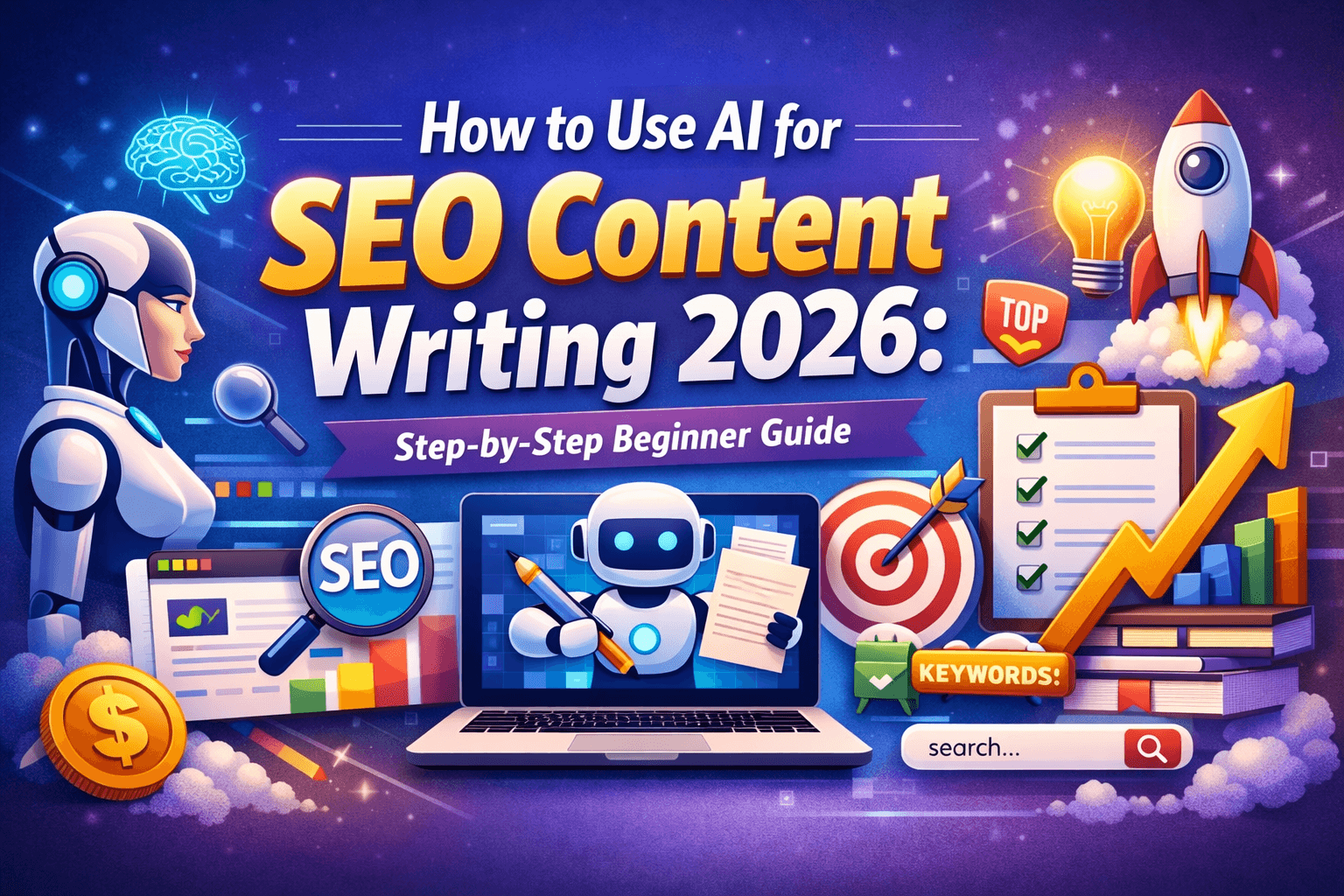
This guide explains step-by-step how to use AI for SEO content writing in a way that is both effective and aligned with modern search engine standards.
Step 1: Understanding Search Intent Before Using AI for SEO Content Writing
Before generating any content with AI, the most important step is understanding search intent, which refers to the reason behind a user’s query. In 2026, SEO is no longer just about keywords—it’s about satisfying user intent completely. If your content does not match what users are actually looking for, it will not rank, no matter how well it is written.
There are generally four types of search intent: informational, navigational, transactional, and commercial. For example, a search query like “how to use AI for SEO writing” clearly indicates informational intent, meaning the user wants a detailed guide rather than a sales pitch. When using AI tools, you must guide them with clear instructions that align with this intent, otherwise the output may become generic or irrelevant.
Taking a few minutes to analyze top-ranking pages on Google can help you understand what type of content is expected. This step ensures that your AI-generated content is aligned with real user needs rather than just assumptions.
Step 2: Keyword Research Using AI and SEO Tools
Keyword research remains a fundamental part of SEO, even in 2026. AI tools can assist in generating keyword ideas, but relying solely on AI without validation can lead to poor results. The best approach is to combine AI suggestions with professional SEO tools like Google Keyword Planner, Ahrefs, or SEMrush.
Start by identifying a primary keyword, such as “AI SEO content writing,” and then expand it into related keywords, long-tail variations, and questions. AI can help you brainstorm content ideas, but you should always check search volume, competition, and keyword difficulty before finalizing your list.
In addition to primary keywords, focus on semantic keywords and natural language phrases. Google’s algorithms now understand context much better, so stuffing exact-match keywords is no longer necessary. Instead, your goal should be to naturally cover the topic in depth using relevant terms.
Step 3: Creating a Content Outline with AI Assistance
One of the most effective ways to use AI is for generating structured content outlines. A well-organized outline ensures that your article flows logically and covers all necessary points. Instead of asking AI to write a full article immediately, start by prompting it to create headings and subheadings based on your target keyword.
For example, you can ask AI to generate a detailed outline including introduction, main sections, and FAQs. Once you have the outline, review it carefully and adjust it based on your understanding of the topic and competitor analysis.
This step is crucial because it allows you to maintain control over the content structure while still benefiting from AI’s speed and efficiency. A strong outline also improves readability and SEO performance by making your content easier to scan and understand.
Step 4: Generating Content with AI the Right Way
When it comes to writing the actual content, many beginners make the mistake of generating entire articles in one click. This often results in generic, repetitive, or shallow content that lacks depth and originality. In 2026, this approach is ineffective and can even harm your SEO performance.
Instead, generate content section by section. Provide clear and specific prompts for each heading, guiding the AI on tone, style, and depth. This ensures that each part of the article is well-developed and relevant.
For example, instead of saying “write an article about AI SEO,” you can say, “write a detailed paragraph explaining how AI helps in keyword research with practical examples.” This level of specificity significantly improves the quality of the output.
Step 5: Humanizing and Editing AI for SEO Content Writing
AI-generated content should never be published without proper editing. One of the biggest ranking factors in 2026 is content authenticity and human value, which means your content must feel natural, engaging, and insightful.
Editing involves improving sentence flow, adding personal insights, removing repetition, and ensuring clarity. You should also fact-check the information, as AI can sometimes produce outdated or incorrect details.
Adding examples, real-world applications, and simple explanations can make your content more relatable and useful. This human touch is what differentiates high-ranking content from generic AI-generated text.
Step 6: Optimizing Content for SEO
Once your content is written and edited, the next step is optimization. This includes placing your primary keyword in important areas such as the title, headings, introduction, and meta description, while keeping the usage natural.
In 2026, SEO optimization also includes:
- Improving readability
- Using short paragraphs and clear headings
- Adding internal and external links
- Optimizing images with alt text
- Ensuring mobile-friendliness
AI can assist with some of these tasks, but manual review is still necessary to ensure everything is properly aligned.
Step 7: Adding EEAT Signals (Experience, Expertise, Authority, Trust)
Google now strongly emphasizes EEAT (Experience, Expertise, Authority, and Trust) when ranking content. AI alone cannot create these signals—you need to add them manually.
You can improve EEAT by:
- Sharing personal insights or experiences
- Citing credible sources
- Writing in a confident and knowledgeable tone
- Keeping your content accurate and up to date
Even small additions, such as practical tips or real examples, can significantly enhance your content’s credibility.
Step 8: Publishing and Updating Content Regularly
Publishing your content is not the final step. In 2026, SEO success depends on continuous improvement. Search trends change, and content needs to be updated to remain relevant.
AI can help you refresh old content by suggesting updates, adding new sections, or improving readability. Regular updates signal to Google that your content is active and maintained, which can improve rankings over time.
Common Mistakes to Avoid When Using AI for SEO Content Writing
Many beginners misuse AI tools, which leads to poor results. Some common mistakes include:
- Publishing unedited AI content
- Ignoring search intent
- Overusing keywords unnaturally
- Relying completely on AI without human input
- Creating shallow or repetitive content
Avoiding these mistakes is essential for long-term SEO success.
Conclusion
Using AI for SEO content writing in 2026 is not about automation—it’s about smart collaboration between human creativity and machine efficiency. AI can help you research faster, write more efficiently, and optimize content better, but it cannot replace the human ability to understand audience needs and provide real value.
By following a structured approach—understanding search intent, conducting proper keyword research, creating strong outlines, generating content strategically, and adding human refinement—you can create high-quality, SEO-optimized content that performs well in search results.
For beginners, the key is to treat AI as a powerful assistant rather than a shortcut. When used correctly, it can significantly improve your productivity and help you build a strong foundation in SEO content writing that delivers long-term results.
Frequently Asked Questions.
1. Is AI content writing good for SEO in 2026?
Yes, AI content writing can be very effective for SEO in 2026, but only when used correctly. AI helps speed up research, generate ideas, and structure content efficiently, but it should not be used as a one-click solution. Search engines now prioritize helpful, user-focused content, so AI-generated text must be edited, refined, and enhanced with human insights to rank well.
2. Can AI-generated content rank on Google?
AI-generated content can rank on Google if it is high-quality, original, and properly optimized. Google does not penalize AI content itself; instead, it evaluates the usefulness and relevance of the content. If your article satisfies search intent, provides value, and feels natural to read, it has a strong chance of ranking regardless of how it was created.
3. How do beginners use AI for SEO content writing?
Beginners should start by using AI as a support tool rather than relying on it بالكامل. The best approach is to first research keywords, then create an outline, generate content section by section, and finally edit and optimize it manually. This step-by-step process ensures that the content remains structured, relevant, and aligned with SEO best practices.
4. What is the biggest mistake when using AI for SEO?
The most common mistake is publishing raw AI-generated content without editing. This often leads to generic, repetitive, or low-value articles that do not perform well in search rankings. Another major mistake is ignoring search intent, which results in content that does not match what users are actually looking for.
5. Do I need keyword research if I am using AI tools?
Yes, keyword research is still essential even when using AI. While AI can suggest ideas, it cannot always accurately determine search volume, competition, or ranking difficulty. Using proper SEO tools alongside AI ensures that your content targets the right keywords and has a better chance of ranking.
6. How can I make AI content sound more human?
To humanize AI content, you should edit the text by improving sentence flow, adding real examples, simplifying complex ideas, and removing repetition. Writing in a natural tone and including practical insights can make the content more engaging and relatable for readers.
7. Is AI content safe for AdSense approval?
Yes, AI content is safe for AdSense as long as it is high-quality, original, and valuable. Google does not reject content just because it is AI-assisted, but it will reject low-quality or copied content. Make sure your articles are well-written, informative, and properly structured before applying.
8. What type of AI content performs best in SEO?
Long-form, in-depth, and informative content performs best in SEO. Articles that fully cover a topic, answer user questions, and provide clear explanations tend to rank higher. Content that is structured with headings, easy to read, and optimized for user intent also performs better.
9. Can I fully automate SEO content writing with AI?
No, full automation is not recommended in 2026. While AI can handle many parts of content creation, human input is still necessary for quality control, fact-checking, and adding unique value. Fully automated content often lacks depth and authenticity, which can hurt SEO performance.
10. How long should AI-written SEO articles be?
The ideal length depends on the topic, but most SEO articles perform well when they are between 1000 to 2000+ words. The focus should be on covering the topic completely rather than hitting a specific word count. Detailed and well-explained content usually ranks better.
11. Which AI tools are best for SEO content writing?
There are many AI tools available, including ChatGPT, Jasper, Copy.ai, and others. The best tool depends on your needs, but the key is not the tool itself—it’s how you use it. Proper prompting, editing, and optimization matter more than the specific platform.
12. How do I optimize AI content for better rankings?
To optimize AI content, include your main keyword naturally in the title, headings, and introduction. Use related keywords throughout the content, improve readability, add internal links, and ensure your content is mobile-friendly. Proper formatting and structure also play a big role.
13. What is EEAT, and why is it important in AI content?
EEAT stands for Experience, Expertise, Authority, and Trust. It is a key ranking factor in Google’s algorithm. AI content must be enhanced with real insights, accurate information, and a trustworthy tone to meet EEAT standards and perform well in search results.
14. How often should I update AI-generated content?
You should review and update your content regularly, especially if it covers topics that change over time. Updating content with new information, improved structure, and better optimization helps maintain rankings and improve long-term SEO performance.
15. What is the best strategy for using AI in SEO writing?
The best strategy is to combine AI efficiency with human creativity. Use AI for research, outlining, and drafting, but always refine the content manually. Focus on user value, clear structure, and proper SEO practices to create content that ranks and engages readers effectively.