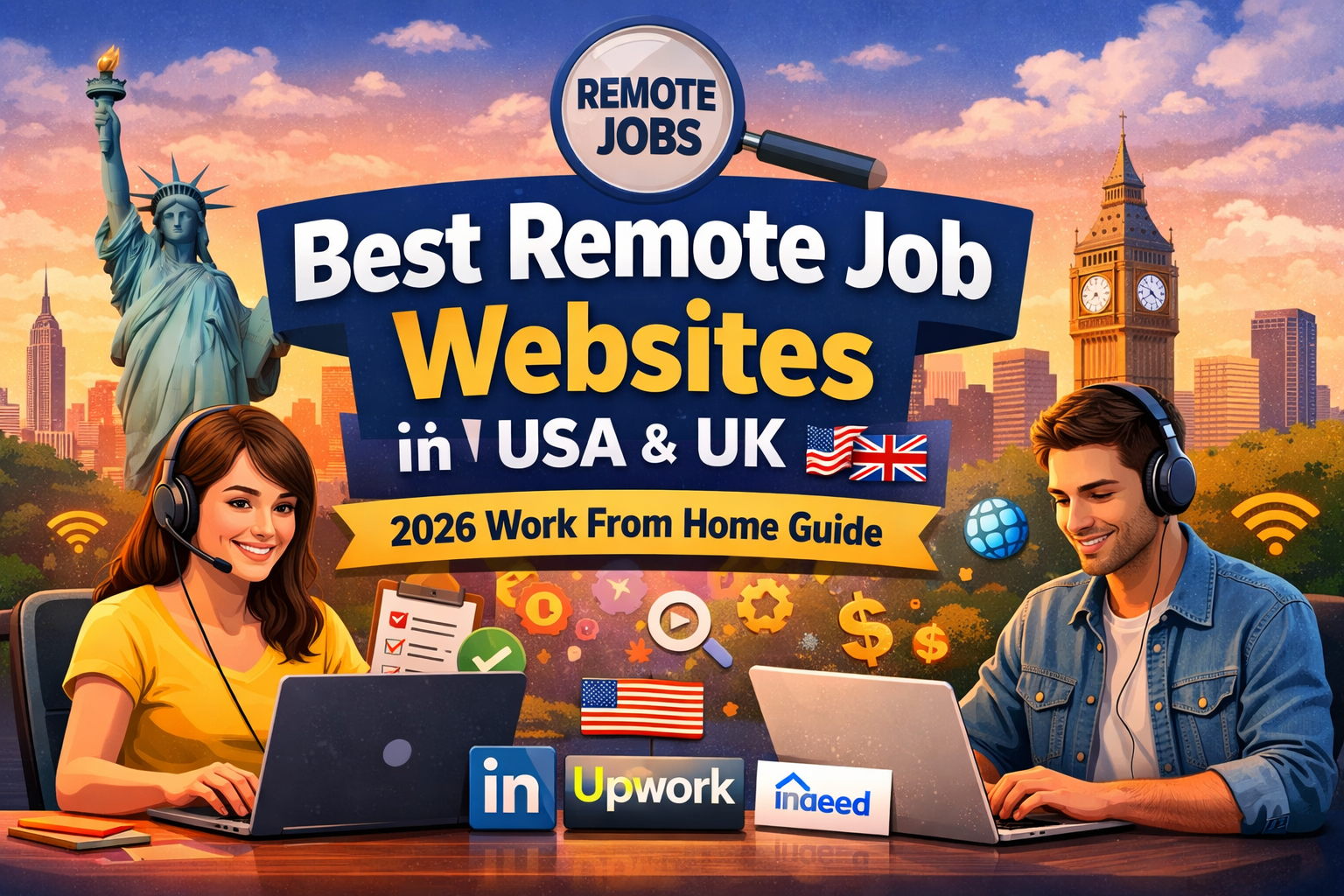
Best Remote Job Websites in USA & UK (2026 Work From Home Guide)
Best Remote Job Websites in USA & UK (2026 Work From Home Guide)
Introduction: The Future of Work Is Remote
Let me ask you something.
Have you ever sat in rush hour traffic, watching the minutes tick by, wondering why you’re spending two hours of your day just driving to a building you don’t want to be in? I have. And it’s exhausting.
By 2026, remote work isn’t some futuristic dream anymore. It’s reality. Millions of people in the USA and UK are already working from home, from coffee shops, from anywhere they want. Companies have finally realized something obvious: you don’t need a cubicle to do great work.
But here’s the problem.
With so many remote job websites out there, it’s hard to know which ones are actually legit. Some are filled with low-quality listings. Others are straight-up scams. And if you’re just starting out, wasting time on the wrong platforms can kill your motivation fast.
I’ve been there. I’ve applied to jobs that never replied. I’ve clicked on “too good to be true” posts that were exactly that. Fake.
That’s why I put together this guide.
You’re about to discover the best remote job websites in the USA and UK for 2026. No fluff. No outdated lists. Just the platforms that actually work, based on real experience and current market data.
Whether you’re a complete beginner or an experienced professional looking to escape the office, these websites will help you find legitimate, high-paying work-from-home opportunities.
Let’s get started.
Over the past few years, the way people work has changed significantly. By 2026, remote work is no longer just a trend—it will have become a global standard. Companies across the USA and UK are increasingly adopting flexible work environments, allowing employees to work from home, coffee shops, or anywhere in the world.
Remote job websites have made it easier than ever for professionals to find work online. Whether you’re a freelancer, a full-time job seeker, or a beginner starting your career, these platforms open the door to countless opportunities.
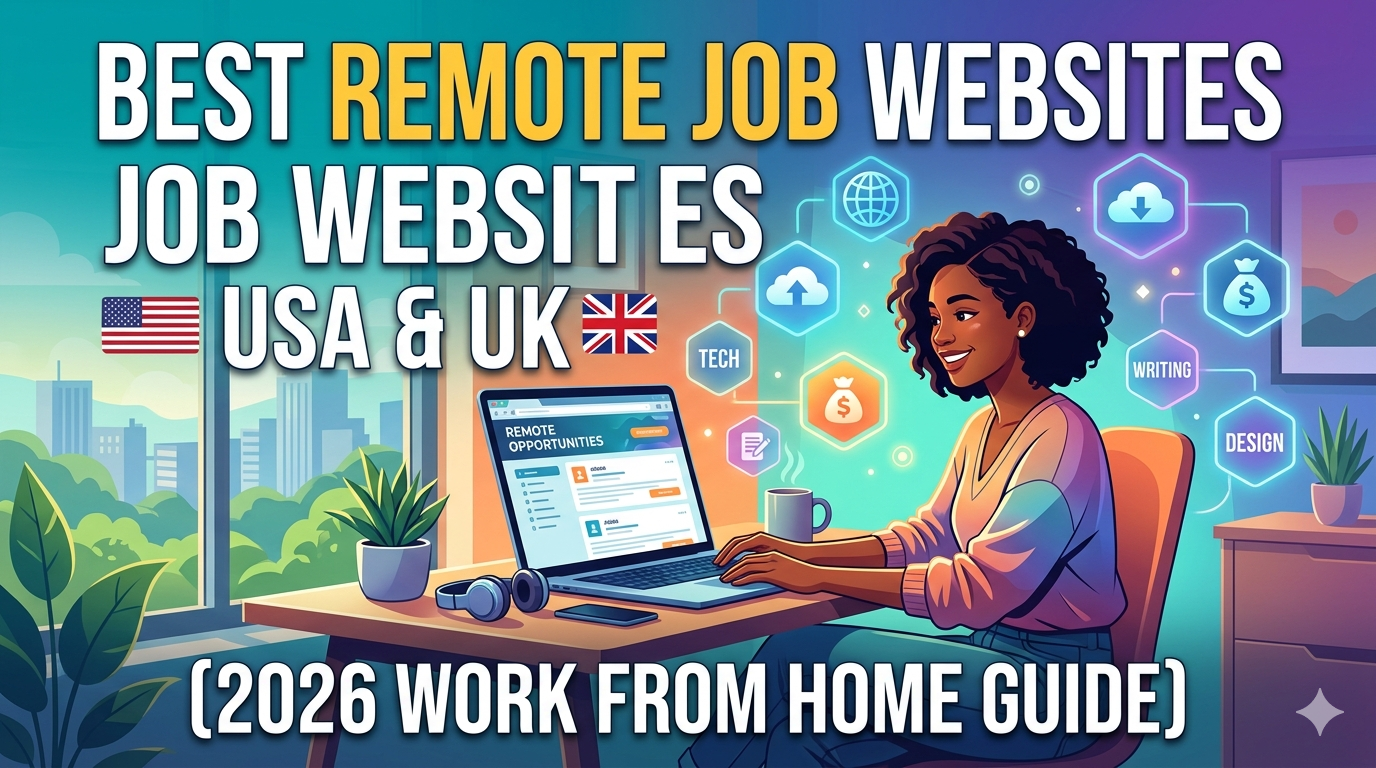
However, with so many platforms available, finding legitimate and high-paying remote jobs can be overwhelming. Many people struggle with low-quality listings or scams. That’s why choosing the right platform is essential if you want to succeed in the remote job market.
In this comprehensive 2026 guide, you’ll discover the best remote job websites in the USA and UK, along with practical tips to help you build a successful work-from-home career.
Why Remote Jobs Are Booming in 2026
Remote jobs are growing rapidly in both the USA and the UK for several key reasons.
First, companies are reducing costs by hiring remote employees instead of maintaining expensive office spaces. Second, modern tools like Slack, Zoom, and project management software make communication and collaboration seamless. Third, employees prefer remote work because it offers better work-life balance, less commuting stress, and higher productivity.
As a result, companies across industries—including technology, marketing, customer service, writing, and design—are actively hiring remote workers.
1. Upwork – Best for Freelancers and Beginners
Upwork is one of the most popular freelancing platforms globally. It connects clients from the USA and UK with freelancers offering services such as writing, graphic design, web development, and more.
Beginners can start with small projects and gradually build their profiles, while experienced freelancers can secure long-term, high-paying contracts. However, competition is strong, so creating a professional profile and writing customized proposals is essential.
2. Fiverr – Best for Selling Digital Services
Fiverr allows freelancers to create service listings (called “gigs”) that clients can purchase directly. Services start at $5 but can scale to hundreds or even thousands of dollars.
It’s especially popular for creative services like logo design, video editing, SEO, and content writing. Fiverr is beginner-friendly because you don’t need to apply for jobs—clients come to you.
3. LinkedIn Jobs – Best for Professional Remote Roles
LinkedIn has evolved into one of the best platforms for finding high-quality remote jobs. Many companies in the USA and UK post remote positions directly on LinkedIn.
It’s ideal for professionals seeking full-time roles in fields like IT, marketing, finance, and management. By optimizing your profile and using the “Remote” filter, you can find opportunities tailored to your skills.
4. Indeed – Best for Large Job Listings
Indeed is one of the largest job search engines in the world. It gathers job listings from multiple sources, making it a powerful platform for finding remote jobs.
You can search using keywords like “remote” or “work from home” and apply to multiple jobs quickly. However, always review listings carefully to avoid low-quality or irrelevant opportunities.
5. FlexJobs – Best for Verified Remote Jobs
FlexJobs is a premium platform known for providing 100% verified remote and flexible job listings. Every job is screened to ensure it’s legitimate and scam-free.
Although it requires a subscription, many users find it worth the cost due to the high-quality opportunities available across various industries.
6. Remote.co – Best for Fully Remote Companies
Remote.co focuses entirely on remote work opportunities. It features companies that operate fully remotely, making it ideal for long-term remote careers.
The platform also provides helpful resources and insights about remote work culture.
7. We Work Remotely – Best for Tech Jobs
We Work Remotely is one of the largest remote job boards, especially popular in the tech industry. Companies frequently post jobs for developers, designers, and product managers.
You don’t need an account to browse jobs, making it easy to start applying right away.
8. PeoplePerHour – Best for UK-Based Freelancers
PeoplePerHour is widely used in the UK and Europe. It connects freelancers with businesses looking for services like writing, SEO, and web development.
It offers both project-based and hourly work, making it a great option for freelancers targeting UK clients.
9. Toptal – Best for High-End Professionals
Toptal is a premium platform that connects top freelancers with elite clients. It has a strict screening process, accepting only a small percentage of applicants.
If you have advanced skills in software development, finance, or design, Toptal can offer very high-paying opportunities.
10. Guru – Best Alternative Freelance Platform
Guru is another reliable freelancing platform with flexible payment options and a wide range of job categories. It is generally less competitive than Upwork, making it easier for beginners to get started.
How to Choose the Right Remote Job Website
Choosing the right platform depends on your skills, experience, and goals.
- Beginners should start with Fiverr or Upwork
- Professionals should focus on LinkedIn and Indeed
- For verified listings, FlexJobs is a great option
Using multiple platforms is a smart strategy, as it increases your chances of finding better opportunities.
Tips to Succeed in Remote Jobs (2026 Strategy)
To succeed in the remote job market, you need more than just skills.
First, create a strong and professional profile that highlights your expertise. Use relevant keywords to improve visibility.
Second, build a solid portfolio. Clients want to see real examples of your work before hiring you.
Third, improve your communication skills. Clear and professional communication is essential in remote work.
Finally, stay consistent. Apply regularly, keep learning new skills, and update your profile frequently.
Common Mistakes to Avoid on Remote Job Websites in the USA & UK
Many beginners make avoidable mistakes when searching for remote jobs.
Sending generic proposals is one of the biggest errors. Always customize your applications.
Ignoring skill development is another mistake. The remote job market is highly competitive, so continuous learning is necessary.
Also, avoid platforms or offers that seem too good to be true. Stick to trusted websites to stay safe from scams.
Conclusion: Start Your Remote Career Today
Conclusion: Start Your Remote Career Today (No More Excuses)
Let me be real with you for a second.
For years, I believed remote work was only for tech geniuses or people with fancy degrees. I was wrong.
Today, in 2026, remote work isn’t some exclusive club. It’s open to anyone willing to learn, apply, and stay consistent. Whether you live in New York, London, Texas, or a small town in the Midwest, if you have an internet connection, you have an opportunity.
But here’s what most people won’t tell you.
You won’t land your dream remote job overnight. You’ll face rejection. You’ll send applications that never get replies. You might even doubt yourself along the way.
That’s normal. That’s part of the process.
The difference between those who succeed and those who quit is simple: they keep going.
The Truth About Remote Work in 2026
Remote work is no longer the future. It’s the present.
Companies across the USA and UK have embraced work-from-home culture permanently. They’re actively hiring remote workers for roles in customer service, tech support, writing, virtual assistance, marketing, and hundreds of other fields.
The websites I’ve shared with you in this guide – Upwork, Fiverr, LinkedIn Jobs, Indeed, FlexJobs, Remote.co, and We Work Remotely – are proven platforms. Thousands of people land legitimate, high-paying jobs on these sites every single month.
But here’s the catch.
A website alone won’t do the work for you. You have to show up.
Your Action Plan for the Next 7 Days
Stop reading and start doing. Here’s exactly what you need to do this week:
| Day | Action |
|---|---|
| Day 1 | Pick 2-3 websites from this guide. Create complete profiles. |
| Day 2 | List your skills. If you’re missing any, start a free course today. |
| Day 3 | Apply to 5 jobs. Customize every application. No copy-paste. |
| Day 4 | Follow up with applications from Day 3. |
| Day 5 | Learn one new skill relevant to your target job. |
| Day 6 | Apply to 5 more jobs. Refine your proposals. |
| Day 7 | Review your week. Celebrate small wins. Repeat. |
Small, consistent actions beat waiting for “perfect” every single time.
Remote work is no longer the future—it’s the present. With the right approach and the right platforms, anyone can build a successful online career in 2026.
Whether you are just starting out or already experienced, the websites listed in this guide can help you find legitimate, high-paying remote jobs in the USA and UK.
The key is to take action. Create your profile, start applying, and stay consistent. With time and effort, remote work can become a stable and rewarding career.
Frequently Asked Questions (FAQs) About Remote Job Websites in USA & UK
1. What are the best websites for remote jobs in the USA and UK?
Let me save you hours of research.
The best and most trusted platforms right now in 2026 are Upwork, Fiverr, LinkedIn Jobs, Indeed, FlexJobs, Remote.co, and We Work Remotely.
Here’s the quick breakdown:
| Website | Best For | Cost |
|---|---|---|
| Upwork | Freelancers, long-term projects | Free |
| Fiverr | Selling services starting at $5 | Free |
| LinkedIn Jobs | Professional full-time remote roles | Free |
| Indeed | All types of remote jobs | Free |
| FlexJobs | Screened, scam-free listings | Paid (worth it) |
| Remote.co | Curated remote-first companies | Free |
| We Work Remotely | Tech and creative roles | Free |
Start with 2-3 of these. Don’t overwhelm yourself by signing up for all seven at once.
2. Can beginners get remote jobs with no experience?
Yes. 100%. I promise you.
Every single expert on these platforms started exactly where you are right now – with zero experience, zero reviews, and zero confidence.
Here’s how you do it:
-
Start with small, low-paying projects (5−20)
-
Deliver amazing work every single time
-
Collect 5-star reviews
-
Raise your prices slowly
-
Repeat the process
Within 3-6 months, you’ll have a solid profile and consistent income. No degree required. No experience needed. Just willingness to learn and deliver.
3. Are remote jobs legitimate? How do I avoid scams?
Most jobs on the trusted websites I’ve listed are completely legitimate.
But let me be honest with you. Scams exist everywhere – even on LinkedIn and Indeed.
Here’s how to protect yourself:
Red Flags to Watch For:
-
Someone asks you to pay money to get a job
-
They want your bank details before you start working
-
The pay is “too good to be true” (like $5,000/week for basic data entry)
-
They communicate only on WhatsApp or Telegram
-
No video interview – just instant “hiring.”
Green Flags to Trust:
-
Clear job description
-
Reasonable pay for the work
-
The company has a website and online presence
-
They agree to use the platform’s payment system (Escrow, Upwork Protection)
-
Video interview with real people
Trust your gut. If something feels off, walk away. There are thousands of legitimate jobs out there.
4. What skills are most in demand for remote jobs in 2026?
The market has changed. Here’s what USA and UK employers are actually hiring for right now:
| Skill Category | Specific Skills | Demand Level |
|---|---|---|
| AI & Automation | ChatGPT, Make.com, Zapier, AI prompting | 🔥 Very High |
| Content Creation | Blog writing, copywriting, video scripts | 🔥 High |
| Digital Marketing | SEO, social media, email marketing | 🔥 High |
| Design | Graphic design, Canva, video editing | ✅ Medium-High |
| Development | Web design, WordPress, basic coding | ✅ Medium |
| Virtual Assistance | Admin, email management, scheduling | ✅ Medium |
| Customer Support | Chat support, email support | ✅ Medium |
My advice? Pick ONE skill from this list. Get really good at it. Then start applying. Don’t try to learn everything at once.
5. How much can I really earn from remote jobs?
Let’s talk money honestly.
Your earnings depend on three things: your skill level, your niche, and your consistency.
Here’s a realistic breakdown for 2026:
| Experience Level | Hourly Rate (USD) | Monthly Income (Full-Time) |
|---|---|---|
| Beginner (0-3 months) | 5–15 | 500–2,000 |
| Intermediate (3-12 months) | 15–35 | 2,000–5,000 |
| Advanced (1-3 years) | 35–75 | 5,000–10,000 |
| Expert (3+ years) | 75–150+ | 10,000–20,000+ |
Can you earn more? Yes. Some freelancers charge $200+/hour for specialized skills like AI consulting or high-end development.
But don’t focus on the maximum. Focus on getting your first 100.Then500. Then $1,000. Small wins build momentum.
6. Do I need a degree to get a remote job?
No. Let me say it again. No.
I don’t have a tech degree. Most successful remote workers I know don’t either.
Companies in 2026 care about one thing: can you do the job?
A degree might help for certain fields like medicine, law, or engineering. But for the majority of remote jobs – writing, design, marketing, virtual assistance, customer support, AI tools – your portfolio and reviews matter way more than any diploma.
Here’s what matters instead of a degree:
-
A strong profile with clear skills listed
-
Samples of your work (even if they’re personal projects)
-
Good reviews from clients (start small to get them)
-
Communication skills (respond fast, speak clearly)
-
Reliability (meet deadlines every single time)
Focus on building these. A degree is optional.
7. How long does it take to get my first remote job?
This is the question everyone asks. Here’s the honest answer.
| Effort Level | Time to First Job |
|---|---|
| Full-time (40 hours/week applying + learning) | 1-3 weeks |
| Part-time (15-20 hours/week) | 3-6 weeks |
| Weekends only (5-10 hours/week) | 6-12 weeks |
But here’s what most people won’t tell you.
Your first job won’t be perfect. It might pay $10 for a small task. That’s fine. The goal is not money in the beginning. The goal is your first 5-star review.
Once you have that review, getting the next job becomes 10x easier.
So don’t worry if it takes time. Every application you send is practice. Every rejection teaches you something. Keep going.
8. Can I work remote jobs from outside the USA or UK?
Yes, but with some conditions.
Many USA and UK companies hire remote workers from anywhere in the world. However, some restrict hiring to their own country due to tax laws and time zone requirements.
What to check before applying:
-
Does the job posting say “USA only” or “UK only”?
-
Does the company mention “must work within EST/CST/PST hours”?
-
Does the platform allow international payments?
Best platforms for international remote workers:
-
Upwork (global)
-
Fiverr (global)
-
Remote.co (global)
-
We Work Remotely (global)
If you live in Pakistan, India, Philippines, or any other country – you can absolutely work for USA and UK clients. Millions of people do it every single day.
9. Should I use paid remote job websites like FlexJobs?
Good question. Here’s my honest take.
FlexJobs charges a fee (around 15−25/month). In return, they screen every single job listing. No scams. No low-quality posts. Just legitimate remote opportunities.
When to use paid sites:
-
You’ve been scammed before or you’re worried about scams
-
You want to save time (no filtering through fake posts)
-
You’re looking for serious, full-time roles with established companies
When to skip paid sites:
-
You’re just starting out and want to test the waters
-
You prefer freelance platforms like Upwork and Fiverr
-
You’re on a tight budget
Start with free platforms first. If you’re serious and frustrated with low-quality listings, then invest in FlexJobs. It’s worth every penny for the right person.
10. What’s the single best piece of advice for remote job success?
If you take nothing else from this guide, remember this one thing.
Be the person who replies fast and delivers early.
Here’s why.
Most remote workers are slow. They take hours to reply to messages. They submit work at 11:59 PM on the deadline day.
If you reply within 5 minutes and deliver 24 hours early every single time, you’ll stand out more than any skill or degree ever could.
Clients remember speed and reliability. They will hire you again. They will refer you to others. They will pay you more.
Speed + quality + consistency = unstoppable.
Stop overthinking. Start applying. Be fast. Deliver early. Watch what happens.
Ready to Start Your Remote Career?
You now have answers to the most common questions. No fluff. Just honest, actionable advice.
The only thing left is action.
Pick one platform from this guide. Create your profile today. Send your first proposal this week.
You’ve got this. 🚀