
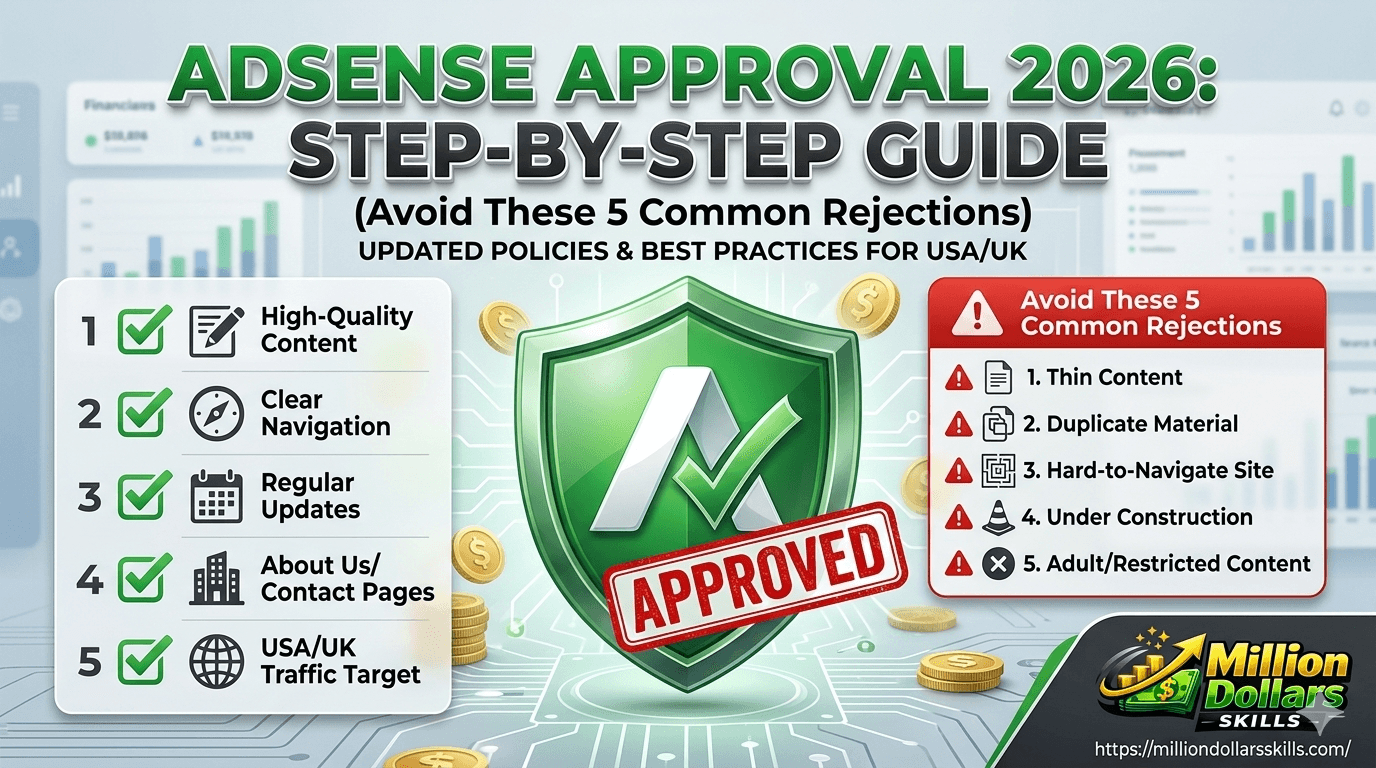
AdSense Approval 2026: The Step-by-Step Guide (Avoid These 5 Common Rejections)
AdSense Approval 2026: The Step-by-Step Guide (Avoid These 5 Common Rejections)
Getting approved for Google AdSense in 2026 is no longer as simple as launching a website and applying right away. Google has significantly tightened its policies to prioritize quality, authenticity, and user experience. If you’re serious about monetizing your website with AdSense, you need a structured approach that aligns with current standards. This guide walks you through every step while also highlighting the most common mistakes that lead to rejection—so you can avoid them entirely for getting AdSense Approval 2026.
If you’ve been staring at a “Low Value Content” rejection or feel like the goalposts for monetization keep moving, you aren’t alone. With Google’s latest emphasis on helpful content and authentic user experience, the standard for entry has shifted. But here’s the good news for AdSense Approval 2026: getting that green light isn’t about having a million visitors; it’s about having a rock-solid foundation. In this guide, we’re cutting through the noise to give you a definitive, step-by-step roadmap to AdSense approval, specifically designed to help you bypass the 5 most common pitfalls that stop most bloggers in their tracks.
Understanding Google AdSense in 2026
Google AdSense remains one of the most reliable ways to monetize a website, but its approval process now reflects Google’s broader focus on helpful, people-first content. The platform evaluates not just your content, but your site structure, credibility, and overall user experience.
In simple terms, AdSense wants to ensure that your website provides real value. Thin, automated, or low-effort content is quickly filtered out. Instead, Google favors websites that demonstrate expertise, originality, and trustworthiness.
Step 1: Choose a Niche with Real Value
Before writing a single article, your niche selection matters more than ever. Many applicants fail because their content lacks focus or targets oversaturated topics without offering anything new.
A strong niche should:
- Solve specific problems for a defined audience
- Allow consistent content creation
- Have long-term relevance
- Offer monetization potential beyond AdSense
Instead of broad niches like “health” or “technology,” aim for something more targeted, such as “home workouts for busy professionals” or “budget tech setups for students.” This clarity helps both readers and search engines understand your website.
Step 2: Build a Professional Website
Your website is your first impression, and AdSense reviewers evaluate it carefully. A poorly designed or incomplete site is one of the fastest ways to get rejected.
Make sure your website includes:
- A clean, mobile-friendly design
- Fast loading speed
- Easy navigation
- No broken links or empty pages
Use a reliable CMS like WordPress and choose a lightweight theme. Avoid cluttered layouts and excessive pop-ups. Your goal is to create a smooth and distraction-free user experience.
Step 3: Create High-Quality, Original Content
Content is the core of AdSense approval. Google looks for originality, depth, and usefulness. Publishing a few generic articles will not be enough.
To meet AdSense standards:
- Write at least 15–25 high-quality articles
- Each article should be 800–1500+ words
- Ensure content is 100% original and plagiarism-free
- Focus on solving real user problems
Your writing should feel natural and engaging, not robotic or overly optimized. Avoid keyword stuffing and instead focus on clarity, readability, and value.
Step 4: Optimize for SEO Without Overdoing It
SEO is important, but over-optimization can hurt your chances. Google’s algorithm in 2026 prioritizes user intent and content quality over technical tricks.
Follow these best practices:
- Use relevant keywords naturally
- Write compelling titles and meta descriptions
- Structure content with headings (H1, H2, H3)
- Add internal links between related articles
- Use descriptive alt text for images
Good SEO should enhance your content, not dominate it. Write for people first, then refine for search engines.
Step 5: Add Essential Pages
Many AdSense applications are rejected simply because the website lacks basic legal and informational pages. These pages build trust and show professionalism.
Make sure your site includes:
- About Us
- Contact Us
- Privacy Policy
- Terms and Conditions
- Disclaimer (if applicable)
These pages don’t need to be overly complex, but they should be clear and accessible from your homepage. If you fulfill the above criteria, you must hear the good news from Google about AdSense Approval 2026.
Step 6: Ensure Content Compliance
AdSense has strict content policies. Even a single violation can result in rejection.
Avoid publishing:
- Copyrighted material without permission
- Adult or explicit content
- Hate speech or harmful content
- Misleading or deceptive information
- Excessive affiliate links or spammy promotions
Your website should maintain a safe and respectful environment for users.
Step 7: Build Traffic Before Applying
While AdSense does not officially require a minimum amount of traffic, having some consistent visitors increases your chances of approval.
Focus on:
- Organic traffic through SEO
- Sharing content on social media
- Building an email list
- Engaging with your audience
Even a small but steady flow of traffic shows that your website is active and valuable.
Step 8: Apply for AdSense the Right Way
Once your site is fully prepared, you can submit your application.
Before applying, double-check:
- All pages are complete
- No placeholder or duplicate content exists
- Navigation is working properly
- Content is indexed by Google
After submission, the review process can take anywhere from a few days to a few weeks and you will be glad to know about AdSense Approval 2026.
Avoid These 5 Common AdSense Rejections
Even well-designed websites get rejected due to avoidable mistakes. Understanding these common issues can save you time and frustration.
1. Thin or Low-Quality Content and get AdSense Approval 2026
One of the biggest reasons for rejection is insufficient or low-value content. Articles that are too short, repetitive, or generic fail to meet Google’s standards.
Solution: Focus on depth, clarity, and usefulness. Each article should provide real insights or solutions.
2. Lack of Website Structure
A disorganized website signals poor user experience. Missing menus, unclear navigation, or incomplete pages can lead to rejection.
Solution: Ensure your site is easy to navigate, with clear categories and a logical structure.
3. Policy Violations
Even unintentional violations—such as using copyrighted images—can result in rejection.
Solution: Use royalty-free images, write original content, and review AdSense policies carefully.
4. Insufficient Content Pages
Applying with only a handful of articles is a common mistake.
Solution: Build a solid content base before applying. Aim for at least 15 high-quality posts.
5. Poor User Experience
Slow loading times, intrusive ads, or cluttered layouts can harm your chances.
Solution: Optimize your website for speed, simplicity, and usability.
Final Thoughts
Getting AdSense approval in 2026 requires more than just meeting basic requirements—it demands a thoughtful, user-first approach. By focusing on high-quality content, a clean website structure, and full policy compliance, you significantly increase your chances of success.
Instead of rushing the process, take the time to build a strong foundation. A well-prepared website not only gets approved faster but also performs better in the long run. If you follow the steps outlined in this guide and avoid the common mistakes, AdSense approval becomes much more achievable. Focus on creating real value, and the results will follow.
Getting your AdSense “Site is ready to show ads” notification is a massive milestone, but it’s just the beginning of your digital journey. In 2026, the websites that win are those that treat their readers like people, not just traffic statistics. By implementing these steps, you aren’t just ticking boxes for an algorithm—you are building a high-value asset that offers genuine solutions to the freelance and SEO community.
We know the AdSense Approval 2026 can feel like a “black box” sometimes. If you’ve faced a rejection or have a specific question about the new 2026 policies, drop a comment below. Let’s discuss your site’s journey and get you over the finish line together.
Don’t forget to bookmark this guide as your go-to checklist for future niche sites!
Frequently Asked Questions (FAQs) – AdSense Approval 2026 Guide
1. How long does Google AdSense approval take in 2026?
The approval time for Google AdSense in 2026 usually ranges from a few days to up to 2–4 weeks. In some cases, it may take longer if your website needs improvements. The speed of approval depends on your content quality, website structure, and overall compliance with AdSense policies.
2. How many articles do I need before applying for AdSense?
There is no official fixed number, but most successful websites have at least 15 to 25 high-quality articles before applying. The focus should not be on quantity alone but on depth, originality, and usefulness. Each article should provide real value to readers instead of being short or repetitive.
3. Can I get AdSense approval with low traffic?
Yes, you can still get AdSense approval even if your website has low traffic. Google does not require a minimum traffic threshold. However, having some consistent visitors can improve your chances because it shows that your content is useful and being discovered organically.
4. Why does Google AdSense reject websites?
Google AdSense usually rejects websites for reasons such as low-quality content, lack of important pages (like Privacy Policy or About page), poor website design, policy violations, or insufficient content. Another major reason is websites that look incomplete or provide little value to users.
5. What type of content is not allowed for AdSense approval?
AdSense does not approve websites that contain copyrighted material, adult content, violent or harmful content, misleading information, or spammy affiliate pages. Your website must follow Google’s content policies strictly to qualify for approval.
6. Do I need SEO for AdSense approval?
SEO is not a strict requirement for approval, but it strongly improves your chances. Proper SEO helps Google understand your website structure, improves visibility, and ensures your content is well-organized and user-friendly. However, avoid over-optimization or keyword stuffing.
7. Is a custom domain required for AdSense approval?
Yes, having a custom domain (like .com, .net, or .org) significantly improves your chances of approval. While some platforms may allow subdomains, a professional custom domain builds trust and shows that your website is serious and credible.
8. Can I apply for AdSense with a new website?
Yes, you can apply with a new website, but it must be fully developed first. This means it should have enough original content, proper navigation, essential pages, and a clean design. Applying too early with an incomplete site often leads to rejection.
9. What are the most important pages for AdSense approval?
The most important pages include About Us, Contact Us, Privacy Policy, Terms and Conditions, and Disclaimer. These pages help build trust and show that your website is transparent and professionally managed.
10. How can I improve my chances of AdSense approval?
To improve your chances, focus on writing high-quality original content, maintaining a clean website design, ensuring fast loading speed, adding essential pages, and following Google’s content policies. Consistency and quality are more important than shortcuts.






One Comment