
10 Remote Jobs for Beginners 2026 (No Degree, No Experience Needed)
10 Remote Jobs for Beginners 2026 (No Degree, No Experience Needed)
Introduction: Your Dream Job Is Closer Than You Think
Let me tell you something that might surprise you. You do not need a four-year degree to build a successful career. You do not need ten years of experience to earn a living wage. And you absolutely do not need to spend thousands of dollars on certifications that may never pay off. What you actually need is a simple list of opportunities, a little bit of guidance, and the courage to take the first step.
Every single day, thousands of people just like you sit in front of their computers, scrolling through job boards, feeling defeated before they even begin. They see “Bachelor’s degree required” and click away. They see “3+ years of experience” and close the tab. They convince themselves that remote work is only for tech geniuses with fancy diplomas. That belief is completely false. In fact, it is one of the biggest lies the traditional job market has sold to honest, hardworking people.
The year 2026 has brought a massive shift in how companies hire. Businesses have finally realized that degrees do not guarantee competence. Experience does not always mean excellence. What actually matters is whether you can show up on time, follow instructions, communicate clearly, and solve problems as they appear. These are not skills you learn in a university lecture hall. These are skills you develop by simply being a responsible human being. In this article, I have tried my best to raise awareness among the masses about the best Remote Jobs for beginners in 2026
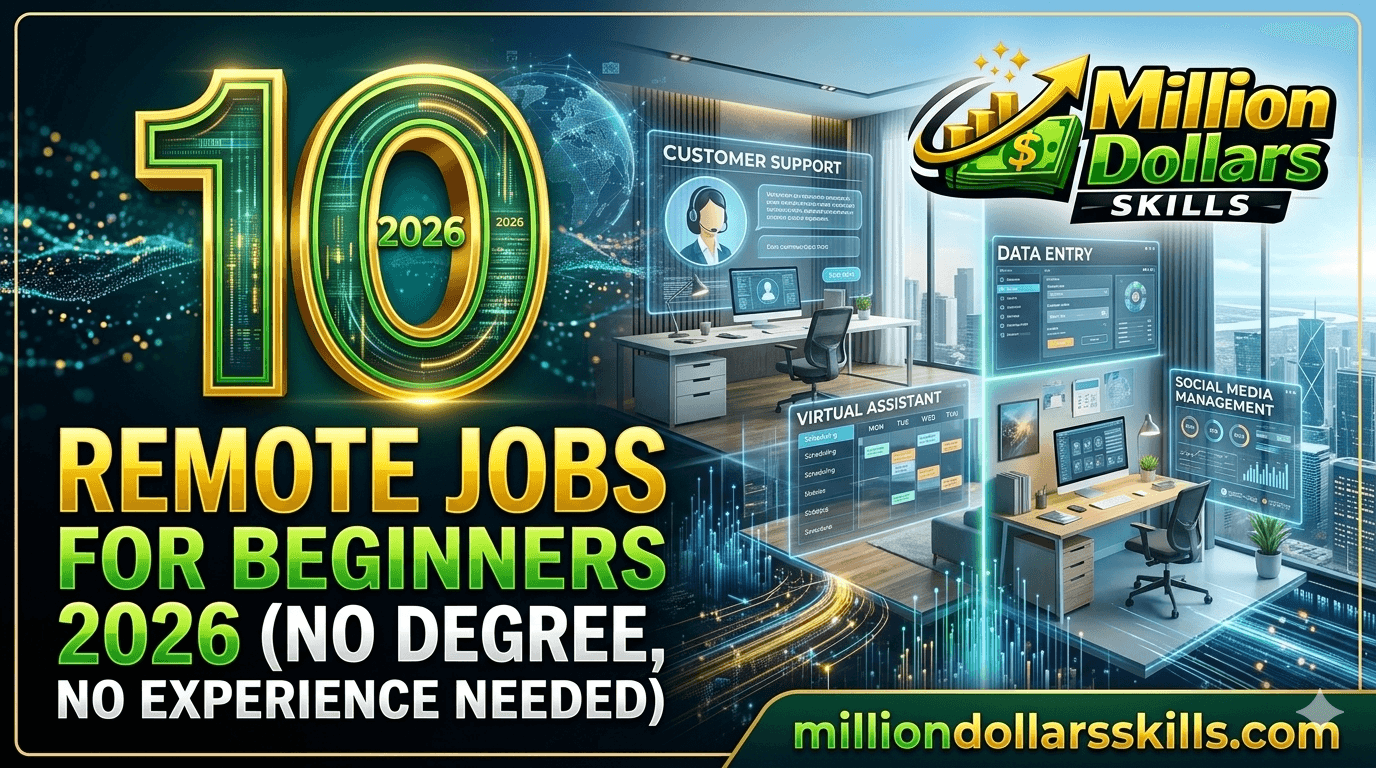
In this guide, we will walk you through ten legitimate remote jobs that require no degree and no prior experience. Each opportunity has been researched, verified, and ranked based on real hiring data from 2026. You will learn exactly what each job involves, how much money you can expect to earn, where to find these positions, and most importantly, how to apply without feeling embarrassed about your empty resume.
If you are looking to supplement your remote job with automated earnings, this comprehensive guide offers a roadmap to reaching $1,000 per month. It is an essential resource for those seeking financial freedom through sustainable side hustles alongside their professional careers. Recommended Reading: 15+ Best Passive Income Ideas for Beginners in 2026
Securing a premium remote role requires staying ahead of market trends, making it vital to master high-demand technical and creative skills. This article identifies the most lucrative skills for 2026, helping you significantly increase your market value and earning potential. Must Check: Top 10+ High-Paying Freelance Skills in the USA (2026 Guide)
Your lack of a degree is not a life sentence. Your missing experience is not a permanent condition. They are simply your starting point. And today, we are going to change that starting point forever. Let us begin.
Why 2026 Is the Best Year to Start Working Remotely
Before we dive into the actual jobs, let us take a moment to understand why this particular moment in history is so special for beginners. The remote work revolution was already underway before 2020, but the pandemic forced every company on earth to experiment with work-from-home arrangements. What did they discover? They discovered that employees are actually more productive at home. They discovered that office leases are incredibly expensive and largely unnecessary. They discovered that talent exists everywhere, not just within commuting distance of a downtown skyscraper.
Those discoveries have permanently changed the hiring landscape. According to recent data from FlexJobs, a leading remote job platform, over 35 percent of all job postings in 2026 are fully remote. That is up from just 5 percent in 2019. Even more encouraging for beginners, the same data shows that entry-level remote positions have increased by nearly 200 percent over the last two years alone.
What does this mean for you? It means that companies are no longer demanding degrees for roles that never needed them in the first place. A customer support representative does not need a bachelor’s degree to answer emails and resolve complaints. A data entry clerk does not need a master’s degree to type numbers into a spreadsheet. A virtual assistant does not need a diploma to schedule meetings and organize files. The only reason these requirements existed before was that employers could afford to be picky. Now, with the talent pool spread across the entire planet, they have become much more reasonable.
The second major trend working in your favor is the rise of skills-based hiring. Progressive companies have abandoned the outdated practice of screening candidates by their educational credentials. Instead, they ask you to complete a small paid trial task. Can you write a professional email? Can you follow a simple set of instructions? Can you communicate clearly without constant supervision? If you answer yes to these questions, you are qualified for dozens of remote roles, regardless of what your resume says.
Finally, the explosion of artificial intelligence tools has actually created more entry-level jobs, not fewer. Companies need humans to train AI models, review AI outputs, and handle the tasks that automation still cannot manage. These roles often have zero experience requirements because the field is so new that nobody has experience in it. This is your golden opportunity to get in on the ground floor of an industry that is only going to grow larger.
With that context established, let us now explore the ten specific jobs that will change your financial future. Here are the best remote jobs for beginners with no experience required.
Job #1: Customer Support Representative
Customer support is the backbone of the remote economy. Every company that sells products or services needs someone to answer questions, troubleshoot problems, and keep customers from leaving angry reviews. The beautiful thing about customer support is that companies care far more about your communication skills and your attitude than they care about your credentials.
What You Will Actually Do:
You will handle incoming inquiries through email, live chat, or phone calls. Most of the time, you will follow prepared scripts or knowledge base articles to resolve common issues. When a customer asks about shipping times, you will check their order status and provide an update. When someone cannot log into their account, you will guide them through the password reset process. When a customer has a complaint, you will listen patiently, apologize sincerely, and offer a solution within your allowed limits. That is essentially the entire job description.
The overwhelming majority of customer support interactions follow predictable patterns. Companies maintain extensive internal wikis that contain answers to virtually every question a customer might ask. Your job is not to invent solutions from thin air. Your job is to find the correct answer in the knowledge base and deliver it to the customer in a friendly, professional manner.
Earning Potential:
Entry-level customer support representatives earn between $12 and $20 per hour, depending on the company and your location. Some platforms like Alorica and Arise regularly hire beginners at 15perhourwithnoexperiencerequired.As you gain six months of experience, your rate can increase to 18 to 25perhour. Some specialized support roles in software or healthcare pay $25 to $35 per hour.
Where to Find These Jobs:
-
Alorica – Hires remote customer support agents with no experience
-
Arise – Connects you with Fortune 500 companies needing customer support
-
Indeed and FlexJobs – Search for “customer support entry level remote.”
-
Omni Interactions – Contract-based customer support for major brands
How to Get Hired with No Experience:
Create a simple resume that highlights your communication skills, your typing speed, and any unpaid experience, like helping family members or volunteering. Most customer support interviews include a role-playing exercise where you respond to a mock customer complaint. Practice by writing polite responses to angry comments you find on social media. If you can stay calm and helpful when someone is yelling at you, you are already qualified.
Job #2: Virtual Assistant
Have you ever helped a friend organize an event, book travel arrangements, or clean up their messy email inbox? Congratulations. You already have the core skills of a virtual assistant. Virtual assistants provide administrative support to busy professionals, entrepreneurs, and small business owners who do not have time to handle their own paperwork.
What You Will Actually Do:
The tasks vary wildly depending on your client. One day, you might be scheduling meetings across different time zones and sending calendar invites. The next day, you might be conducting online research to find suppliers for a product your client wants to launch. You could be organizing digital files, cleaning up spreadsheets, booking flights and hotels, or even managing social media accounts.
The common thread across all virtual assistant work is organization and reliability. Your client does not have time to handle these tasks themselves. That is why they hired you. As long as you complete your assignments correctly and on time, they will be happy. You do not need to be the smartest person in the room. You just need to be the most dependable.
Earning Potential:
On platforms like Fancy Hands and Time Etc, entry-level virtual assistants earn $12 to $18 per hour. Once you gain experience and start finding your own private clients, you can charge $25 to $40 per hour. Some specialized virtual assistants who focus on real estate, legal, or medical administration earn $50 to $75 per hour.
Where to Find These Jobs:
-
Fancy Hands – Assigns micro-tasks that take 5 to 30 minutes
-
Time Etc – Higher-quality VA work with better pay
-
Belay – Premium VA matching for experienced assistants (start with others first)
-
Upwork and Freelancer – Search for “virtual assistant entry level.”
How to Get Hired with No Experience:
Start by watching YouTube tutorials on popular virtual assistant tools like Google Calendar, Trello, Asana, and Calendly. Then offer to work for a small business owner in your network for free for two weeks. Ask them to write you a testimonial afterwards. Use that testimonial and your new confidence to apply for paid positions. Most clients care more about your references than your resume.
Job #3: Data Entry Clerk
Data entry is the classic “no experience needed” remote job, and for good reason. The work is straightforward. You receive information in one format, and you type it into a different system. Spreadsheets, databases, online forms, and customer relationship management systems. That is essentially the entire job description.
What You Will Actually Do:
A company might send you photos of handwritten customer feedback forms. Your job is to type each comment into a spreadsheet. Another company might need you to transfer product information from their old website to their new platform. You will copy product names, prices, and descriptions from one place to another. A third company might need you to clean up their customer database by removing duplicate entries and correcting misspelled addresses.
The work is repetitive and sometimes boring. But it is also incredibly easy once you learn the basics of spreadsheet software. The key to success in data entry is not speed, although that helps. The key is accuracy. A single typo can cause shipping errors, billing problems, or compliance violations. If you are someone who naturally pays attention to details, you will excel at this work.
Earning Potential:
Entry-level data entry roles pay $15 to $25 per hour on platforms like Upwork. Some specialized data entry jobs that require knowledge of specific software pay $30 to $45 per hour. The highest-paying data entry roles involve medical or legal transcription, where accuracy is critical, and mistakes are expensive. Those roles can pay $40 to $60 per hour once you gain certification, but you can start with general data entry immediately.
Where to Find These Jobs:
-
Upwork – Search for “data entry entry level.”
-
Freelancer – Similar to Upwork, with many beginner-friendly postings
-
Clickworker – Micro-task platform with many data entry assignments
-
MTurk – Amazon’s micro-task platform (lower pay but immediate work)
How to Get Hired with No Experience:
Before you apply to any jobs, become proficient in Microsoft Excel and Google Sheets. Watch free tutorials on YouTube about sorting, filtering, and basic formulas like SUM and AVERAGE. Then create a portfolio by taking any public dataset and demonstrating that you can clean, sort, and organize it. Take screenshots and attach them to your job applications. Seeing is believing for data entry clients.
Job #4: Social Media Manager: Remote Jobs for Beginners 2026
If you already spend hours scrolling through TikTok, Instagram, LinkedIn, and Facebook, why not get paid for it? Social media managers plan content, schedule posts, interact with followers, and track performance metrics for businesses. The role does not require a marketing degree. It requires understanding what makes people stop scrolling and pay attention.
What You Will Actually Do:
As a beginner, you will likely start by managing social media for small local businesses or online entrepreneurs. These clients cannot afford big marketing agencies but desperately need someone to post consistently and respond to comments. Your job is to take their existing photos, updates, and announcements and turn them into engaging posts using free tools like Canva.
You will learn to schedule posts using free tools like Buffer or Later. You will respond to comments and messages on behalf of your client. You will track which types of posts get the most engagement and suggest more content like that. Over time, you will develop an intuition for what works on each platform. Instagram favors beautiful photos and short Reels. LinkedIn favors professional insights and industry news. TikTok favors authentic, unpolished, entertaining videos.
Earning Potential:
Social media managers typically charge $500 to $2,000 per month per client. Most beginners start by managing 3 to 5 small clients at $500 to $800 per month each. That means your monthly income can reach 2,500to4,000 within your first six months. As you gain experience and results, you can raise your rates to 1,500to3,000 per client, focusing on fewer but higher-paying accounts.
Where to Find These Jobs:
-
Upwork and Fiverr – Search for “social media manager entry level.”
-
Local Facebook groups – Small business owners post looking for help
-
LinkedIn – Search for “social media coordinator remote entry level.”
-
Cold outreach – DM local businesses with a free social media audit
How to Get Hired with No Experience:
Pick a small local business that has a terrible social media presence. Maybe a restaurant with no Instagram posts since 2022. A real estate agent who posts once every three months. A yoga studio using blurry photos. Create a simple one-page document showing three example posts you would make for them. Include captions, hashtags, and posting times. Walk into their business or send a direct message offering your services for $300 per month. Once you have one client, getting the next becomes ten times easier.
Job #5: Content Writer (Entry Level)
Content writing means creating blog posts, articles, website pages, and marketing copy for businesses. The demand for writers has exploded because every company needs fresh content for SEO, email newsletters, social media, and customer education. Most of this writing is not creative literature. It is practical, straightforward, and formulaic.
What You Will Actually Do:
A client might ask you to write a blog post titled “10 Tips for Cleaning Your Air Conditioner Filter.” Another client might need five product descriptions for their e-commerce store. A third client might want a weekly newsletter sent to their email list summarizing industry news.
Notice that none of these assignments requires you to be the next Shakespeare. They require you to follow a template, use clear language, avoid spelling mistakes, and deliver the work on time. If you can write a coherent email to a friend, you can write entry-level content. If you can follow a recipe and produce a decent meal, you can follow a content brief and produce a decent article.
Earning Potential:
Entry-level content writers earn $10 to $25 per hour starting out. Platforms like Textbroker pay by the word, with rates ranging from 1 cent to 5 cents per word. A 1,000-word article at 3 cents per word pays 30. As you improve your writing and your ratings on these platforms, you can earn 25 to 50perhour.Experiencedfreelancewriterscharge100 to $500 per article.
Where to Find These Jobs:
-
Textbroker – Best for absolute beginners; they test your writing and assign a rating
-
WriterAccess – Higher quality platform with better pay
-
Upwork – Search for “content writing entry level.”
-
ProBlogger Job Board – Curated writing jobs, many beginner-friendly
How to Get Hired with No Experience: Create three sample articles on topics you enjoy. Cooking, fitness, parenting, travel, video games, anything. Publish them on a free Medium or Substack account. Include the link to your portfolio in every job application. Clients want to see that you can write, not that you have a degree in English literature. Three good samples are worth more than any diploma.
Job #6: Website and App Tester
Companies spend millions of dollars building websites and mobile applications. Before they launch to the public, they need real humans to click around, find problems, and share honest feedback. That is exactly what website testing platforms facilitate. You do not need any technical knowledge whatsoever.
What You Will Actually Do:
You will visit a website or download an app, follow a few simple instructions like “try to purchase this product” or “find the contact us page,” and speak your thoughts out loud while recording your screen. The recording captures your mouse movements, your clicks, and your verbal reactions. The company watches your recording to see where real users get confused, frustrated, or delighted.
That is it. You are not fixing bugs. You are not writing code. You are not designing solutions. You are simply being a normal human using a website the way normal humans use websites. Your honest confusion when a button is hard to find is incredibly valuable data to the company that built the site.
Earning Potential:
Platforms like UserTesting pay between $4 and $120 per test. Most tests take 10 to 20 minutes, meaning you can earn 12to40 per hour. Some testers make $100 per day by completing multiple tests during their free time. The best part is that you can do this work while watching TV, waiting for dinner to cook, or sitting in a coffee shop.
Where to Find These Jobs:
-
UserTesting – The largest and most reliable platform
-
Trymata (formerly TryMyUI) – Consistent work with fair pay
-
Userlytics – Good for mobile app testing specifically
-
UserZoom – Higher paying but more selective
How to Get Hired with No Experience:
Sign up for UserTesting and complete their practice test. They will ask you to record yourself navigating a sample website while speaking your thoughts. Speak clearly, explain why you are clicking each button, and say when something confuses you. Most people fail the practice test because they stay silent. If you narrate your entire experience out loud, you will pass. Once approved, keep the UserTesting dashboard open in a browser tab and refresh frequently. Tests disappear quickly.
Job #7: Online Tutor or Homework Helper is one of the best Remote Jobs for Beginners 2026
You do not need a teaching degree to tutor online. You do not need a PhD in mathematics to help students with basic algebra. You just need to know something that someone else wants to learn. And honestly, you know more than you think. If you speak English fluently, you can tutor English learners. If you passed high school math, you can answer middle school algebra questions. If you play a musical instrument, you can teach beginner lessons.
What You Will Actually Do:
On Cambly, you video chat with English learners from around the world. The conversations are casual. You talk about hobbies, travel, daily life, and current events. There is no curriculum to follow and no lesson planning. You just talk, and they practice listening and speaking. The pay is per minute, so you can log in whenever you want and start earning immediately.
On StudyPool, students post homework questions and offer a payment between $3 and $40 for a correct answer. You browse available questions, answer the ones you understand, and get paid when the student accepts your response. Some tutors earn over $1,000 per month just by answering questions during their spare evenings.
Earning Potential:
Cambly pays 10.20perhouroftalktime.Youonlygetpaidwhilespeaking,butyoucangoonlineduringpeakhoursandstaybusycontinuously.StudyPooltutorsearn3 to 40perquestion,withmosttutorscompleting5to15questionsperday.TheaveragehourlyearningsonStudyPoolrangefrom15 to $35.
Where to Find These Jobs:
-
Cambly – English conversation tutoring (no lesson planning)
-
Preply – Broader tutoring platform covering many subjects
-
StudyPool – Homework help by answering posted questions
-
Chegg – Similar to StudyPool with consistent demand
How to Get Hired with No Experience:
For Cambly, simply sign up, complete your profile with a friendly video introduction, and go online during peak hours (evenings and weekends when students in Asia and the Middle East are free). For StudyPool, create an account and start answering questions immediately. Your first few answers might be rejected if they are incomplete or incorrect. Learn from the feedback and improve. Within a week, you will understand exactly what each question expects.
Job #8: AI Training Task Worker
Artificial intelligence models need humans to train them. This is not science fiction. It is a rapidly growing category of remote work where you perform simple tasks that help AI systems learn. The tasks include identifying objects in images, evaluating chatbot responses, transcribing short audio clips, categorizing text, and rating search results.
What You Will Actually Do:
You might spend an hour drawing boxes around every car in a series of street photos. Another task might ask you to read a chatbot conversation and rate whether the bot’s response was helpful, rude, or off-topic. A third task could involve listening to a 10-second audio clip and typing exactly what was said.
None of these tasks requires any specialized knowledge. They require patience, attention to detail, and the ability to follow instructions precisely. The companies that assign this work literally cannot automate it themselves. That is why they pay humans to do it.
Earning Potential:
Remotasks, the largest platform for this type of work, pays between 10and20 per hour depending on task complexity and your accuracy. The more tasks you complete correctly, the higher your quality rating, and the more high-paying tasks become available to you. Some specialized training tasks pay $25 to $40 per hour.
Where to Find These Jobs:
-
Remotasks – Largest platform, many beginner-friendly tasks
-
Appen – More selective but higher paying
-
Clickworker – Offers some AI training tasks alongside other micro-work
-
Scale AI – Premium tasks for high-quality workers
How to Get Hired with No Experience:
Go to Remotasks.com and sign up with your email address. Complete the onboarding training modules, which teach you how to perform each type of task correctly. Take your time on the training and aim for perfect scores. Higher training scores unlock better tasks immediately. Once you are approved, start with simple tasks like image classification to build your accuracy record. After completing 100 tasks accurately, you will gain access to higher-paying projects.
Job #9: Micro-Task and Survey Worker
Sometimes you just need to make a quick $20 without committing to anything serious. Micro-task platforms connect you with tiny assignments that take seconds or minutes to complete. They will not make you rich, but they provide reliable pocket money during your downtime. They are perfect for building confidence while you search for higher-paying opportunities.
What You Will Actually Do:
On Clickworker, you might categorize products into the correct department, record short voice clips saying specific phrases, verify that business addresses are correct, or transcribe a receipt. Most tasks pay between 0.05and5 and take under 10 minutes. On Free Cash, you earn money by completing surveys, watching short videos, testing mobile games, and signing up for free trials of other apps.
Earning Potential:
The typical worker on these platforms earns $5 to $15 per hour. The key is efficiency. You learn which tasks pay the most for your time and ignore the rest. Experienced users on Clickworker report earning 30to50 per hour by selectively choosing high-paying tasks. Beginners should expect 8to12 per hour while learning the platform.
Where to Find These Jobs:
-
Clickworker – More professional, higher-paying micro-tasks
-
Free Cash – Game testing and survey platform with quick payouts
-
MTurk (Amazon Mechanical Turk) – Huge variety, lower pay, immediate work
-
Swagbucks – Surveys, videos, and shopping cashback
How to Get Hired with No Experience:
Create accounts on Clickworker and Free Cash. Complete your profile verification, which may include providing your ID or phone number. This is normal for these platforms to prevent fraud. On Clickworker, take all available qualification tests. Higher qualifications unlock better-paying tasks. On Free Cash, start with the “offer walls” that pay for completing surveys or downloading apps. The first few days will be slow while you learn which tasks are worth your time.
Job #10: Appointment Setter
Appointment setters are the frontline workers for coaches, consultants, real estate agents, and high-ticket sales organizations. Your job is to engage with potential customers through direct messages, emails, or phone calls, qualify their interest, and schedule appointments for closers to convert into paying clients.
What You Will Actually Do:
You will receive a list of leads, which are people who have expressed some interest in your client’s product or service. Your job is to contact each lead, ask a few qualifying questions to determine if they are a good fit, and schedule a call or meeting between the lead and your client.
The role requires no experience because companies provide the scripts, the training, and often the leads. You simply read from the script, handle basic objections, and update your spreadsheet when appointments are booked. The best appointment setters are not the most persuasive talkers. They are the most consistent workers who follow the script exactly and never skip steps.
Earning Potential:
Remote appointment setters earn $3,000 to $7,000 per month, including commissions. The base rate is typically 15to25 per hour, with bonuses of 25to100 for every appointment that turns into a sale. Because closers have high conversion rates, setters can earn significant commissions without any selling pressure themselves.
Where to Find These Jobs:
-
LinkedIn – Search for “appointment setter remote entry level.”
-
Indeed, Many real estate and insurance companies hire remote setters
-
Upwork – Search for “appointment setter” or “lead generation.”
-
Direct outreach – Follow coaches and course creators on Instagram; they often post hiring calls in their stories
How to Get Hired with No Experience:
Create a simple one-minute video introducing yourself and stating that you are organized, persistent, and comfortable following scripts. Post this video on your LinkedIn profile. Then message small business owners and coaches directly on Instagram or LinkedIn offering to handle their outreach for two weeks for free. Once you prove you can book appointments, ask for a paid contract at $20 per hour plus commission.
How to Apply for Remote Jobs Without a Degree or Experience
You have the list of jobs. Now let me tell you how to actually get hired. Because sending the same generic application as everyone else guarantees you will be ignored. Here is a step-by-step system that works.
Step One: Create a Simple Skills-Based Resume
Forget the traditional reverse-chronological resume format. You do not have work history to list, and pretending otherwise is foolish. Instead, create a skills-based resume that highlights what you can do right now.
Divide your resume into these sections:
-
Core Skills: List 5 to 7 concrete skills. Typing speed (measure it), Microsoft Excel, Google Workspace, social media platforms, customer service software, communication, and problem-solving.
-
Relevant Experience: Include unpaid experience. Did you organize a family event? Help a friend with their small business social media? Manage a Discord server or Facebook group? Volunteer at a local charity? List it with bullet points describing what you accomplished.
-
Education: List your highest degree, even if incomplete. Also, list any online courses you have completed, especially free certifications mentioned below.
Step Two: Complete Free Certifications
Free certifications immediately signal to employers that you are serious. They take only a few hours and cost nothing.
| Certification | Platform | Time Required |
|---|---|---|
| The Fundamentals of Digital Marketing | Google Digital Garage | 40 hours (free) |
| Work Smarter with Microsoft Excel | Microsoft Learn | 2 hours (free) |
| Customer Service Professional | The Balance Careers | 1 hour (free article + quiz) |
| AI for Everyone | DeepLearning.AI | 4 hours (free) |
Add these certificates to your LinkedIn profile and your resume. They demonstrate initiative and basic competence.
Step Three: Write an Honest, Confident Cover Letter
Do not apologize for your lack of a degree or experience. Address it directly and then move on to your strengths. Here is a template you can copy and adapt:
“I do not have a traditional degree or years of office experience. What I do have is reliability, attention to detail, and an eagerness to learn. In the past month, I completed [certification name] and have been practicing [relevant skill] daily. I am looking for an opportunity to prove that motivation matters more than a resume. Give me two weeks, and I will outperform candidates with degrees who stopped learning years ago.”
Step Four: Apply Strategically
Applying to 500 jobs with the same generic application is a recipe for burnout and failure. Instead, apply to 10 jobs per day with customized applications. Read each job description carefully. Use the exact keywords from the description in your application. Address the hiring manager by name if possible.
Track your applications in a simple spreadsheet. Note the date, company, role, and follow-up date. Send a polite follow-up email five days after each application if you have not heard back.
Conclusion: Your Remote Career Starts Today
The idea that you need a four-year degree or years of experience to work remotely is a myth. It was always a myth. But it is a particularly harmful myth because it convinces talented, motivated people to never even try. Do not let that be you.
Look back at the list you just read. Customer support. Virtual assisting. Data entry. Social media management. Content writing. Website testing. Online tutoring. AI training. Micro-tasks. Appointment setting. These are not fantasies. These are real jobs posted by real companies, filled by real people who started exactly where you are right now.
The difference between you and someone already earning $3,000 per month from home is not a degree. It is not a decade of experience. It is not exceptional intelligence or rare talent. The difference is that they started. They created the profile. They sent the application. They handled the rejection. They kept applying until someone said yes. And then they learned on the job, grew their skills, raised their rates, and never looked back.
Your first remote job will not be glamorous. The pay will not be life-changing. You will make mistakes, and you will occasionally feel foolish. That is not failure. That is tuition. Every awkward customer support call, every rejected proposal, every confusing task teaches you something that no certification can provide.
Start this week. Pick one job from this guide that feels achievable. Create your profile on the recommended platform. Complete any required tests or training. Apply to five opportunities. Then ten. Then twenty. Within thirty days, you will have momentum. Within ninety days, you will have income. Within one year, you will look back at this article and smile at how far you have come.
You do not need permission from anyone to start building your remote career. You do not need a degree to validate your potential. You do not need experience to prove your worth. You just need to begin.
Beyond traditional employment, affiliate marketing provides a powerful platform to build a digital business without the need for a formal degree. Follow this complete 2026 guide to learn how to partner with top global brands and generate consistent commission-based revenue. Related Guide: How to Start Affiliate Marketing for Beginners (2026 USA Guide)
The remote work revolution is not waiting for you to feel ready. It is happening right now, and there is a seat at the table with your name on it. Take it today. I am sure that after reading this guide, you have enhanced your knowledge about the best Remote Jobs for beginners in 2026.
To streamline your workflow and boost efficiency, it is crucial to leverage the latest technology specifically designed for independent professionals. Explore our comprehensive guide on the Best AI Tools for Freelancers 2026 (No Coding Required) to discover how you can automate daily tasks without any technical background.
Scaling your freelancing business often requires moving beyond manual tasks into the high-demand field of system automation. Learn how to position yourself as an expert with our AI Automation Consultant: A Complete Guide to Freelancing in 2026, which details the roadmap for this lucrative career path.
Growing a digital presence in today’s competitive landscape requires a deep understanding of how modern content discovery systems function. Our breakdown of the YouTube Algorithm 2026: How Small Channels Can Reach 100K Subscribers provides actionable insights for creators aiming for rapid and sustainable growth.
The secret to high audience retention often lies in a well-structured script that captures attention from the very first second. Master the art of storytelling by learning how to Write Viral YouTube Scripts with ChatGPT (Step-by-Step Guide 2026) to produce professional-grade content effortlessly.
Optimizing your video metadata is just as important as the content itself if you want your work to be found by the right audience. Follow our Step-by-Step Proven SEO Guide on How to Rank Videos on YouTube 2026 to ensure your channel gains maximum visibility and engagement.
Frequently Asked Questions (FAQs)
Q1: Do these remote jobs really require no degree or no experience, or is that just marketing?
Yes, they genuinely require neither. The data entry jobs on Upwork explicitly state “no prior experience required” in the job descriptions. Customer support platforms like Alorica hire people without asking for resumes. The key is distinguishing between “no experience required” and “no skills required.” You do need basic computer literacy, attention to detail, and reliability. But those are not things you need a job to learn, and they are certainly not things that require a degree.
Q2: How do I prove I can do the job without any work history?
You prove it by doing the job before you get paid for it. Offer to manage a friend’s social media for free for two weeks. Create sample data entry spreadsheets. Write three sample blog posts and publish them on Medium. Record yourself testing a website and narrating your feedback. These small demonstrations of competence are called portfolios, and they are far more convincing than any resume.
Q3: Which of these jobs pays the most for absolute beginners?
Appointment setting offers the highest earning potential for true beginners, with monthly incomes of 3,000 to 7,000, including commissions. Social media management is second, with beginners often earning 2,500to4,000 per month within six months. If you prefer not to work in sales, customer support, or virtual assisting provides a stable income at 15to25 per hour with very low stress.
Q4: Are these jobs available outside the United States?
Many are available globally, though pay rates vary significantly by location. Data entry, AI training, and micro-tasks are generally available worldwide. Customer support and virtual assistant roles sometimes restrict hiring to specific countries due to time zone and language requirements. Platforms like Cambly and Preply explicitly hire tutors from any country with English fluency. The pay may be lower outside the US, but remote work is absolutely possible from almost anywhere.
Q5: How do I avoid remote job scams?
Legitimate remote jobs never ask you to pay for training, equipment, or application fees. They never ask for your bank account information before hiring you. They never promise unrealistic earnings like “$5,000 per week working two hours daily.” They never ask you to receive and forward packages from your home address. Trust your instincts. If an opportunity sounds too good to be true, research the company name plus the word “scam” on Google before applying.
Q6: How long does it take to land my first remote job?
With focused daily effort, most beginners land their first remote gig within two to four weeks. Platform-based work like data entry or micro-tasks can start within days. Direct-hire customer support or virtual assistant roles typically take two to three weeks of consistent applications. The people who fail are not the unqualified ones. They are the ones who apply to five jobs, hear nothing back, and give up. Consistency is the secret weapon.
Q7: Can I do multiple remote jobs at the same time?
Yes, many remote workers combine multiple income streams. You might work 20 hours weekly as a customer support specialist and complete data entry tasks during evenings and weekends. You could run a small social media management agency while tutoring on Cambly during slow hours. Just ensure your primary employer does not have exclusivity clauses in your contract. Most entry-level remote roles are explicitly part-time or flexible.
Q8: What is the single fastest way to start earning money today from this list?
Sign up for Cambly and go online immediately as an English tutor. The onboarding takes a few hours, and you can start talking to students the same day. The pay is modest at around $10 per hour, but it’s immediate. Simultaneously, create profiles on UserTesting and Clickworker.Thesethreeplatformstogethercanproduce300 to $500 in your first month while you search for higher-paying opportunities.
Q9: Do I need a quiet home office or expensive equipment?
No. Most entry-level remote jobs require only a reliable internet connection, a computer or laptop (not just a phone, though some jobs like Cambly work fine on mobile), and a basic headset with a microphone. Your kitchen table or bedroom desk is perfectly acceptable. Noise-canceling headphones help if you have a noisy environment. Many successful remote workers started in shared apartments, dorm rooms, and even coffee shops.
Q10: What is the best first job from this list for someone completely new to working online?
Virtual assisting on Fancy Hands or Time Etc is the best starting point. The tasks are small and well-defined, the platforms handle payment and client management, and you can learn what you enjoy without any pressure. Within two weeks of consistent work, you will have a clear sense of which skills you want to develop further. From there, you can specialize in social media, customer support, or any other path that excites you.
Million Dollars Skills – Helping beginners build remote careers without degrees, debt, or decades of experience.
Disclaimer: Earnings and job availability mentioned in this article are based on market data from 2025-2026. Individual results vary based on effort, location, and market conditions. Always verify job legitimacy before providing personal information. This article is for informational purposes only and does not constitute professional career advice.