
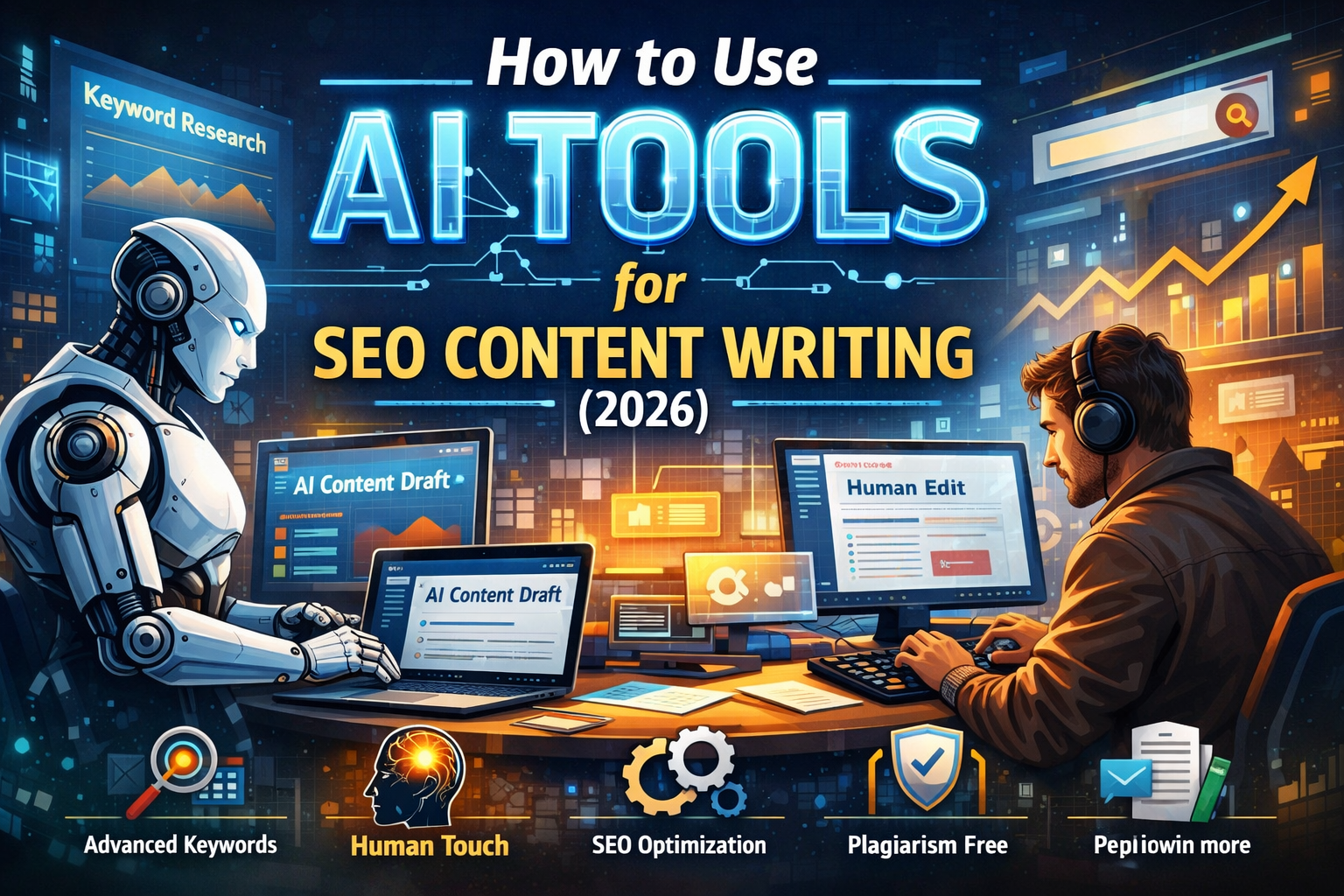
How to Use AI Tools for SEO Content Writing (2026): The Ultimate Guide
How to Use AI Tools for SEO Content Writing (2026): The Ultimate Guide
In 2026, the digital landscape is no longer about “Man vs. Machine.” It is about “Man with Machine.” Gone are the days when you could simply click a button, generate a generic AI article, and expect it to rank via AI Tools for SEO Content Writing on the first page of Google. Today, search engine algorithms are incredibly sophisticated, focusing heavily on human intent, personal experience, and high-value insights.
If you want to survive and thrive as a content creator or SEO professional, you must master the art of using AI as your “Co-Pilot” rather than your “Auto-Pilot.” This guide will walk you through the exact, step-by-step process of using AI tools for SEO content writing in 2026—ensuring your content is high-ranking, plagiarism-free, and resonates with human readers.

Bilkul, aapke “How to Use AI Tools for SEO Content Writing (2026)“ article ke liye ye ek professional aur SEO-friendly Table of Contents (TOC) hai.
Agar aap WordPress use kar rahe hain, toh ye headings automatic links ban jayengi (agar aapne TOC plugin install kiya hua hai).
Table of Contents
-
Introduction: The 2026 SEO Shift – Why “Generic AI” Fails
-
Advanced Keyword Research & Intent Mapping with AI
-
Leveraging AI for Semantic Clusters
-
Building Topic Authority in 2026
-
-
Drafting a High-Performance Outline: The Socratic Method
-
Selecting the Right “AI Stack” for Professional Writers
-
The “Human-AI Hybrid” Workflow: A Step-by-Step Process
-
Part A: Crafting the Human Introduction
-
Part B: Generating the AI Body Draft
-
Part C: Adding the “Human Layer of Truth”
-
-
How to Humanize AI Content to Avoid Search Penalties
-
Techniques for Emotional Resonance and Flow
-
-
Technical SEO Optimization for AI-Assisted Content
-
Readability & Formatting Standards for 2026
-
Common Pitfalls: Avoiding Fact Hallucinations and Over-Reliance
-
Conclusion: Mastering the Ultimate Million Dollar Skill
-
Frequently Asked Questions (FAQs)
1. The 2026 SEO Shift: Why “Generic AI” Fails
Before we dive into the “how,” we must understand the “why.” In 2026AI Tools for SEO Content Writing, Google’s SGE (Search Generative Experience), and other AI-driven search engines have flooded the internet with average content. To stand out, your content must offer something AI cannot: Originality and a human perspective.
Using AI tools for SEO content writing is no longer about speed alone; it is about enhanced depth. If your article looks like every other AI-generated piece, it will be buried. The goal is to use AI to handle the data, structure, and research while you provide the soul and the strategy.
2. Advanced Keyword Research & Intent Mapping with AI
Keyword research in 2026 has moved beyond simple “Search Volume.” It is now about Contextual Intent by the use of AI Tools for SEO Content Writing is common.
Leveraging AI for “Semantic Clusters”
Instead of focusing on a single keyword, use AI tools like Perplexity AI or Gemini 2.0 to identify “Semantic Clusters.”
-
The Strategy: Ask the AI to “Identify the primary pain points and secondary questions of a user looking for [Your Topic].”
-
Why it works: This helps you cover the topic in its entirety, which is a massive ranking signal for Google.
Topic Authority
AI can help you map out a “Content Silo.” For example, if you are writing about AI tools, the AI can suggest 10 related sub-topics (like “AI for Image Generation” or “AI for Data Analysis”) that you should link to. This builds “Topic Authority,” telling search engines that your site is an expert in this niche.
3. Drafting a High-Performance Outline
A common mistake is letting AI write the whole article at once. Instead, use AI to build a Logic-Based Outline.
The “Socratic” Prompting Method
Instead of saying “Give me an outline,” try this: “I am writing a 1500-word guide on AI tools for SEO. I want to target professional writers. Based on the current top 5 ranking results for this keyword, suggest an outline that includes unique sections they have missed, such as [Specific Niche Topic].”
By doing this, you ensure your outline is better than the competition from the very beginning.
4. Selecting the Right “AI Stack” for 2026
You don’t need every tool; you need the right tools. Here is the recommended “AI Stack” for professional SEO writers:
-
Generative Engines: ChatGPT-5 or Claude 4 (for creative drafting and brainstorming).
-
SEO Optimization: Surfer SEO or Rank Math’s Content AI (to ensure your keyword density and LSI keywords are perfect).
-
Fact-Checking: Perplexity AI (to verify the latest 2026 statistics and real-time data).
-
Humanization: Quillbot or specialized “Humanizer” prompts to break the repetitive patterns typical of AI writing.
5. Writing the Content: The “Human-AI Hybrid” Workflow
This is the core of high-quality content creation. Follow this “sandwich” method:
Part A: The Human Introduction
Always write your own introduction. Use a “Hook” that addresses a current 2026 trend. AI often starts with “In the fast-paced world of…”—avoid this. Start with a bold statement or a personal observation.
Part B: The AI Body Draft
Use AI to expand on your outline sections. Feed it specific data points.
-
Pro Tip: Prompt the AI to write in a “conversational yet professional tone, using short sentences and avoiding clichés.”
Part C: The Human “Layer of Truth”
Go through the AI draft and add:
-
Personal Anecdotes: “When I used Tool X for my Shopify store, I noticed…”
-
Expert Opinions: Quote a famous industry leader or a recent study.
-
Emotional Nuance: AI cannot feel frustration or excitement. Add these human elements to keep the reader engaged.
6. Humanizing AI Text to Avoid Penalties
Google does not penalize AI content if it is helpful. However, “AI-sounding” text often has high bounce rates because it feels cold.
Techniques to Humanize:
-
Vary Sentence Length: AI loves medium-length sentences. Manually add very short sentences for impact. And some longer, descriptive ones.
-
Use Idioms and Metaphors: AI is getting better at this, but a unique, localized metaphor (e.g., “Finding a keyword is like fishing in a crowded pond”) makes the text feel authentic.
-
Active Voice: AI often slips into passive voice. Convert it back to the active voice to make the writing more energetic.
7. SEO Optimization (The Technical Layer)
Once your human-style content is ready, it’s time to optimize for search engines.
-
LSI Keywords: Use your AI tool to identify “Latent Semantic Indexing” keywords. These are words naturally related to your topic (e.g., for “SEO,” words like “Backlinks,” “Crawlability,” and “UX” are LSI).
-
Internal Linking: Ensure you link to at least 3-5 other articles on Million Dollar Skills. This keeps users on your site longer.
-
External Authority: Link to high-authority sites (like Google’s official blog or major tech journals) to show your content is well-researched.
8. Formatting for 2026 Readability
In 2026, most users consume content on mobile or through “AI Summaries.” Your formatting must be “Scannable.”
-
Use Bullet Points: Like these!
-
Short Paragraphs: No more than 3-4 sentences.
-
Bold Key Phrases: Help the reader’s eye catch the most important information.
-
Custom Visuals: Use AI-generated images (like the one we created earlier) to break up the text.
9. Common Pitfalls: What to Avoid
-
The “Copy-Paste” Trap: Never copy AI output directly into WordPress. Always read it aloud first. If it sounds robotic to you, it will sound robotic to Google.
-
Fact Hallucinations: AI can invent statistics. Always verify dates, percentages, and names using a real-time search tool.
-
Keyword Stuffing: Don’t force keywords. In 2026, “User Satisfaction” is a bigger ranking factor than “Keyword Percentage.”
10. Conclusion: The Million Dollar Skill of 2026
Mastering AI tools for SEO content writing is the ultimate “Million Dollar Skill” of this era. It allows you to produce the work of five people with the quality of a master craftsman.
The future belongs to the “Editor-in-Chief” who knows how to guide AI to produce greatness. By combining the data-crunching power of AI with your unique human perspective, you create content that doesn’t just rank—it converts.
Frequently Asked Questions (FAQs)
Q1: Does Google penalize AI-written content in 2026?
Ans: No. Google’s official stance remains that it rewards high-quality, helpful content regardless of how it was produced. However, low-quality, “spammy” AI content that offers no new value is heavily penalized.
Q2: What is the best AI tool for human-like writing?
Ans: As of 2026, Claude 4 and Gemini 2.0 are considered the best for natural, human-like flow. However, the “best” tool is always the one used in combination with human editing.
Q3: How do I check if my AI content is plagiarism-free?
Ans: Use tools like Copyscape or Grammarly Premium. While AI usually generates unique text, it can sometimes mimic existing structures too closely. Always run a final check.
Q4: Can AI handle technical SEO writing?
Ans: AI is excellent at explaining technical concepts (like Schema Markup or Core Web Vitals). However, you must double-check the technical accuracy, as AI can sometimes provide outdated code or instructions.