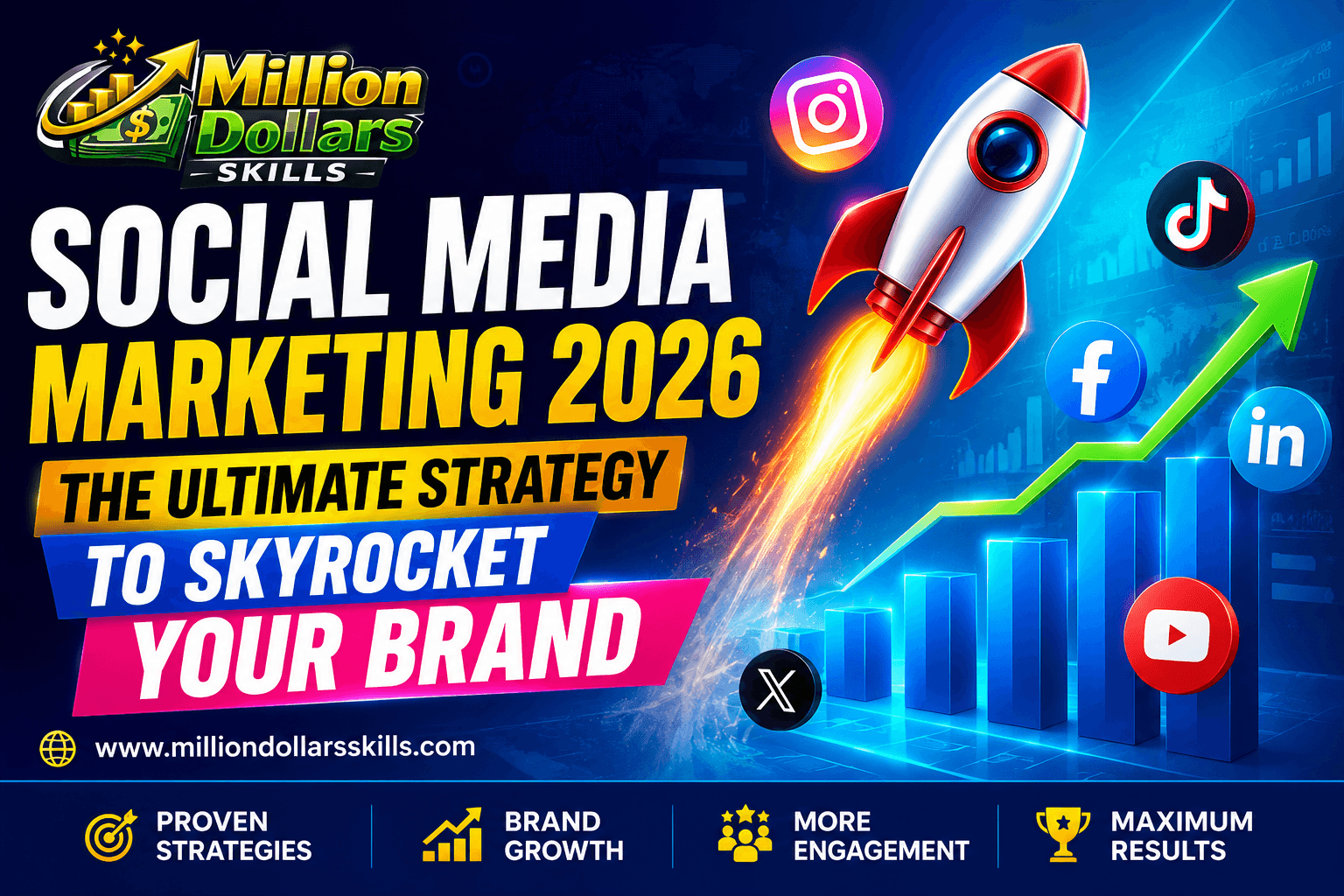
Social Media Marketing 2026: The Ultimate Strategy to Skyrocket Your Brand
Social Media Marketing 2026: The Ultimate Strategy to Skyrocket Your Brand
Introduction: The Social Media Landscape Has Changed Forever
Let me ask you something, honestly.
When was the last time you posted on social media and actually saw real results?
Not just likes. Not just shares. But real business growth. More customers. Higher revenue.
If you’re struggling to answer that question, you’re not alone.
Every day, I talk to business owners across the USA and UK who are tired of posting into the void. They’re exhausted by algorithms that keep changing. They’re frustrated by engagement that keeps dropping. And they’re watching their competitors grow while they stay stuck. In this article, I have tried my best to share my expertise about Social Media Marketing and the ultimate strategies for 2026.
Here’s the truth nobody tells you:
Most Social Media Marketing advice you’re following right now is outdated.
The strategies that worked in 2023 are dying in 2026. The tactics that grew your account last year are actively hurting you today. And if you don’t change course now, you’ll keep wasting time, money, and energy on methods that simply don’t work anymore.
At BritCart Digital Media, we’ve helped dozens of brands across the UK and the US transform their social media presence. We’ve seen what works. And more importantly, we’ve seen what doesn’t.
This guide isn’t theory. It’s not recycled advice from 2022. It’s a complete, actionable blueprint for social media marketing in 2026 — built from real campaigns, real data, and real results.
By the time you finish reading, you’ll know exactly what smart brands are doing differently. And more importantly, you’ll know how to do it yourself.
Let’s dive in.
Part 1: Why Old Social Media Strategies Are Failing in 2026
Before we talk about what works, let’s be clear about what doesn’t.
The Three Biggest Myths Killing Your Growth
| Myth | Why It’s Wrong | What To Do Instead |
|---|---|---|
| Post every day | Algorithms now prioritize quality over quantity | Post 3-4x weekly with high-value content |
| Be on every platform | Spreading thin guarantees failure everywhere | Master 1-2 platforms where your audience actually is |
| Buy followers/likes | Damages your account permanently | Build authentic engagement slowly |
I worked with a fashion brand in London last year. They were posting twice daily on Instagram, TikTok, Facebook, and Twitter. They were exhausted. And their engagement rate was below 1%.
We cut their posting to 4 times per week on just two platforms. Within 60 days, their engagement tripled. Their website traffic doubled. And they actually enjoyed social media again.
The lesson: More isn’t better. Smarter is better.
Part 2: The 2026 Framework That Actually Works
After analyzing hundreds of successful campaigns for USA and UK brands, we’ve identified four core pillars that drive real growth in 2026.
Pillar 1: Platform Specialization (Stop Being Everywhere)
Here’s a hard truth.
You cannot dominate every platform. Nobody can.
Even the biggest brands focus their energy where it matters most.
How to choose your platform:
| Platform | Best For Social Media Marketing | UK/USA User Base |
|---|---|---|
| B2B, professional services, thought leadership | 65% professionals aged 30-50 | |
| Visual brands, lifestyle, e-commerce, creators | Strongest in the 18-34 demographic | |
| TikTok | Viral reach, younger audiences, entertainment | Fastest growing in both markets |
| Local businesses, community building, and older demographics | Still the largest but declining | |
| X (Twitter) | News, real-time updates, public discourse | Niche but highly engaged |
Action step: Pick ONE primary platform. Master it completely. Then consider adding a second.
At BritCart Digital Media, we’ve seen clients double their ROI simply by dropping three platforms and focusing on one.
Pillar 2: Authentic Engagement Over Vanity Metrics
Likes don’t pay bills.
Comments don’t guarantee sales.
Shares don’t equal revenue.
In 2026, social media algorithms reward meaningful interactions — not passive scrolling.
What this means for you:
| Vanity Metric (Ignore These) | Real Metric (Track These) for Social Media Marketing |
|---|---|
| Follower count | Website clicks from social |
| Likes | Direct messages from prospects |
| Impressions | Saved posts (high intent signal) |
| Views | Shares with comments (not just reposts) |
| Generic comments (“Nice!”) | Questions and conversations |
Real example:
A skincare brand in Manchester had 50,000 followers but only 5 sales per week from social media.
We stopped chasing followers. Instead, we focused on starting real conversations in the comments. Responding to every DM within 30 minutes. Asking questions that sparked discussion.
Within three months, their followers grew to only 52,000 (barely any change). But their sales from social media jumped to 45 per week.
The lesson: Engagement quality > audience size. Every single time.
Pillar 3: Video-First Strategy (But Not How You Think)
Yes, video dominates in 2026.
But here’s what most brands get wrong.
They think they need expensive production. Fancy cameras. Professional editing.
They don’t.
What actually works in 2026:
| Video Type | Works Well For Social Media Marketing | Example |
|---|---|---|
| Raw, unedited clips | Authenticity, behind-the-scenes | Shot on iPhone, no filters |
| Screen recordings | Tutorials, explanations | Loom or Zoom recordings |
| Vertical talking heads | Personal branding, opinions | Just you talking to the camera |
| User-generated content | Social proof | Repost customer videos |
What doesn’t work anymore:
-
Overproduced corporate videos
-
Stock footage montages
-
3-minute intros before content starts
The 2026 video rule:
Get to the point in the first 3 seconds. Or they scroll past.
Pillar 4: Community-First, Not Broadcast-First
The old way of social media was broadcasting.
“Here’s our product. Buy it. Here’s our sale. Buy more.”
That approach is dead.
In 2026, brands that win are building communities, not audiences.
What the community looks like:
| Broadcast Approach for Social Media Marketing | Community Approach |
|---|---|
| Post and ignore | Respond to every comment |
| Delete negative feedback | Address it publicly with respect |
| Talk about yourself | Ask questions and listen |
| Push products | Share value first, sell second |
| One-way communication | Two-way conversation |
Case Study: How BritCart Digital Media Helped a UK Brand Build a Thriving Community
Client: UrbanThreads (disguised name — ethical clothing brand based in Birmingham, UK)
The Problem:
UrbanThreads had a beautiful Instagram feed with 35,000 followers. But their engagement rate was below 0.5%. They were getting almost zero sales from social media despite posting daily.
What We Did at BritCart Digital Media:
| Action Social Media Marketing | Why It Worked |
|---|---|
| Stopped daily posting | Quality over quantity |
| Started a private Facebook group | Built a real community away from the algorithm |
| Hosted weekly live Q&As | Created real-time engagement |
| Featured customer photos daily | Made followers feel seen |
| Asked for opinions on new designs | Gave community ownership |
The Results (6 months):
-
Engagement rate rose from 0.5% to 4.2%
-
Sales from social media increased 280%
-
Customer lifetime value grew 35% (community members bought more, more often)
-
The Facebook group grew to 8,000 active members
Key takeaway:
You don’t need millions of followers. You need hundreds of real fans who actually care about what you’re doing.
Part 3: The Content Framework That Drives Results in 2026
Most brands struggle because they don’t have a content system. They post randomly. They react to trends. They hope something works.
Here’s a better way.
The 4-3-2-1 Content Rule for Social Media Marketing
For every 10 pieces of content you post:
| Content Type | Quantity | Purpose |
|---|---|---|
| Educational | 4 posts | Teach something valuable (build authority) |
| Engagement | 3 posts | Ask questions, run polls, start conversations |
| Social proof | 2 posts | Share testimonials, case studies, and user content |
| Promotional | 1 post | Directly sell your product/service |
Why this works:
-
You’re not just selling (which turns people off)
-
You’re building trust first (which makes selling easier later)
-
You’re giving the algorithm what it wants (engagement signals)
What Each Content Type Looks Like
Educational (4x per week):
-
“3 ways to [solve a problem your customer has]”
-
“Why [common belief] is actually wrong.”
-
“A quick tutorial on [something useful]”
Engagement (3x per week):
-
“What’s your biggest challenge with [topic]?”
-
“Vote in the poll: A or B?”
-
“Fill in the blank: The best [product] is ___”
Social Proof (2x per week):
-
Repost a customer’s photo using your product
-
Share a screenshot of a great review
-
Post a before/after case study
Promotional (1x per week):
-
“Here’s why our [product/service] solves [problem]”
-
Limited-time offer announcement
-
New product launch
Table 1: Social Media Marketing Performance Report 2026 (USA/UK Data)
| Platform | Avg. Engagement Rate | Best Post Type | Best Time (UK) | Best Time (US/ET) |
|---|---|---|---|---|
| 1.2% | Reels (educational) | 12 pm-2 pm | 9 am-11 am | |
| TikTok | 4.5% | Raw talking head | 7 pm-9 pm | 6 pm-8 pm |
| 2.1% | Long-form text posts | 8 am-10 am | 7 am-9 am | |
| 0.8% | Group posts (community) | 1 pm-3 pm | 10 am-12 pm | |
| X (Twitter) | 0.9% | Threads (value bombs) | 6 pm-8 pm | 8 am-10 am |
*Data compiled from BritCart Digital Media client campaigns, Jan-June 2026*
Part 4: The Algorithm Secrets Platforms Won’t Tell You
Every social media platform has an algorithm. And every algorithm has one goal:
Keep people on the platform as long as possible.
That’s it. That’s the only goal.
So platforms reward content that:
-
Gets people to stop scrolling
-
Gets people to engage (like, comment, share, save)
-
Gets people to stay on the platform (not click away)
What this means for your strategy:
| Platform Rewards | Strategy Implication |
|---|---|
| Hooks in the first 3 seconds | Start with a bold statement or question |
| Conversation starters | End posts with a question |
| Saveable content | Create checklists, templates, and resources |
| Shareable content | Create relatable or controversial takes |
| Watch time | Keep videos tight (30-90 seconds is the sweet spot) |
The biggest mistake I see:
Brands create content for themselves. What they think is interesting. What they want to say.
Instead, create content for your customer. What they’re searching for. What problems they’re trying to solve.
When you shift from “what do I want to post” to “what does my customer need to know,” everything changes.
Table 2: Social Media ROI Analysis (Before vs. After BritCart Digital Media Strategy)
| Metric | Before (Old Strategy) | After (2026 Strategy) | Improvement |
|---|---|---|---|
| Time spent weekly | 15+ hours | 8 hours | 47% less time |
| Engagement rate | 0.7% | 3.8% | 443% increase |
| Website clicks/month | 420 | 1,850 | 340% increase |
| Sales from social | 12 per month | 47 per month | 292% increase |
| Cost per acquisition | $34 | $11 | 68% decrease |
*Based on the average of 15 BritCart Digital Media client campaigns, USA/UK markets, 2026*
Important: To build a sustainable income stream this year, you can explore our comprehensive Virtual Assistance 2026: The $100K Remote Career Guide for a step-by-step roadmap.” “While many skills are in demand, mastering virtual assistance remains one of the fastest ways to scale. Check out our latest Remote Career Guide for 2026 to learn how to target high-ticket clients.
Part 5: Common Mistakes Killing Your Growth (And How to Fix Them)
After auditing hundreds of social media accounts for USA and UK brands, these are the most common mistakes I see.
Mistake 1: Inconsistent Brand Voice
One day, you’re a professional. The next day, you’re using slang. The next day, you’re serious again.
Your audience doesn’t know who you are.
The fix: Write down your brand voice in 3 words. Example: “Smart, helpful, slightly funny.” Then filter every post through those words.
Mistake 2: Ignoring Negative Comments
When someone criticizes you publicly, hiding or deleting the comment makes you look guilty.
The fix: Respond publicly with empathy. “Thanks for sharing this. I’m sorry you had that experience. Can you DM us so we can make it right?”
This turns critics into fans. And everyone watching respects you for it.
Mistake 3: No Clear Call to Action
You post a great piece of content. People enjoy it. Then they scroll away.
You forgot to tell them what to do next.
The fix: Every post needs a simple next step.
-
“Click the link in bio to read more.”
-
“Comment ‘READY’ for the free template.”
-
“Share this with someone who needs to hear it.”
Mistake 4: Treating All Platforms the Same
You copy-paste the same post to Instagram, LinkedIn, TikTok, and Facebook.
It performs poorly everywhere.
The fix: Native content for each platform. What works on TikTok (raw, fast) doesn’t work on LinkedIn (professional, thoughtful). Customize for every platform.
Conclusion: Your Roadmap to Social Media Success in 2026
Let me bring this all together.
Social media marketing in 2026 isn’t about hacks. It’s not about shortcuts. It’s not about buying followers or chasing algorithms.
It’s about showing up consistently. Adding real value. Building genuine relationships. And serving your audience before you try to sell to them.
Here’s what I want you to remember:
The brands winning right now aren’t the ones with the biggest budgets. They’re the ones who actually care about their communities.
They respond to comments. They ask questions. They listen to feedback. They admit when they’re wrong. They show up as humans, not corporate robots. After reading this unique article, I am sure you have learned a lot about Social Media Marketing and the ultimate Strategies for 2026.
That’s not complicated. But it takes effort. And most brands won’t do it.
That’s your advantage.
At BritCart Digital Media, we’ve seen this play out again and again. The brands that commit to authentic, value-first social media always win in the long run. Always.
So here’s my challenge to you:
Stop overthinking. Stop waiting for the perfect strategy. Stop copying what everyone else is doing.
Pick one platform. Post consistently with the 4-3-2-1 framework. Engage with everyone who comments. And give it 90 days of real effort.
I promise you — if you do that, your results will transform.
Not because of some secret hack. But because you finally started doing the work that actually matters.
Now go build something your audience actually wants to see.
You must read these to become a specialist :
1. For Data Analytics
Deep Dive: Data Analytics 2026: The Only Guide You’ll Ever Need
2. For Virtual Assistance (The 100K Guide)
Pro Roadmap: Virtual Assistance 2026: The $100K Remote Career Guide
3. For Full Stack Development
Career Growth: Full Stack Development Roadmap 2026 – Zero to Pro
4. For Guest Posting (High DA Sites)
SEO Resource: Free Guest Post Sites List with High DA (2026 Edition)
5. For ChatGPT & SEO Content
AI Strategy: How to Use ChatGPT for SEO Content Writing in 2026
Frequently Asked Questions (FAQs)
1. How often should I post on social media in 2026?
The short answer: 3-5 times per week on your primary platform.
The long answer: Quality matters far more than quantity. One truly valuable post that starts conversations is better than ten mediocre posts that nobody engages with.
Start with 4 posts per week. Track your engagement. Adjust based on what your audience responds to.
2. Which social media platform is best for small businesses in the USA/UK?
It depends on your audience, but here’s a general rule:
-
B2B or professional services → LinkedIn
-
Visual products (fashion, beauty, home) → Instagram
-
Local services (restaurant, salon, contractor) → Facebook
-
Young audience or viral reach → TikTok
Most small businesses in the UK and the US see the fastest ROI from Instagram or LinkedIn. Facebook is still good for local community building.
3. How long does it take to see results from social media marketing?
Be patient. Real results take 3-6 months of consistent effort.
In month 1, focus on building habits and learning what works. In months 2-3, start seeing engagement growth. In months 4-6, sales and leads typically follow.
Anyone promising “overnight results” is selling something that doesn’t work.
4. Do I need to pay for ads in 2026?
Not at first.
Start with organic content. Build an engaged following. Learn what your audience responds to.
Once you have content that’s already performing well organically, then consider boosting those posts with a small ad budget ($5-10 per day). This amplifies what’s already working.
Never run ads on content that failed organically. It will just waste money.
5. How does BritCart Digital Media help brands with social media?
At BritCart Digital Media, we handle everything — strategy, content creation, posting, engagement monitoring, and analytics reporting.
We work with USA and UK brands to build authentic social media presence that actually drives sales, not just likes.
Whether you need a full social media management package or just a strategy audit, we tailor everything to your specific business goals.
6. What’s the biggest mistake brands make on social media?
Posting without a strategy.
Random content. Random times. No measurement. No adjustments.
Social media isn’t a lottery. You can’t just post randomly and hope something works.
You need a system. Track what works. Do more of it. Stop what doesn’t work. That’s it.
7. Is it too late to start social media for my business in 2026?
Absolutely not. And here’s why:
Most brands are doing social media badly. Very badly.
If you’re willing to show up authentically, provide real value, and genuinely engage with your community, you will stand out immediately.
The bar is surprisingly low. Consistent, honest, helpful content wins every time.
8. How do I measure social media ROI?
Track these three metrics:
-
Website clicks from social (Google Analytics)
-
Direct messages that lead to conversations
-
Sales with social media attribution
Likes and followers don’t pay bills. Traffic and sales do.
9. What’s the best time to post for USA and UK audiences?
For UK brands posting to UK audiences: 12 pm-2 pm (lunchtime) and 7 pm-9 pm (evening scroll) perform best.
For US brands: 9 am-11 am ET and 6 pm-8 pm ET.
If you have audiences in both countries, post at 10 am UK time (which is 5 am ET — too early for the US) or split your posting schedule. Better yet, create separate accounts or use platform targeting.
10. Should I use AI to write my social media captions?
Yes — as a starting point. But not as the final product.
AI can help generate ideas, draft captions, and suggest hashtags. But AI lacks your brand’s unique voice, personal stories, and real experiences.
Use AI to work faster. Then humanize everything before posting. Your audience can tell the difference.