How to Fix AdSense Violations: Solutions to 10 Critical Mistakes in 2026
How to Fix AdSense Violations: Solutions to 10 Critical Mistakes in 2026
Introduction
Google AdSense continues to be one of the most trusted and widely used monetization platforms for website owners, bloggers, and digital publishers in 2026. However, alongside its earning potential comes a strict set of policies designed to protect advertisers, users, and the overall ecosystem. Many publishers do not realize that even small mistakes—often made unknowingly—can lead to serious AdSense violations, reduced earnings, or, in severe cases, permanent account suspension. The challenge today is not just getting AdSense approval, but maintaining full compliance in an environment where Google’s AI-based monitoring systems are more advanced than ever.
Understanding how to fix AdSense violations is essential for anyone who wants to build a long-term, stable income online. Most violations are not the result of intentional wrongdoing but rather a lack of awareness regarding updated policies, improper ad placement strategies, low-quality content practices, or traffic issues. Google’s systems in 2026 are highly sensitive to user behavior patterns, meaning that even indirect mistakes such as misleading layouts or unnatural traffic spikes can trigger warnings.
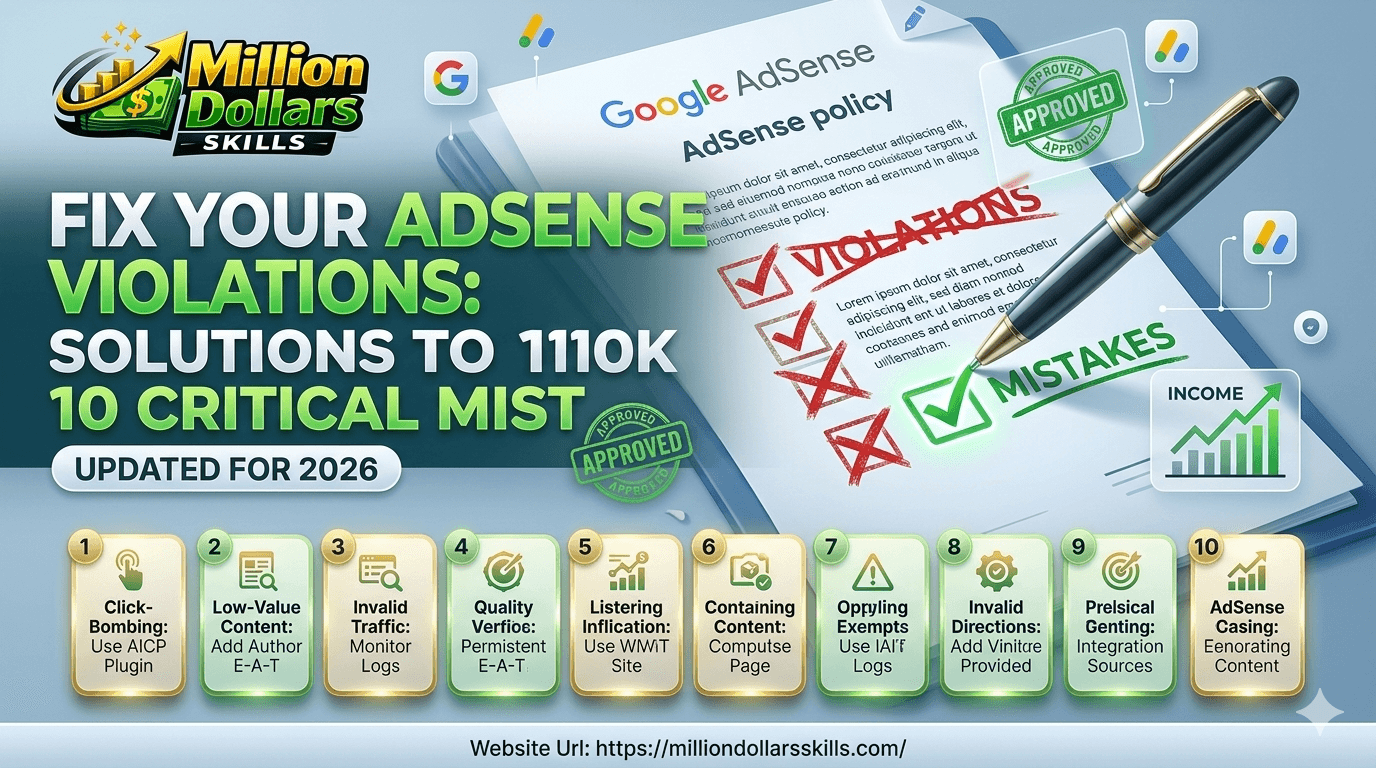
This comprehensive guide explains how to fix the 10 most critical AdSense mistakes that can put your account at risk. Each section provides practical, SEO-friendly, and policy-compliant solutions that not only help you resolve existing issues but also prevent future violations. Whether you are a beginner or an experienced publisher, these insights will help you maintain a healthy AdSense account, improve website quality, and ensure consistent revenue growth without interruptions.
1. Fixing Invalid Click Activity Issues: Fix AdSense Violations
One of the most serious AdSense violations involves invalid click activity, which includes accidental clicks, intentional clicks on your own ads, or artificially generated clicks through bots or third-party services. To fix this issue, the first step is to audit your traffic sources and remove any suspicious or low-quality referrals. It is also essential to ensure that you never interact with your own ads under any circumstances, even for testing purposes.
Improving user experience can significantly reduce accidental clicks. Ensure that ads are not placed too close to navigation buttons or interactive elements. If invalid activity has already been detected, review your AdSense policy center notifications carefully and take corrective action immediately. Google often reinstates accounts when publishers demonstrate genuine compliance improvements over time.
2. Improving Low-Quality Content Problems
Low-quality or thin content is another major reason for AdSense violations. Websites that publish shallow articles, duplicated content, or AI-generated text without value often get flagged. To fix this issue, focus on creating in-depth, original, and user-focused content that answers real questions and provides actionable insights.
Each article should be well-structured, detailed, and written with the reader in mind. Avoid keyword stuffing and instead focus on natural SEO optimization. Updating old posts with fresh information can also improve content quality signals. Google rewards websites that demonstrate expertise, authority, and trustworthiness, commonly known as E-E-A-T.
3. Resolving Copyright and Content Ownership Issues
Using copyrighted images, videos, or text without permission is a serious violation that can quickly lead to AdSense penalties. To fix this, remove any unauthorized content from your website immediately and replace it with licensed or royalty-free alternatives. Platforms such as Unsplash, Pexels, and Pixabay can be used for safe visual content.
It is also important to ensure that your written content is original and not copied from other websites. If plagiarism is detected, rewrite the affected pages completely in your own words while adding value and context. Maintaining originality is crucial for long-term AdSense stability.
4. Fixing Traffic Quality Issues
Traffic quality plays a major role in AdSense compliance. If your website receives traffic from bots, paid click services, or irrelevant sources, it can trigger invalid traffic violations. To fix this issue, analyze your Google Analytics data and identify unusual spikes or suspicious referral sources.
Focus on building organic traffic through SEO, social media marketing, and high-quality content. Avoid shortcuts like buying traffic packages, as these often lead to account restrictions. Google prioritizes natural audience engagement over artificially inflated numbers.
5. Correcting Improper Ad Placement
Improper ad placement is a common but often overlooked violation. Ads placed in misleading positions—such as near buttons, menus, or interactive elements—can lead to accidental clicks, which Google considers invalid. To fix this, redesign your layout to ensure clear separation between ads and content.
Ads should always be distinguishable and placed in areas where users can identify them naturally. Avoid making ads look like navigation tools or content links. A clean, user-friendly design not only improves compliance but also enhances overall user experience and engagement.
6. Improving Mobile User Experience
In 2026, most website traffic comes from mobile devices, making mobile optimization essential for AdSense compliance. Websites that are not mobile-friendly often suffer from poor layout structures that increase accidental clicks and user frustration.
To fix this issue, use responsive design frameworks and test your website on multiple devices. Ensure that ads scale properly and do not overlap with content. Fast loading speed and smooth navigation are also important factors that contribute to better user satisfaction and policy compliance.
7. Removing Prohibited or Sensitive Content
Google strictly prohibits content related to illegal activities, adult material, hate speech, and harmful misinformation. If your website contains such content, it must be removed immediately to avoid AdSense penalties.
To fix this violation, perform a complete content audit and categorize your pages based on compliance risk. Remove or rewrite any content that violates Google’s policies. Always aim to maintain a safe, informative, and family-friendly website that aligns with advertiser expectations.
8. Strengthening Website Structure and Trust Signals
A poorly structured website can lead to trust issues and policy violations. Missing essential pages like Privacy Policy, About Us, Contact Us, and Terms & Conditions can negatively impact AdSense approval and retention.
To fix this, ensure that your website has a clear structure with easy navigation and well-defined informational pages. These pages help build trust with both users and Google’s review systems. A professional layout signals credibility and improves overall site authority.
9. Reducing Excessive Ad Density
Overloading your website with ads can significantly harm user experience and lead to policy violations. Google encourages a balanced approach where content remains the primary focus and ads are secondary.
To fix this issue, reduce the number of ads displayed per page and ensure they are placed strategically. Avoid cluttered layouts that distract users from reading the content. A clean design not only improves compliance but also increases engagement and long-term revenue potential.
10. Staying Updated with AdSense Policy Changes
One of the most overlooked mistakes is ignoring AdSense policy updates. Google frequently updates its guidelines to adapt to new technologies and user behaviors. Failing to stay informed can result in unintentional violations.
To fix this, regularly check your AdSense dashboard and policy center for updates. Subscribe to official Google announcements and review your website periodically for compliance. Staying proactive is the best way to avoid future penalties and maintain a stable account.
Conclusion
Fixing AdSense violations is not just about resolving current issues—it is about building a long-term strategy that ensures sustainable growth, compliance, and trustworthiness. In 2026, Google’s systems are more intelligent and strict than ever, meaning publishers must prioritize quality, transparency, and user experience above all else. Most AdSense problems arise from preventable mistakes such as poor content quality, improper ad placement, or ignoring policy updates.
By systematically addressing each of the 10 critical mistakes discussed in this guide, you can significantly reduce the risk of account suspension while improving your website’s overall performance. The key is consistency and ethical publishing practices. A well-maintained website that focuses on user value will always perform better in search rankings and monetization.
Ultimately, AdSense success is not about quick tricks or shortcuts—it is about building a reliable digital platform that serves users effectively. When you align your content strategy with Google’s guidelines and prioritize quality over quantity, you create a strong foundation for long-term revenue generation and online credibility.
Frequently Asked Questions (FAQs)
1. What are Google AdSense violations in 2026?
Google AdSense violations refer to any activity or content that breaks Google’s monetization policies. This includes invalid clicks, copyrighted material, low-quality content, misleading ad placement, and non-compliant traffic sources. In 2026, Google’s systems are more advanced, so even small mistakes can be detected quickly.
2. How can I fix AdSense violations on my website?
To fix AdSense violations, you need to first identify the issue through your AdSense Policy Center. After that, remove or correct the problematic content, improve ad placement, ensure original high-quality content, and clean up any suspicious traffic sources. Once fixed, maintain consistent compliance to avoid future issues.
3. Can my AdSense account be recovered after a violation?
Yes, in some cases AdSense accounts can be reinstated if the violation is minor and properly fixed. However, severe violations such as repeated invalid traffic or policy abuse may lead to permanent suspension. It is important to act quickly and follow all corrective steps recommended by Google.
4. What type of content causes AdSense policy violations?
Content that is copied, thin, misleading, or violates copyright laws can lead to AdSense issues. Additionally, content related to adult material, violence, illegal activities, or harmful misinformation is strictly prohibited under Google AdSense policies.
5. How does Google detect invalid traffic?
Google uses advanced AI systems and behavioral analysis to detect invalid traffic. It monitors IP addresses, click patterns, user behavior, and traffic sources. Any unusual or artificial activity can trigger an automatic review or violation warning.
6. Is AI-generated content safe for AdSense approval?
AI-generated content is allowed only if it is high-quality, original, and helpful to users. Low-value or repetitive AI content that lacks depth may lead to rejection or monetization issues. Google prioritizes content that provides real human value.
7. How important is ad placement for AdSense compliance?
Ad placement is very important for AdSense compliance. Ads should not be misleading, hidden, or placed near clickable elements like menus or buttons. Poor placement can lead to accidental clicks, which are considered invalid activity by Google.
8. Do I need special pages for AdSense approval?
Yes, essential pages such as Privacy Policy, About Us, Contact Us, and Terms & Conditions are required for AdSense approval. These pages help build trust with users and demonstrate that your website is legitimate and transparent.
9. Can buying traffic affect my AdSense account?
Yes, buying low-quality or fake traffic can seriously harm your AdSense account. Google strictly prohibits artificial traffic sources, and using them can lead to invalid activity violations or permanent account suspension.
10. How can I prevent future AdSense violations?
To prevent future violations, focus on creating high-quality content, using proper ad placement, avoiding invalid traffic sources, and staying updated with Google AdSense policies. Regular website audits also help maintain long-term compliance and account safety.