
10 Critical Google AdSense Mistakes That Can Get Your Account Banned in 2026
10 Critical Google AdSense Mistakes That Can Get Your Account Banned in 2026
Introduction
Monetizing a website through Google AdSense remains one of the most accessible and scalable ways to generate passive income online, but it is far from risk-free. Every year, thousands of publishers lose their AdSense accounts—often permanently—because they unknowingly violate Google’s policies or attempt to cut corners for quick gains. In 2026, Google’s enforcement systems will have become even more sophisticated, relying heavily on AI-driven detection, behavioral analysis, and stricter compliance checks. This means even minor mistakes can trigger account suspension or a full ban without warning.
If you are serious about building a sustainable income stream through AdSense, understanding what not to do is just as important as knowing best practices. Many publishers focus solely on traffic and earnings while ignoring compliance, content quality, and user experience—three pillars that Google prioritizes above all else. A single violation, whether intentional or accidental, can wipe out years of hard work overnight.
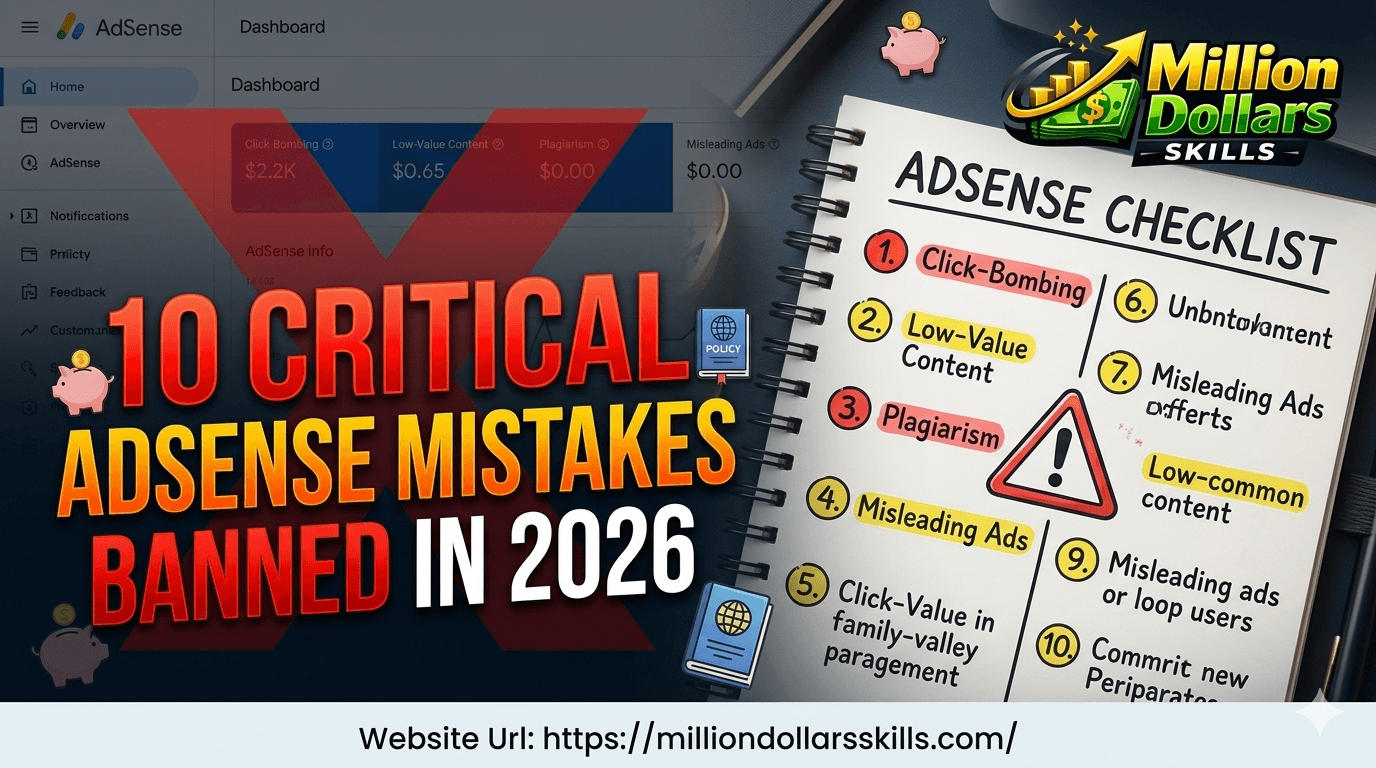
This article dives deep into the 10 most critical Google AdSense mistakes that can get your account banned in 2026. Each section explains the issue in detail, why it matters, and how you can avoid it while staying fully compliant with Google’s evolving policies. Whether you are a beginner or an experienced publisher, this guide will help you protect your account, grow safely, and maintain long-term revenue stability.
1. Clicking Your Own Ads or Encouraging Invalid Clicks
One of the fastest ways to get your AdSense account banned is by engaging in invalid click activity. This includes clicking your own ads, asking friends or family to click ads, or using bots and paid services to inflate clicks artificially. Google has extremely advanced systems that track user behavior patterns, IP addresses, click frequency, and engagement signals. Even a few suspicious clicks can raise red flags.
Encouraging users to click ads with phrases like “Support us by clicking ads” or placing misleading elements that trick users into clicking is strictly prohibited. Google expects clicks to be completely organic and based on genuine user interest. Violating this rule not only damages advertiser trust but also undermines the entire ecosystem.
To stay safe, never interact with your own ads and avoid any strategy that manipulates user behavior. Focus instead on creating valuable content that naturally attracts engagement.
2. Publishing Low-Quality or Thin Content is one of the most Common Google AdSense Mistakes
Content quality is one of the most critical ranking and monetization factors in 2026. Websites filled with thin, duplicated, or AI-generated content with no real value are increasingly being penalized—not just in search rankings but also in AdSense approval and retention.
Google prioritizes original, helpful, and user-focused content. If your articles are too short, lack depth, or simply rephrase existing material without adding new insights, your site may be flagged. Thin content signals low authority and poor user experience, both of which can lead to account suspension.
To avoid this mistake, ensure every piece of content is well-researched, comprehensive, and genuinely useful. Aim for depth, clarity, and originality in every article you publish.
3. Using Copyrighted Material Without Permission
Using images, videos, text, or any other media without proper licensing is a serious violation. Many publishers unknowingly copy content from other websites or use copyrighted images from Google search, assuming it’s acceptable. It’s not.
Google takes intellectual property rights very seriously. If your website is found to be hosting copyrighted material without permission, your AdSense account could be disabled permanently.
Always use royalty-free images, licensed media, or content you create yourself. Websites like Unsplash, Pexels, and Pixabay offer free resources, but even then, it’s important to verify licensing terms.
4. Driving Traffic from Unethical Sources: Google AdSense Mistakes
Not all traffic is considered equal in Google’s eyes. Traffic generated from bots, paid-to-click services, traffic exchanges, or spammy referral sources can lead to invalid activity detection. Even if your intentions are good, poor-quality traffic can harm your account.
Google expects publishers to attract visitors organically through search engines, social media, or legitimate marketing efforts. Sudden spikes in traffic from suspicious sources can trigger automated reviews and penalties.
Focus on building traffic through ethical SEO strategies, high-quality content, and genuine audience engagement. Avoid shortcuts that promise quick traffic boosts.
5. Placing Ads in Misleading Positions
Ad placement plays a crucial role in compliance. Placing ads too close to clickable elements like navigation menus, download buttons, or images can lead to accidental clicks, which Google considers invalid activity.
Misleading layouts that make ads look like content or interactive elements are strictly prohibited. For example, disguising ads as “Download Now” buttons or placing them where users might accidentally click can result in a ban.
Ensure your ads are clearly distinguishable from your content and positioned in a way that enhances—not disrupts—the user experience.
6. Ignoring Mobile Optimization
In 2026, the majority of web traffic comes from mobile devices. If your website is not mobile-friendly, it not only affects user experience but also raises compliance concerns with AdSense policies.
Poor mobile layouts can lead to accidental ad clicks, slow loading times, and frustrated users—all of which negatively impact your account. Google expects publishers to maintain responsive designs that adapt seamlessly across devices.
Use responsive themes, optimize images, and test your site regularly on different screen sizes to ensure a smooth and compliant experience.
7. Hosting Prohibited Content
Google has strict policies regarding the type of content that can be monetized. Websites containing adult content, violent material, hate speech, illegal activities, or misleading information are not eligible for AdSense.
Even borderline content can trigger manual reviews and potential account suspension. It’s important to understand that Google evaluates not just individual pages but your entire website.
Stick to safe, informative, and family-friendly content that aligns with Google’s guidelines. When in doubt, always review the official AdSense policy documentation.
8. Not Maintaining a Clear Site Structure
A poorly structured website with broken links, missing pages, or confusing navigation can harm both user experience and compliance. Google expects websites to be easy to navigate, transparent, and trustworthy.
Essential pages such as Privacy Policy, Terms and Conditions, About Us, and Contact Us are not optional—they are required for AdSense approval and continued operation.
A clear structure signals professionalism and builds trust with both users and advertisers. Regularly audit your website to fix errors and improve usability.
9. Overloading Your Site with Ads
While it might be tempting to maximize revenue by placing as many ads as possible, this approach often backfires. Too many ads can overwhelm users, slow down your website, and violate Google’s ad placement policies.
Google prioritizes user experience over aggressive monetization. Websites that appear cluttered or spammy are more likely to face penalties.
Maintain a balanced approach by placing ads strategically and ensuring they complement your content rather than dominate it.
10. Ignoring Policy Updates and Notifications
Google frequently updates its AdSense policies to adapt to new technologies, user behaviors, and advertiser expectations. Ignoring these updates can lead to unintentional violations.
Many publishers lose their accounts simply because they fail to read policy changes or ignore warning emails from Google. These notifications often provide an opportunity to fix issues before serious action is taken.
Stay informed by regularly checking the AdSense policy center and keeping an eye on your email for important updates. Being proactive can save your account from irreversible damage.
Conclusion
Building a successful AdSense-based website in 2026 requires more than just publishing content and placing ads—it demands a deep understanding of Google’s policies, a commitment to quality, and a long-term mindset focused on sustainability. The mistakes outlined in this article are not just common—they are critical, and in many cases, irreversible once a ban is enforced.
The key takeaway is simple: prioritize users over revenue. When your website delivers genuine value, maintains transparency, and follows ethical practices, AdSense becomes a natural extension of your success rather than a risky dependency. Avoid shortcuts, stay updated with policy changes, and continuously improve your content and user experience.
Remember, an AdSense account is not just a tool—it’s an asset. Protect it by staying compliant, thinking strategically, and treating your website like a professional business. By doing so, you not only safeguard your current earnings but also create a foundation for long-term growth and financial stability in the ever-evolving digital landscape. In this article, I have tried my best to share my knowledge about Critical Google AdSense Mistakes That Can Get Your Account Banned in 2026. In the next article, I will describe the solution to these Google AdSense Mistakes.
Frequently Asked Questions (FAQs)
1. What are the most common Google AdSense mistakes that lead to account bans?
The most common AdSense mistakes include clicking your own ads, using invalid traffic sources, placing ads in misleading positions, and publishing low-quality or copyrighted content. These violations are taken seriously by Google and can result in permanent account suspension.
2. Can my AdSense account get banned for accidental policy violations?
Yes, even accidental violations can lead to penalties if they are repeated or severe. Google uses automated systems to detect policy breaches, so it is important to regularly review AdSense guidelines and ensure your website remains fully compliant.
3. How does Google detect invalid traffic on AdSense websites?
Google uses advanced AI systems to monitor user behavior, IP addresses, click patterns, and engagement signals. Any unusual or suspicious activity, such as sudden traffic spikes or repeated clicks from the same source, may be flagged as invalid traffic.
4. Is AI-generated content safe for AdSense approval in 2026?
AI-generated content can be used, but it must be high-quality, original, and provide real value to users. Low-quality or spammy AI content that lacks depth or usefulness may lead to rejection or account issues.
5. What type of content is not allowed in Google AdSense?
Google does not allow content related to adult material, violence, hate speech, illegal activities, or misleading information. Websites must follow strict content policies to remain eligible for monetization.
6. How many ads should I place on my website for AdSense?
There is no fixed limit, but Google recommends a balanced approach. Too many ads can harm user experience and increase bounce rates. Ads should be placed naturally and should not overwhelm the content.
7. Do I need a Privacy Policy page for AdSense approval?
Yes, having a Privacy Policy page is mandatory for AdSense approval. It helps users understand how data is collected and used, and it builds trust with both visitors and advertisers.
8. Can buying traffic help increase AdSense earnings?
No, buying traffic is against Google AdSense policies if it involves low-quality or non-human sources. Such traffic can lead to invalid activity and may result in account suspension.
9. How often does Google update AdSense policies?
Google updates its AdSense policies regularly to improve ad quality and user experience. Publishers should check for updates frequently to avoid unintentional violations.
10. How can I protect my AdSense account from being banned?
To protect your account, focus on high-quality content, avoid invalid traffic, follow ad placement guidelines, and stay updated with policy changes. Ethical and consistent practices are the best way to maintain a safe AdSense account.






2 Comments