
10 Best Freelancing Skills for Beginners in 2026 (Earn $1000+)
10 Best Freelancing Skills for Beginners in 2026 (Earn $1000+)
Introduction: The New Era of the Solopreneur
Let me ask you something.
Have you noticed how freelancing has changed? A few years ago, you could list “data entry” or “virtual assistant” on a platform and watch the offers roll in. Clients didn’t ask many questions. They just needed a warm body to do the work. Those days are gone. And honestly? That’s a good thing.
The digital landscape in 2026 is vastly different from that of the early 2020s. We’ve moved past the gig economy and entered the Expert Economy. Freelancing is no longer just a side hustle; it has become a global career path that can provide financial stability and growth—if you master the right high-income skills.
Whether you’re a student looking for side income, a professional seeking to leave your 9-to-5, or a digital nomad in the making, the question is no longer “how do I start?” but “which skills will make me indispensable in a world dominated by AI?”
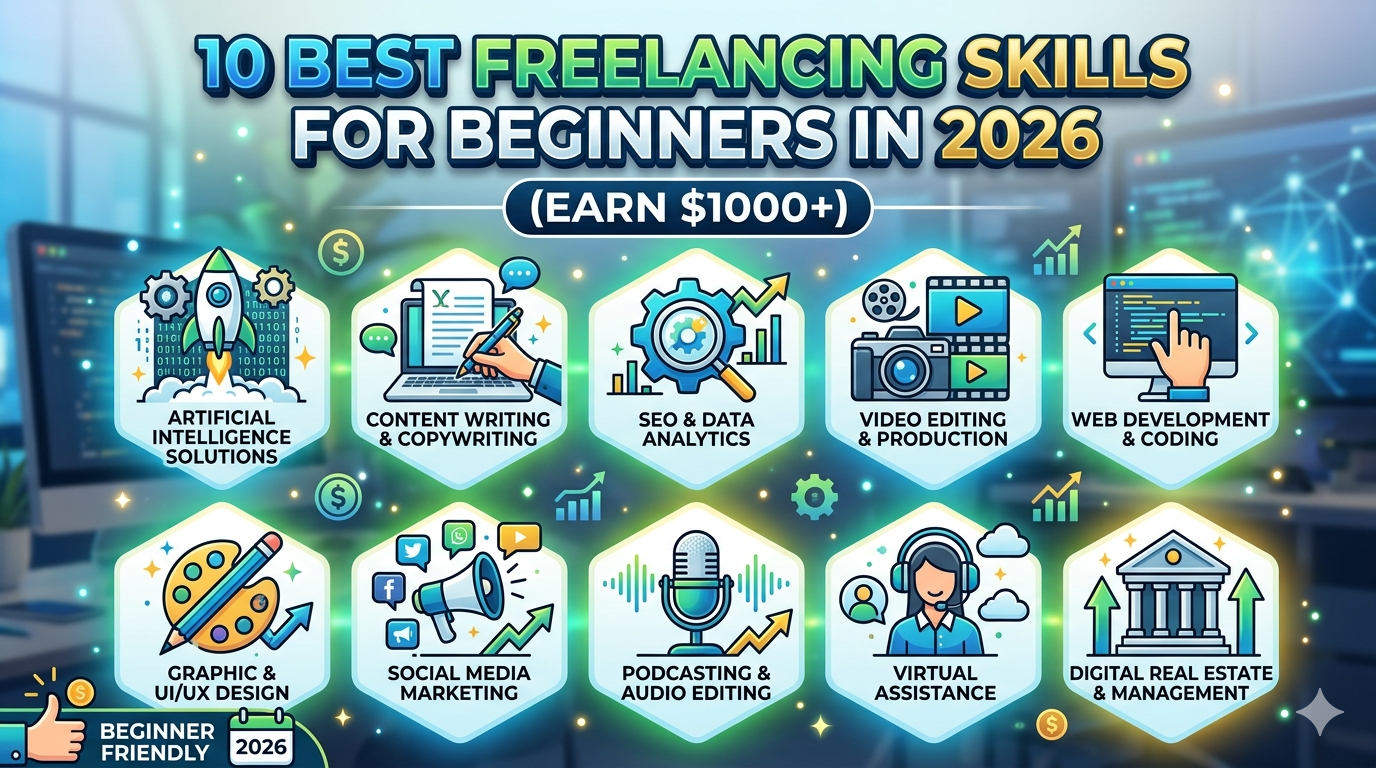
In 2026, freelancers who succeed are problem-solvers, not task-doers. This guide highlights the 10 best freelancing skills for beginners that can help you earn $1,000+ per month, scale quickly, and future-proof your career.
What Changed in 2026
Here’s the reality.
We’ve moved past the gig economy. Way past it. We’re now living in the Expert Economy.
Let me explain what that means.
| Old Gig Economy | New Expert Economy |
|---|---|
| Do what you’re told | Solve complex problems |
| Charge by the hour | Charge for results |
| Compete on price | Compete on expertise |
| Replaceable | Indispensable |
| Side hustle mindset | Career mindset |
Freelancing isn’t a side hustle anymore. It’s a global career path. Millions of people are earning full-time incomes from home. They’re not just surviving. They’re thriving.
But here’s the catch. Not everyone is winning.
The ones who succeed are the ones who have mastered high-income skills. The ones who learned how to solve problems that AI can’t touch. The ones who positioned themselves as experts, not task-doers.
The Question You Need to Ask Yourself
Whether you’re a student looking for side income, a professional trying to escape your 9-to-5, or a future digital nomad planning your next adventure, the question has changed.
It’s no longer “how do I start?” That part is easy. You start by opening a laptop and creating a profile. The real question is:
Which skills will make me indispensable in a world dominated by AI?
Think about that for a moment. AI can write. AI can design. AI can even code.
But AI cannot solve unique problems. AI cannot build genuine relationships. AI cannot provide the human judgment that clients truly value. The freelancers who understand this are the ones charging 100,150, or even $200 per hour. The ones who don’t? They’re competing with bots for $5 gigs.
The Shift You Must Make
Here’s what I’ve learned after years of freelancing.
The old approach was simple. Learn a task. Do the task. Get paid. The new approach is different. You must become a problem-solver. Not a task-doer.
| Task-Doer | Problem-Solver |
|---|---|
| “I will write 500 words” | “I will help you rank on Google” |
| “I will design a logo” | “I will build your brand identity” |
| “I will manage your inbox” | “I will save you 15 hours per week” |
See the difference?
Task-doers are replaceable. Problem-solvers are indispensable. Clients pay premium rates to people who solve their biggest headaches. Not to people who check boxes.
What This Guide Will Show You
I’ve put together the 10 best freelancing skills for beginners in 2026.
Skills that can help you earn $1,000+ per month. Skills that scale quickly.
Skills that will future-proof your career against automation. But here’s what makes this guide different. I’m not just listing skills. I’m showing you why they work in 2026. How to learn them fast. And how to position yourself as a problem-solver, not a task-doer.
Your First Step
Close this guide. Open a new tab.
Pick one skill from the list below. Spend 30 minutes learning something about it.
That’s it. That’s your only task.
Because the best time to start was yesterday. The next best time is now.
Ready? Let’s go. 🚀
The Three Principles That Work in 2026
Before we dive into the skills, you need to understand three things.
1. Hybrid Advantage
The winning freelancers in 2026 don’t fight AI. They use it.
They blend human judgment with AI efficiency. They let AI handle the repetitive stuff. They focus their energy on the creative, strategic, and relational work that machines cannot do.
AI is not your enemy. It’s your assistant. Learn to use it.
2. The Trust Economy
Clients are tired of generic, AI-generated content. They can spot it from a mile away.
What they want now is authentic, human-verified quality. They want to know a real person is behind the work. They pay more for trust.
Your humanity is your competitive advantage.
3. Niche Over General
Here’s a hard truth.
Generalists struggle. Specialists thrive.
A freelancer who offers “social media management for real estate agents” will always earn more than someone who offers “social media management for everyone.”
Specialization builds trust. Trust commands higher rates. Higher rates build sustainable careers.
Pick a niche. Go deep. Stop trying to serve everyone.
What Success Looks Like in 2026
Let me paint a picture for you.
Imagine waking up without an alarm. You make coffee. You walk to your home office. You open your laptop.
You have messages from clients who trust you. They’ve already paid. They just need your expertise.
You solve their problems. You deliver value. You close your laptop at 2 PM.
Not because you’re lazy. Because you’re efficient.
Because you focused on skills that matter. Because you positioned yourself as an expert. Because you stopped competing on price and started competing on value.
That’s not a dream. That’s what thousands of freelancers are living right now.
And you can too.
Before You Read Further
Here’s my only warning.
These skills won’t make you rich overnight. Anyone promising “easy money” is lying.
But if you’re willing to learn, to practice, to fail forward, to keep showing up – these skills will transform your income and your life.
Not in a week. Not in a month.
But in 6-12 months of focused effort, you can build a freelance career that gives you freedom, flexibility, and financial stability.
The question isn’t whether it’s possible.
It’s whether you’re ready to start.
1. High-Impact Content Writing & Strategic Copywriting
Earning Potential: $0.10 – $1.00 per word / $500 – $5,000 per sales page
While AI can generate generic content, it cannot replicate empathy, brand voice, or high-stakes persuasion. Content writing in 2026 has evolved into Revenue Writing.
Opportunities:
- Ghostwriting LinkedIn thought-leadership posts for executives.
- Writing email sequences that convert subscribers into buyers.
- Crafting white papers and case studies for B2B clients.
Pro Tip: Offer packages, e.g., a blog post + newsletter summary + social media snippets, to maximize value and rates.
2. Advanced SEO & Search Experience Optimization (SXO)
Earning Potential: $1,000 – $5,000+ per month
SEO in 2026 focuses on Search Experience Optimization rather than keyword stuffing. Google rewards helpful, human-centered content.
Key Skills:
- Programmatic SEO: Creating thousands of optimized pages efficiently.
- Entity-Based SEO: Teaching Google “who” and “what” your brand is.
- Technical Audits: Ensuring fast, mobile-friendly, error-free websites.
Beginner Path: Start with keyword research, on-page SEO, and content optimization for small businesses.
3. Video Editing & Visual Storytelling
Earning Potential: $50 – $300 per short-form video
Short-form video dominates social media. Brands pay top dollar for videos that engage audiences.
Opportunities:
- TikTok/YouTube Shorts with fast-paced captions.
- Faceless YouTube channels using stock footage and AI voiceovers.
- Corporate training videos transformed into engaging content.
Tools: CapCut Desktop (fast editing) → Adobe Premiere Pro (professional quality).
4. Full-Stack Digital Marketing & Funnel Building
Earning Potential: $2,000+ per month
A modern digital marketer is a Growth Architect, optimizing the entire customer journey.
Sub-Skills:
- Paid social ads (Meta/TikTok).
- Conversion Rate Optimization (CRO).
- Omnichannel messaging for consistent brand presence.
Pro Tip: Offer performance-based packages (e.g., % of sales) to scale earnings quickly.
5. No-Code Web Development & E-Commerce
Earning Potential: $1,500 – $10,000 per website
No-Code platforms make web development accessible to beginners. You can build fully functional websites and stores without extensive coding knowledge.
Platforms to Learn:
- Shopify: Ideal for dropshipping or 3PL stores.
- Webflow/Framer: For artistic, high-end websites.
- WordPress (Elementor/Divi): Perfect for local businesses and small enterprises.
6. AI Operations & Workflow Automation
Earning Potential: $100 – $250 per hour
AI is now essential but complex for businesses. Freelancers who know how to integrate AI tools are highly paid.
Key Roles:
- Prompt engineering for marketing teams.
- Connecting AI to CRMs and Slack using Zapier or Make.com.
- Building custom AI bots trained on company data.
Pro Tip: Use AI to assist your work, not replace your human input.
7. Graphic Design & Brand Identity
Earning Potential: $500 – $3,000 per brand kit
Design is no longer just visual—it’s strategic identity creation.
Opportunities:
- UI/UX for apps and websites.
- YouTube thumbnails that improve CTR.
- Investor pitch decks for startups.
Pro Tip: Combine AI tools like Midjourney for inspiration with your human creative strategy.
8. Specialized Virtual Assistance / Online Business Management
Earning Potential: $20 – $50 per hour
The “Data Entry VA” is outdated. Businesses pay for Executive VAs or Online Business Managers (OBMs) who can run operations while the founder sleeps.
Key Services:
- Project management using ClickUp or Notion.
- Customer success for high-ticket coaching programs.
- Podcast management: booking, editing, and distributing episodes.
How to Choose Your Path: The IKIGAI Method
Consider three questions before choosing your skill:
- What are you naturally good at? (Organizing, writing, solving problems)
- What does the market need? (Check Upwork, Fiverr, LinkedIn job postings)
- What can you get paid for immediately? (Can you sell a $50 service tomorrow?)
Step-by-Step Roadmap: From Zero to $3k/Month
Phase 1: Skill Sprint (Days 1–30)
- Focus on one skill. 2 hours/day learning, 2 hours/day cloning professional work.
- Designers: recreate 10 logos. Writers: rewrite 5 top-performing blogs.
Phase 2: Proof Portfolio (Days 31–45)
- Build a live portfolio:
- SEOs: rank a blog post.
- Video editors: edit trending content.
- Devs: build a mock Shopify store.
Phase 3: Outreach Engine (Days 46–60)
- Cold email businesses with audits or improvement suggestions.
- LinkedIn: post 3x/week in your niche.
- Upwork: apply to 3 personalized jobs/day.
Common Pitfalls to Avoid
- The AI-Crutch Trap: Don’t let AI do 100% of the work.
- Undercharging: Avoid $5/hour jobs; charge mid-range rates.
- The Lone Wolf Mentality: Join communities to find high-paying opportunities.
Conclusion: Adaptability is Key
Let me leave you with something important.
The barrier to entry for freelancing is low. Anyone with a laptop and internet connection can call themselves a freelancer. But here’s what most people don’t realize. The ceiling is extremely high.
The barrier to entry for freelancing is low, but the ceiling is extremely high. Whether you choose SEO, Video Editing, AI Operations, or Content Writing, success requires consistency, communication, and continuous learning.
Your laptop is your office, your skills are your currency, and the global market is your playground. The question isn’t whether you can succeed—it’s which skill you’ll master first. Start today.
The Gap Most Freelancers Never Cross
Most freelancers stay at the bottom. They compete for $5 gigs. They fight with hundreds of others for the same low-paying projects. They wonder why it’s so hard to make real money.
Then they quit.
But a small group breaks through. They climb the ladder. They charge 50,100, or even $200 per hour. What’s the difference? It’s not talent. It’s not luck.
It’s adaptability. The freelancers who win are the ones who:
-
Learn new skills before they become mainstream
-
Adapt to market changes instead of fighting them
-
Use AI as a tool, not a crutch
-
Specialize instead of staying general
-
Build relationships instead of just completing tasks
That’s what separates the struggling freelancer from the successful solopreneur.
The Common Pitfalls (And How to Avoid Them)
Let me save you the pain I went through.
Here are the traps that keep beginners stuck:
The AI-Crutch Trap
AI is powerful. It can write, design, and analyze. But clients don’t pay for AI-generated work. They pay for human refinement.
Don’t let AI do 100% of the work. Use it to save time. Then add your human touch. That’s where the value is.
The Undercharging Trap
I see beginners charging $5/hour and wondering why they’re burned out.
Here’s the truth. Low prices attract bad clients. Bad clients demand endless revisions. Endless revisions kill your motivation. Charge mid-range rates from the start. 15−25/hour as a beginner. Once you have reviews, raise to 30−40. Keep climbing. You’re not doing anyone a favor by working for free.
The Lone Wolf Mentality
Freelancing can be lonely. Many beginners try to do everything alone. They don’t ask for help. They don’t join communities. They don’t network.
That’s a mistake.
Join freelancing communities on Facebook, Reddit, or Discord. Share your wins and failures. Ask questions. Learn from others who’ve been where you are. Some of my best clients came from referrals in these communities. Don’t go it alone.
What Success Actually Looks Like
Let me paint a realistic picture.
Success in freelancing isn’t about working 80 hours a week. It’s not about sacrificing your health or relationships.
Success is:
-
Waking up without an alarm
-
Working with clients who respect you
-
Earning enough to cover your bills and save for the future
-
Having time for family, friends, and hobbies
-
Feeling proud of the work you create
That’s the goal. Not millions of dollars. Not a fancy office. Just freedom and stability. And it’s achievable. Thousands of freelancers are living this reality right now.
The Skills That Will Carry You Forward
Whether you choose SEO, video editing, AI operations, content writing, or any other skill from this guide, the same principles apply.
| Principle | Why It Matters |
|---|---|
| Consistency | Show up every day, even when motivation is low |
| Communication | Reply fast, be clear, over-deliver |
| Continuous learning | Markets change. Skills evolve. You must too. |
These three things matter more than talent. More than experience. More than your degree.
Master them, and you’ll succeed in any freelancing niche.
Your Laptop Is Your Office
Here’s something that still amazes me.
I work from home. My laptop is my office. My living room is my boardroom. No commute. No dress code. No asking permission for time off.
Your laptop is your office. Your skills are your currency. The global market is your playground.
You can work for clients in New York while sitting in a small town. You can earn in dollars while living where costs are lower. You can build a career on your own terms. That freedom is real. And it’s available to anyone willing to learn and adapt.
The Question Isn’t Whether You Can Succeed
Let me be clear.
Success in freelancing is not a mystery. It’s not reserved for the lucky few.
The path is clear:
-
Pick one skill
-
Learn it deeply
-
Build a simple portfolio
-
Create profiles on 1-2 platforms
-
Send proposals or create gigs
-
Deliver great work
-
Ask for reviews
-
Raise your prices
-
Repeat
The question isn’t whether you can succeed.
The question is which skill you’ll master first.
Because you can’t learn them all at once. You can’t be great at everything immediately.
Pick one. Commit to 90 days. Give it everything you have.
Then evaluate. Adjust. Keep going.
Your First Client Is Waiting
Somewhere right now, a client is posting a job. They need exactly what you’re learning to do.
They’re frustrated. They’ve tried doing it themselves. They’ve tried AI. Nothing works.
They need a real human who can solve their problem.
That human could be you.
But they can’t hire you if you don’t apply.
So here’s what I need you to do.
Stop reading. Open a new tab. Create a profile on one platform. Write one proposal or create one gig.
Today.
Not tomorrow. Not next week.
Today.
Final Words (Read This Twice)
The freelancing economy in 2026 is bigger than ever. Millions of dollars flow through these platforms every day. Clients are desperate for skilled professionals who can solve real problems.
But the window won’t stay open forever. Every month you wait, more freelancers enter the market. More AI tools emerge. More competition arrives. The best time to start was yesterday. The second-best time is now. You have the guide. You have the skills. You have everything you need. The only missing piece is you taking that first step. So here’s my challenge.
Thirty days from now, I want you to look back and see progress. One client. One review. One dollar earned through your own skill. That’s all it takes to build momentum. One small win leads to another. And another. And another. Before you know it, you’re not a beginner anymore. You’re a professional. But it starts with one decision. Made today.
Your freelancing career is waiting.
Go claim it. 🚀
Frequently Asked Questions (FAQs) – 10 Best Freelancing Skills for Beginners in 2026
1. Which freelancing skill is best for absolute beginners in 2026?
Great question. Here’s my honest answer based on what I’ve seen work.
| Skill | Why It’s Good for Beginners | Learning Time |
|---|---|---|
| Virtual Assistance | Lowest learning curve, always in demand | 1-2 weeks |
| AI Content Editing | AI does the heavy lifting, you refine | 2-3 weeks |
| Social Media Management | You already use these platforms | 2-3 weeks |
| Graphic Design (Canva) | Free tool, tons of templates | 3-4 weeks |
If you want to earn quickly, start with AI content editing or virtual assistance. If you want higher long-term rates, learn SEO or video editing.
The “best” skill is the one you’ll actually stick with for 90 days.
2. Do I need a degree to learn these skills?
No. Let me be crystal clear.
None of these skills requires a college degree. Clients care about your portfolio and your results, not your diploma.
I’ve seen high school graduates earn more than MBA holders because they focused on building real skills and showing real results.
Your degree doesn’t matter. Your ability to solve problems does.
3. How long does it take to learn a freelancing skill?
Here’s a realistic timeline based on 10-15 hours of practice per week:
| Skill | Basic Competence | Client-Ready | High Income Level |
|---|---|---|---|
| Virtual Assistance | 1-2 weeks | 3-4 weeks | 2-3 months |
| AI Content Editing | 2-3 weeks | 4-6 weeks | 3-4 months |
| Social Media Management | 2-3 weeks | 4-6 weeks | 3-4 months |
| Graphic Design | 3-4 weeks | 6-8 weeks | 4-6 months |
| SEO | 4-6 weeks | 2-3 months | 6-9 months |
| Video Editing | 6-8 weeks | 3-4 months | 6-12 months |
You can start earning at the “Client-Ready” stage. “High Income Level” comes with experience and reviews.
Don’t wait until you’re an expert. Start when you can help someone solve a small problem.
4. How much can I really earn as a beginner?
Let me give you honest numbers based on real freelancers.
| Experience Level | Monthly Income (Part-Time) | Monthly Income (Full-Time) |
|---|---|---|
| First 1-3 months | 200–500 | 500–1,500 |
| 3-6 months | 500–1,500 | 1,500–3,000 |
| 6-12 months | 1,000–3,000 | 3,000–6,000 |
| 12+ months | 2,000–5,000+ | 5,000–10,000+ |
These numbers assume consistent effort (10-15 hours/week for part-time, 30-40 hours/week for full-time).
Some people earn faster. Some take longer. The key is to keep going.
5. Do I need a portfolio before I get my first client?
Yes and no.
You don’t need paid client work. But you do need samples.
Here’s how to build a portfolio without clients:
| Skill | How to Create Samples |
|---|---|
| Content Writing | Write 5 blog posts on topics you enjoy |
| Graphic Design | Recreate 10 logos for fake companies |
| Video Editing | Edit trending content from TikTok/YouTube |
| SEO | Optimize your own blog post and try to rank it |
| Virtual Assistance | Create sample email templates and schedules |
Put these samples in a Google Drive folder or a free portfolio site. Link them in your proposals.
Clients want to see what you can do. They don’t care if you were paid for it.
6. Which platform should I use to find clients?
Here’s my recommendation based on your chosen skill:
| Skill | Best Platform | Why |
|---|---|---|
| Content Writing | Upwork, LinkedIn | Higher rates, professional clients |
| Video Editing | Fiverr, Upwork | Short-form video is huge on both |
| SEO | Upwork, LinkedIn | Long-term contracts, higher pay |
| Graphic Design | Fiverr, 99designs | Visual work sells well on gigs |
| Virtual Assistance | Upwork, Facebook Groups | Many small businesses need help |
| AI Operations | Upwork, Fiverr | Both have demand for AI services |
Don’t sign up for five platforms at once. Pick one. Master it. Then expand.
7. How do I find my first client?
Here’s the exact process that works:
| Step | Action | Time |
|---|---|---|
| 1 | Create a complete profile with a real photo | 30 minutes |
| 2 | Add 3-5 samples of your work | 1-2 hours |
| 3 | Write a clear headline and bio | 30 minutes |
| 4 | Send 10-15 personalized proposals daily (Upwork) OR create 3-5 optimized gigs (Fiverr) | 1-2 hours/day |
| 5 | Follow up politely after 2-3 days | 15 minutes |
| 6 | Repeat until you get a yes | Daily |
The first client is the hardest. Once you have one review, the second comes easier. Once you have five reviews, clients start finding you.
Don’t give up before you get that first win.
8. What should I charge as a beginner?
Here’s a simple pricing guide for beginners:
| Experience Level | Hourly Rate | Per Small Project |
|---|---|---|
| First 3 projects | 10–15 | 20–50 |
| After 5 good reviews | 15–25 | 50–150 |
| After 10+ reviews | 25–40 | 150–500 |
| Established (6+ months) | 40–75+ | 500–2,000+ |
Start at the lower end to get your first reviews. Then raise your prices every 2-3 months.
Don’t work for $5/hour. You’re not helping anyone by undervaluing yourself.
9. Which skill pays the most in 2026?
Based on current market data, here’s the earning hierarchy:
| Skill | Typical Rate | Top Earners |
|---|---|---|
| AI Operations / Automation | 100–250/hour | $10,000+/month |
| SEO (Advanced) | 50–150/hour | 5,000–15,000/month |
| Video Editing | 50–300/video | 4,000–10,000/month |
| Web Development (No-Code) | 50–100/hour | 5,000–15,000/month |
| Digital Marketing | 40–100/hour | 4,000–10,000/month |
| Copywriting | 0.10–1/word | 3,000–10,000/month |
| Graphic Design | 30–80/hour | 3,000–8,000/month |
| Virtual Assistance | 20–50/hour | 2,000–5,000/month |
AI Operations and SEO pay the most, but they take longer to learn. Virtual Assistance pays less but is fastest to start.
Choose based on your patience and goals.
10. Can I learn these skills for free?
Yes. Absolutely.
Here are free resources for each skill:
| Skill | Free Learning Resources |
|---|---|
| Content Writing | Medium, HubSpot Academy, YouTube |
| SEO | Moz Beginner’s Guide, Google SEO Starter Guide |
| Video Editing | CapCut (free), Davinci Resolve (free), YouTube tutorials |
| Graphic Design | Canva Design School, YouTube |
| Virtual Assistance | YouTube, Free VA courses on Skillshare (free trial) |
| No-Code Web Dev | Webflow University, Shopify Compass (free tier) |
You don’t need to spend money on expensive courses. Everything you need to start is available for free.
Invest in paid courses only after you’ve earned money and want to level up.
11. Is freelancing oversaturated in 2026?
Yes and no. Let me explain.
Low-skill areas are crowded. Basic data entry, simple transcription, and generic writing. Hundreds of freelancers fight for $5 gigs.
Specialized, high-demand skills face talent shortages. Good SEO experts are hard to find. Skilled AI content editors are in demand. Competent video editors can name their price.
The market isn’t saturated for skilled professionals. It’s saturated for people who refuse to level up.
Focus on niche expertise. Become the best in a small area. You’ll never struggle to find work.
12. How do I stand out from other freelancers?
Here’s what actually works:
| Strategy | Why It Works |
|---|---|
| Pick a niche | “Social media for real estate agents” beats “social media for everyone” |
| Reply fast | Most freelancers take hours. Reply in minutes. |
| Deliver early | Submit work 24 hours before the deadline |
| Ask good questions | Show you understand their problem |
| Follow up | Politely check in after proposals |
| Build relationships | Past clients are your best source of new work |
These things matter more than talent. More than experience. More than your portfolio.
Be easy to work with. Deliver quality. Communicate clearly. You’ll never lack clients.
13. Can I freelance while working a full-time job?
Yes. This is how most people start.
Here’s a realistic weekly schedule:
| Day | Time | Task |
|---|---|---|
| Monday-Friday | 1-2 hours after work | Learn skills, send proposals |
| Saturday | 3-4 hours | Complete projects, build portfolio |
| Sunday | 2-3 hours | Plan next week, apply to jobs |
That’s 10-15 hours per week. Within 3-6 months, you can replace a significant portion of your income.
Once you consistently earn enough to cover your expenses, you can decide whether to go full-time freelance.
No rush. Build at your own pace.
14. What if I fail or get rejected?
Expect rejection. Accept it. Learn from it.
Every successful freelancer has been rejected more times than they can count.
| Rejection | What It Means | What To Do |
|---|---|---|
| No reply | They didn’t see your proposal | Improve your subject line |
| “Not selected” | Someone else was a better fit | Ask for feedback if possible |
| Lowball offer | They don’t value your skill | Politely decline or negotiate |
| Ignored after follow-up | Move on | Not every client is your client |
Don’t take rejection personally. It’s not about you. It’s about fit.
Each no moves you closer to a yes. Keep going.
15. What’s the single biggest mistake beginners make?
Trying to do everything at once.
They open accounts on five platforms. They try to learn three different skills. They watch tutorials for everything.
Then they burn out in two weeks.
Don’t be that person.
Pick ONE platform. Pick ONE skill. Focus for 90 days.
That’s not a limitation. That’s a winning strategy.
16. How do I know which skill is right for me?
Ask yourself three questions:
| Question | What It Reveals |
|---|---|
| What am I naturally good at? | Organizing? Writing? Solving problems? Designing? |
| What does the market need? | Check Upwork, Fiverr, LinkedIn job postings |
| What can I get paid for immediately? | Can you sell a $50 service tomorrow? |
The intersection of these three answers is your ideal skill.
Don’t overthink it. Pick one. Start. You can always switch later.
17. Do I need to know AI to freelance in 2026?
Not necessarily. But it helps enormously.
Here’s the reality:
| Without AI | With AI |
|---|---|
| Write 1 article in 2 hours | Write 1 article in 30 minutes |
| Design 1 logo in 3 hours | Design 5 concepts in 1 hour |
| Edit 1 video in 4 hours | Edit 1 video in 1.5 hours |
AI makes you faster. Faster means you can take more projects or charge the same for less time.
You don’t need to be an AI expert. But learning basic AI tools will double your earning potential.
Start with ChatGPT for writing, Canva AI for design, or CapCut AI for video editing.
18. How long until I replace my full-time job?
Here’s a realistic timeline assuming consistent part-time effort (10-15 hours/week):
| Phase | Timeframe | Income Level | Action |
|---|---|---|---|
| Learning | Month 1 | 0–200 | Focus on skill development |
| First clients | Month 2-3 | 200–800 | Building portfolio and reviews |
| Consistent income | Month 4-6 | 800–2,000 | Regular clients, repeat work |
| Replacement ready | Month 7-12 | 2,000–5,000+ | Can consider going full-time |
Most people replace their full-time income within 6-12 months of consistent effort.
Some do it faster. Some take longer. The key is to keep going.
19. What tools do I need to start?
Here’s the basic toolkit for each skill:
| Skill | Essential Tools (Free Options) |
|---|---|
| Content Writing | Google Docs, Grammarly (free), ChatGPT (free) |
| SEO | Google Search Console, Ubersuggest (free tier) |
| Video Editing | CapCut (free), DaVinci Resolve (free) |
| Graphic Design | Canva (free), GIMP (free) |
| Virtual Assistance | Google Suite, Trello (free), Calendly (free) |
| No-Code Web Dev | Webflow (free tier), Shopify (free trial) |
Start with free tools. Upgrade only when you’re earning money and need specific features.
Don’t buy expensive software before you make your first dollar.
20. What’s the one piece of advice you’d give someone starting today?
Start before you’re ready.
You’ll never feel ready. Your profile will never feel perfect. Your portfolio will never feel complete.
That’s fine.
Start anyway. Send imperfect proposals. Make mistakes. Learn from them. Improve slowly.
The perfect time to start was yesterday. The next best time is now.
Close this guide. Open your freelancing platform. Take one small action today.
That’s how freelancing careers are built. One small action at a time.
Now go start. 🚀

One Comment