
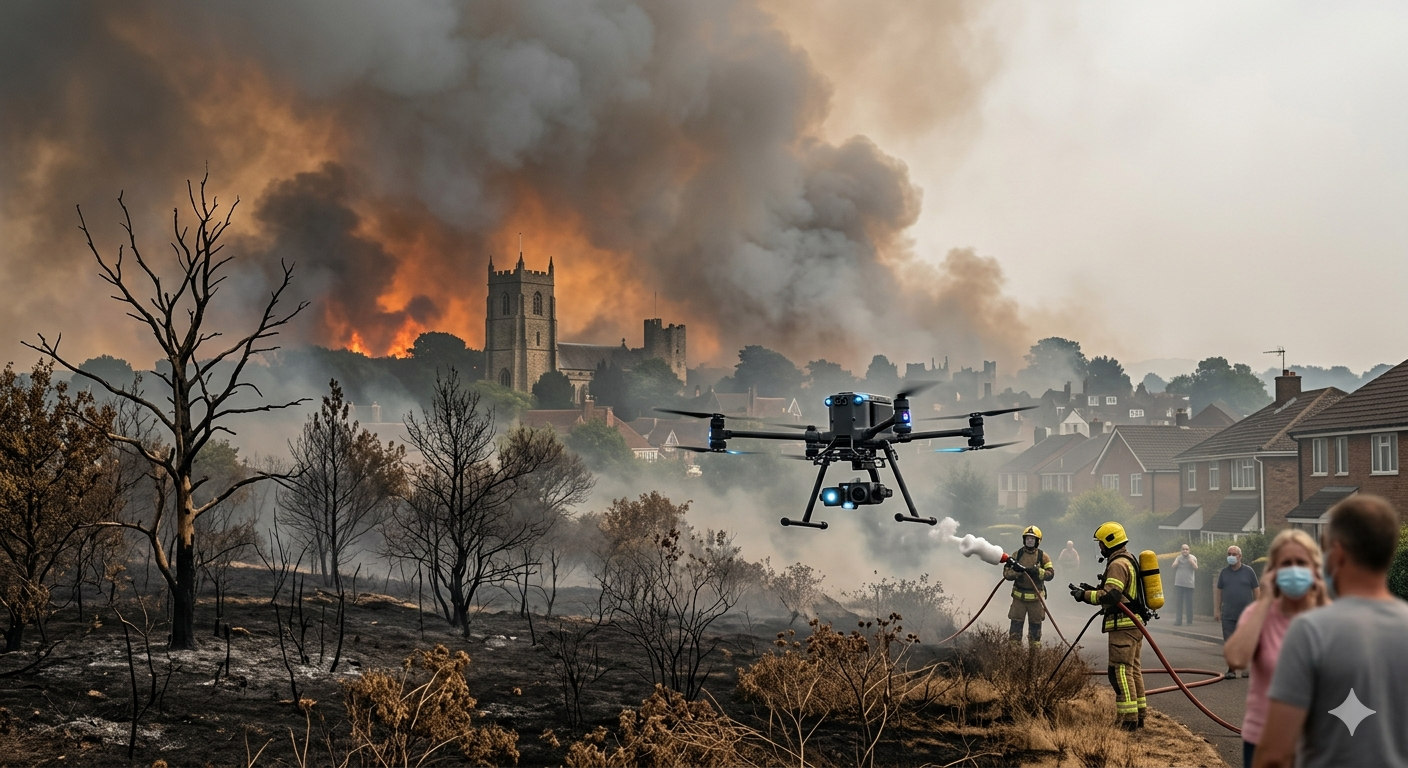
UK Climate Emergency: The 2026 Wildfire Crisis Guide
UK Climate Emergency: The 2026 Wildfire Crisis Guide
As we move through the first quarter of 2026, the global climate landscape has shifted from a “warning” to a full-blown “survival” phase. For the United Kingdom—a nation historically defined by its drizzle and mild summers—the reality of 40°C+ heatwaves and uncontrollable wildfires has become the new, terrifying norm. 2025 was a turning point, but 2026 is where the implementation of radical policy and individual responsibility must collide.
This isn’t just about melting ice caps anymore; it’s about the smoke filling the lungs of residents in London, the scorched heathlands of Surrey, and the disappearing biodiversity of the Scottish Highlands. In this definitive guide, we break down the science of the 2025-26 crisis, the devastating impact of wildfires, and the roadmap for a sustainable future.
Table of Contents
-
Introduction: The 2026 Climate Reality Check
-
1. The UK’s New Climate Profile: Beyond 40°C
-
2. Why the Crisis is Intensifying: The Greenhouse Effect 2.0
-
3. The Wildfire Epidemic: A 30% Surge in 2025-26
-
Impact on Biodiversity and Habitats
-
Air Quality: The Invisible Health Threat
-
-
4. Government Policy: Are We Doing Enough?
-
5. Futuristic Solutions: AI, Drones, and Fire-Resistant Urbanism
-
6. Individual Agency: How to Reduce Your Carbon Footprint
-
7. The Economic Cost of Climate Neglect
-
Conclusion: The Time to Act is Yesterday
-
Frequently Asked Questions (FAQs)
1. The UK’s New Climate Profile: Beyond 40°C
The myth of the “mild British summer” died in 2025. With record-breaking temperatures surpassing 40.3°C, the UK infrastructure—designed for cold and rain—is struggling to cope. In 2026, we are seeing the driest spring on record, leading to “Tinderbox Britain” where a single cigarette butt or a stray spark from a BBQ can incinerate miles of forest within hours.
2. Why the Crisis is Intensifying: The Greenhouse Effect 2.0
The primary driver remains human activity. The burning of fossil fuels releases carbon dioxide ($CO_2$) and methane ($CH_4$), which act like a thermal blanket around the Earth.
In 2026, the concentration of $CO_2$ in the atmosphere has reached a staggering 425 ppm (parts per million), a level not seen in millions of years. This warming doesn’t just make things “hotter”; it disrupts the jet stream, leading to prolonged droughts and sudden, violent storms.
3. The Wildfire Epidemic: A 30% Surge in 2025-26
Wildfires in the UK are no longer “rare events.” In 2025, England and Wales saw a 30% increase in wildfire incidents compared to the previous five-year average.
Destruction of Wildlife and Habitats
Our native species—deer, rare birds like the Nightjar, and essential pollinators—are losing their homes. A wildfire doesn’t just burn trees; it sterilizes the soil, making it nearly impossible for native flora to return for decades. This leads to an “Ecological Collapse” where the food chain is broken from the bottom up.
Air Quality: The Invisible Health Threat of UK Climate
Crucially, wildfire smoke contains PM2.5 (fine particulate matter) that can penetrate deep into the human bloodstream. For instance, during the peak fires of 2025, air quality in parts of Northern England reached “Hazardous” levels. As a result, this led to a significant spike in hospital admissions for both respiratory and cardiovascular issues. Consequently, the public health impact of these fires is no longer a distant threat but a current medical emergency.
4. Government Policy: Are We Doing Enough?
On the other hand, the UK government has officially pledged to reach “Net Zero by 2050.” However, as we move through 2026, critics argue that the actual pace of change remains far too slow. Specifically, environmental experts point out that while targets are set, the practical implementation on the ground is lacking. Therefore, there is an urgent need for more aggressive legislative action to match the speed of the climate crisis.
-
The Green Grid: While renewable energy (wind and solar) now accounts for over 45% of the UK’s power, the transition of the heating and transport sectors remains a massive hurdle.
-
Urban Planning: New regulations now require “Firebreaks” around residential developments near woodland, but retrofitting older towns is an expensive and slow process.
5. Futuristic Solutions of UK Climate: AI, Drones, and Fire-Resistant Urbanism
The battle against the climate emergency is being bolstered by technology:
-
AI-Powered Detection: Artificial Intelligence systems now analyze satellite imagery and thermal sensors to detect “hotspots” before a flame even becomes visible to the human eye.
-
Firefighting Drones: In 2026, the UK Fire Services started deploying drones that can drop specialized fire-retardant foam in inaccessible terrains like the Scottish Moors.
-
Carbon Capture (CCS): Large-scale plants are being tested to literally “suck” $CO_2$ out of the air and store it safely underground in depleted North Sea gas fields.
6. Individual Agency: How to Reduce Your Carbon Footprint
Government action is a top-down necessity, but bottom-up individual change is equally powerful.
-
Energy Transition: Switching to heat pumps and electric vehicles can reduce a household’s carbon output by up to 60%.
-
Defensible Space: If you live near rural areas, use fire-resistant plants like lavender or succulents and keep a “clear zone” around your property.
-
Consumption Habits: Reducing meat consumption and opting for “circular fashion” (recycling clothes) significantly lowers the global demand for carbon-intensive industries.
Aapke article mein Transition Words (rabt paida karne wale alfaz) ki kami ki wajah se readability score low ho sakta hai. Google aur SEO tools (jaise Yoast ya RankMath) aise content ko pasand karte hain jahan sentences ek dusre ke saath logically jude hon.
Niche maine aapke Section 7 aur Conclusion ko transition words (bold mein) ke saath rewrite kiya hai taake flow behtar ho jaye:
7. The Economic Cost of Climate Neglect
Ultimately, the cost of not acting is far higher than the cost of the transition. For instance, in 2025 alone, the UK spent over £2 billion on wildfire damages, agricultural losses due to drought, and healthcare costs related to heatwaves. Furthermore, by 2030, this figure is expected to triple if global warming is not capped at 1.5°C. Consequently, failing to invest in green infrastructure now will lead to an even more severe financial burden in the near future.
Conclusion: The Time to Act is Now
In summary, the climate emergency is no longer a “future problem” for our grandchildren. Instead, it is already here—in our gardens, our parks, and our streets. As a result, as we navigate the challenges of 2026, we must recognize that every choice matters. Whether it is the policies we vote for or the way we consume energy, every action is a vote for either a scorched earth or a green, resilient future. Therefore, we must commit to change today before the window of opportunity closes forever.
To read more about Asian Weather updates, Click Here.
Frequently Asked Questions (FAQs)
Q1: Why are wildfires increasing in the UK?
Rising temperatures and prolonged periods of drought (caused by climate change) make the vegetation extremely dry, acting as fuel for fires triggered by human negligence or lightning.
Q2: Can AI really stop wildfires?
AI cannot “stop” them, but it can detect them in the first few minutes, allowing firefighters to extinguish them before they grow out of control.
Q3: Is 40°C going to be normal for UK summers?
Current climate models suggest that by 2040, a 40°C summer will happen once every 3-5 years unless global carbon emissions are drastically reduced.
Q4: How can I protect my home from wildfires?
Create a “fire-resistant” buffer zone by removing dry leaves, using non-combustible roofing materials, and planting high-moisture vegetation near the house.
Build a Career in the Green Economy
The world is changing, and so is the job market. As we tackle the climate crisis, “Green Skills” are becoming the highest-paid and most in-demand expertise globally.






One Comment