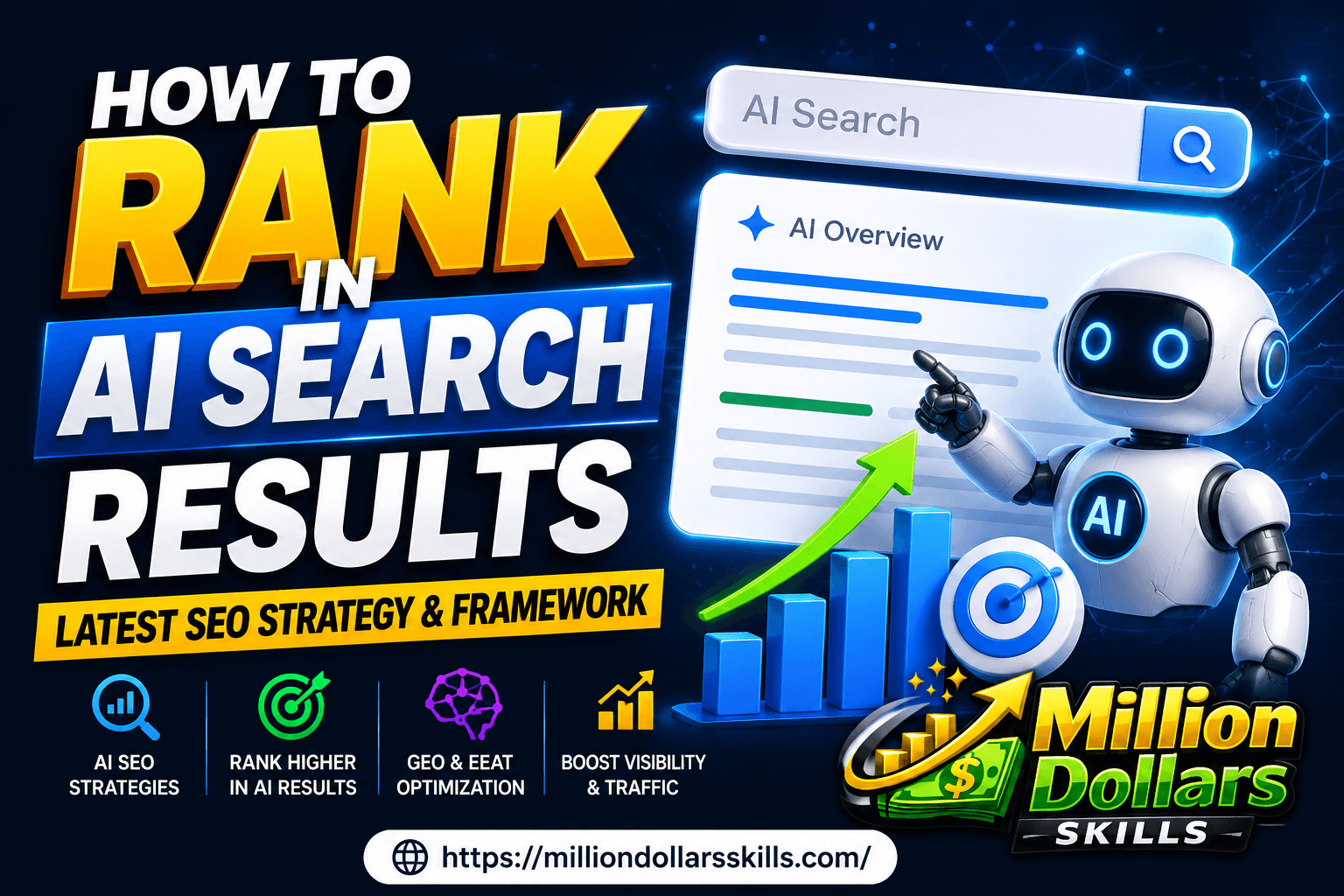
How to Dominate AI Search Rankings (Proven Strategy & Human-Centric Framework)
How to Dominate AI Search Rankings (Proven Strategy & Human‑Centric Framework)
Introduction: Why Most Brands Are Losing the AI Search Game (And How Yours Can Win)
Let’s be honest for a moment.
You’ve probably seen it happening. People don’t just “Google” things anymore.
They open ChatGPT, Perplexity, or Google’s own AI Mode and simply ask.
“What’s the best project management tool for a remote team?”
“Is Brand X actually reliable for enterprise security?”
“Who should I trust for affordable web hosting?”
Within seconds, the AI serves a clean, paragraph‑style answer. No blue links. No scrolling through ads. Just a direct, useful response.
Sounds great for users. But for brands? It’s a whole new battlefield.
Here’s what most businesses miss entirely.
Behind every single AI‑generated answer, two things happen automatically – whether you like it or not:
-
Certain brands are named inside the answer itself.
Example: “According to Brand X, the best approach is…” -
Sources get shown as proof – clickable links that back up what the AI just said.
That combination – being mentioned and cited is what I call AI search visibility.
And here’s the painful truth most companies discover too late:
Most brands get one. Very few get both.
You might get mentioned in a ChatGPT answer, but without a source link, you lose credibility.
Or your content gets cited as a reference, but your brand name never appears – so nobody remembers you.
Either way, you become invisible in the fastest‑growing discovery channel of this decade.
What You’ll Learn in: How to Dominate AI Search Rankings
I’ve personally tracked hundreds of AI responses across ChatGPT, Perplexity, and Google AI Mode. I reverse‑engineered what makes some brands show up again and again while others never appear.
And I’ve boiled it all down into a simple, repeatable framework built around two playbooks:
-
Playbook 1 – Get Seen: Earn positive, visible mentions inside AI answers.
-
Playbook 2 – Be Trusted: Get your content cited as a credible, reliable source.
No fluff. No outdated SEO tricks. Just a human‑centric strategy that works with how AI actually thinks.
If you’re ready to stop chasing algorithms and start showing up where your customers are already asking questions – keep reading.
Let’s dive in.
The AI Visibility Gap: Why Most Brands Lose
According to the latest Semrush Enterprise AI Visibility Index, only a tiny fraction of brands appear in AI answers as both mentioned (seen) and cited (trusted).
Most companies get one or the other.
-
They show up in a ChatGPT response, but without any source link.
-
Or their content gets cited as a reference, but their brand name isn’t mentioned.
That gap isn’t a problem. It’s your competitive edge.
While your competitors are still debating whether AI search even matters, you can close that gap and win.
And that’s exactly what this guide is designed to help you do.
If you want to go deeper into the technical side of this shift, check out our Generative Engine Optimization (GEO): Complete Guide to Ranking in AI Search Results. It breaks down the core technicalities of the new search era.
But for now, let’s focus on the strategic framework that works across every AI platform.
Why Your SEO Team Can’t Solve This Alone
Here’s a hard truth that most marketing directors don’t want to hear.
Your SEO team can optimize every page for speed, keywords, and schema markup and still lose to a smaller, weaker competitor that has stronger brand signals.
Why? Because AI doesn’t only read your website.
It pulls information from:
-
Review platforms (G2, Capterra, Amazon, Yelp)
-
Community discussions (Reddit, Quora, Stack Overflow, Discord)
-
News articles and press releases
-
Support documentation and help centers
These signals live across different teams inside your organization.
-
Customer success owns G2 and Capterra reviews, but if they only collect star ratings, AI has nothing meaty to cite.
-
Product controls pricing, hides everything behind “Contact Sales,” and AI will guess from Reddit complaints.
-
PR lands media coverage that’s pure authority gold.
-
Community shapes Reddit and LinkedIn conversations; every reply changes how AI perceives your brand.
Without coordination, you might crush it in one area but bleed in another. And that weak link? That’s where your competitors slip through.
The good news? You don’t need to fix everything overnight. But you do need a framework that gives every team a clear role.
That’s where the Seen & Trusted Framework comes in.
The Dual Signal Framework: Get Seen + Be Trusted
I call this the Dual Signal Framework (DSF). It’s a two‑playbook system that runs in parallel.
-
Playbook 1 – Get Seen: Win positive, visible mentions inside AI answers.
-
Playbook 2 – Be Trusted: Earn citations as a credible, reliable source.
Run both at the same time, and AI will have no choice but to recognize, reference, and recommend your brand.
Implementing these frameworks isn’t just about visibility; it’s about performance. You can learn how to use AI in Marketing to Skyrocket Your ROI in 2026 and turn your search rankings into actual revenue.
Now, let’s break down exactly how to execute each playbook.
Playbook 1: Get Seen: Win the Sentiment Battle
When I say “get seen,” I mean something very specific: your brand name appears naturally inside an AI answer – without anyone having to click a link.
Try it yourself. Open ChatGPT and ask:
“What are the best email marketing tools?”
Within seconds, you’ll see names like HubSpot, ActiveCampaign, and Mailchimp right there in the response.
Those brands just earned free visibility. No ads. No clicks. Just pure AI real estate.
But here’s the part most people overlook:
AI doesn’t just list brands. It characterizes them.
You won’t simply appear. You’ll be described.
Maybe as “expensive but powerful.” Maybe as “cheap but limited.”
Those labels stick. And they shape what every future user thinks of you.
So the real question isn’t just “How do I get mentioned?”
It’s “How do I get mentioned with positive sentiment?”
That’s where most brands fall short. But it’s also where you can pull ahead.
Where AI Finds the “Sentiment” About Your Brand
AI doesn’t guess how people feel about you. It pulls from real conversations and structured data across the web.
Through tracking hundreds of AI responses, I’ve found that AI systems consistently draw context from four main sources:
-
Review platforms: G2, Capterra, Amazon, Yelp
-
Community discussions: Reddit, Quora, Stack Overflow, Discord
-
Customer‑generated content: social media posts, YouTube walkthroughs, case studies
-
Third‑party “best of” articles: comparison roundups from authoritative publications
Each of these sources feeds AI a different piece of the puzzle.
Your job is to make sure every piece tells the same positive story.
Let’s walk through each one.
Step 1: Own the Right Review Platforms
AI trusts review sites, but not all reviews are equal. A detailed review that explains your onboarding process carries more weight than fifty “Great product!” ratings.
Which platforms matter most?
| Category | Best Platforms for How to Dominate AI Search Rankings |
|---|---|
| B2B SaaS | G2, Capterra, GetApp |
| E‑commerce | Amazon customer reviews |
| Local services | Yelp, Google Reviews |
Real example: When I asked ChatGPT, “Is Slack worth it?” the AI cited G2 – because Slack’s G2 page has up‑to‑date pricing, clear feature lists, and detailed user stories about channel automation.
Your 4‑part review strategy:
-
Timing – Ask for reviews 2–4 weeks after purchase. Too early, no real experience. Too late, they forget details.
-
Prompts – Don’t say “please review us.” Instead: “How did our integration save you development hours?” Specific prompts win.
-
Incentives – Reward depth, not stars. A $10 credit for a 200‑word review creates AI‑friendly content.
-
Engagement – Reply to every review. AI sees vendor engagement as a trust signal.
Want to make this process easier? Here’s a list of my Top SEO Tools 2026 (Used by Our Team Daily). They’ll help you track reviews and sentiment at scale.
Step 2: Show Up Honestly in Community Conversations
AI monitors Reddit, Stack Overflow, Quora, and LinkedIn discussions.
Real‑world case: Typeform, the online form builder, saw AI search become their #1 customer acquisition channel. Their team spent years answering questions on Reddit, not selling, just helping. When I asked ChatGPT for the best free form builder, it mentioned Typeform by name.
What works in communities:
-
Answer questions even when you’re not the solution.
-
Correct misconceptions about your product.
-
Share your real roadmap (including what you won’t build).
-
Respond to complaints honestly, even if it means admitting a mistake.
-
Let founders or engineers answer technical questions directly.
AI detects promotional language. It rewards helpful, honest responses.
Even big players like Zoho actively participate in Reddit conversations to clear up concerns and manage brand sentiment. You can do the same, no matter your company size.
Step 3: Turn Customers Into Organic Advocates
Every time a customer posts a before‑and‑after photo on LinkedIn, walks through their workflow on YouTube, or tweets about a win that becomes training data for AI.
Example: Allbirds, the sustainable shoe brand. Ask ChatGPT for eco‑friendly footwear, and Allbirds tops the list. Not because they run ads, but because customers rave about their wool runners and carbon‑neutral shipping. That word‑of‑mouth appears everywhere: Reddit threads, unboxing videos, Instagram stories.
How to ignite this:
-
Ask customers to leave detailed ratings on third‑party sites.
-
Partner with micro‑influencers for authentic use‑case stories.
-
Design shareable features (like Spotify Wrapped).
-
Reward customers who share feedback publicly (early access, swag, shoutouts).
-
Reply to every public mention AI sees engagement.
Don’t ask for testimonials. Ask customers to help others solve the same problem they once faced.
Step 4: Land “Best Of” Features the Right Way
Comparison articles and “best of” lists are pure gold. When TechRadar publishes “Best Project Management Tools,” that article becomes source material for hundreds of AI answers.
Example: COROS, a newer GPS watch brand, appears in almost every “best running watch” roundup from Runner’s World, WIRED, and GearJunkie. Across those articles, the same key features keep popping up: 41‑hour battery life, lightweight design, dual‑frequency GPS. That repetition builds trust with AI.
How to land these features:
-
Start with a genuinely good product. No list can save a mediocre one.
-
Build a press kit page with specs, pricing, high‑res images, and ready‑to‑use assets.
-
Pitch journalists before their annual refresh cycles; most “best of” lists update once a year.
-
Don’t target only obvious lists. Aim for category expansion (e.g., a GPS watch in general outdoor guides).
Why this works: AI rewards brands that keep showing up in independent comparisons. Garmin, for example, dominates AI answers because its specs (battery life, accuracy, solar charging) are repeated identically across dozens of third‑party reviews.
Playbook 2: Be Trusted: Mastering the Authority Game
Let’s be honest, getting your brand mentioned is only half the win.
The real prize? Getting cited.
When an AI platform cites your content, it’s essentially saying: “This source is reliable enough to back up my answer.”
According to Semrush’s AI Visibility Index, a handful of sources dominate AI citations across the board: Wikipedia, Reddit, Forbes, TechRadar, Bankrate, and Tom’s Guide.
These brands have earned what I call the “Citation Core” universal trust across every major AI system.
Now, how do you join that club?
The answer is surprisingly simple: AI trusts sources that provide verified facts, clean structured data, and a long history of credibility.
Below are five practical, no‑fluff strategies to start building that authority – starting today.
Step 1: Make Your Website AI‑Crawlable
AI can only cite what it can crawl.
What to do:
-
Use semantic HTML (tables, lists, headings) – not endless
<div>tags. -
Don’t hide content behind JavaScript. AI crawlers can’t read JS.
-
Keep important content visible on initial load (no lazy‑loaded tabs).
-
Use schema markup for pricing, products, FAQs, and how‑to guides.
-
Run audits with JavaScript disabled to see what AI sees.
-
Pass Core Web Vitals – fast, stable, clean pages get cited more.
Example: Bankrate is the most cited source in Google AI Mode for finance because its pages are fast, crawlable, and well‑structured.
Step 2: Strengthen Your Wikipedia & Knowledge Graph
AI search engines like ChatGPT and Google AI Mode rely heavily on structured public data. If your Wikipedia entry or Google Knowledge Graph contains outdated product info, incorrect revenue figures, or old leadership bios, those inaccuracies will be repeated across every AI answer about your brand.
What to do for Wikipedia:
-
Audit your page quarterly, fix outdated product names, revenue figures, and leadership bios.
-
Support every edit with a credible third‑party source (news article, analyst report).
-
Use the “Talk” page to propose corrections before editing.
-
If you don’t have a page, meet notability guidelines (coverage in multiple independent outlets), then ask a neutral editor to create it.
What to do for Knowledge Graph:
-
Claim your Google Knowledge Panel (verify your identity).
-
Add the Organization schema to your homepage.
-
Create a complete Wikidata entry (Google often pulls from it).
A well‑maintained Wikipedia page and a complete Google Knowledge Panel go a long way in shaping how AI perceives your brand. Get both right, and you build a foundation of factual authority that AI systems genuinely trust.
Step 3: Stop Hiding Your Pricing
Hidden pricing creates negative sentiment. When users can’t find prices, they go to Reddit – and the speculation is rarely kind.
AI is wired to answer, even if it means guessing. It will quote a Reddit complaint calling you “probably expensive” rather than admit it doesn’t know.
The fix:
-
Show tier breakdowns with clear feature comparisons.
-
Spell out annual vs. monthly options.
-
List limitations or user caps openly.
-
Update pricing on G2, Capterra, and review sites.
Transparent pricing steers AI away from speculation and toward facts. And facts build trust.
According to Semrush’s research, when enterprise software companies hide pricing behind a “Contact Sales” wall, AI almost always tags the brand with negative price sentiment without any real evidence. Don’t let that happen to you.
Step 4: Turn Support Docs Into Citation Magnets
Your help center often gets cited more than your homepage. AI wants problem‑solving content, not marketing fluff.
Example: Apple’s support documentation appears in AI answers for iPhone troubleshooting because it answers specific questions with step‑by‑step clarity.
What you can do:
-
Create dedicated pages for common problems (e.g., “How to connect [Your Product] with Salesforce”).
-
Write troubleshooting guides based on real user issues – ask your sales and support teams.
-
Build an FAQ library that answers hard questions, not marketing softballs.
-
Use static HTML, XML sitemaps for docs, breadcrumb navigation, and HowTo/FAQ schema.
Your goal: become the default source AI turns to when it needs to explain how your product works.
Step 5: Publish Original Data AI Can’t Ignore
Original research gives AI something unique to cite.
Example: SentinelOne, a cybersecurity company, regularly publishes threat reports. As a result, it ranks among the top 20 most cited brands in digital technology.
What AI craves:
-
Annual surveys with 500+ respondents.
-
Benchmark studies comparing real‑world performance.
-
Proprietary data from your own operations.
Best practices for research reports:
-
Lead with key findings in bullet points.
-
Include methodology details (transparency builds credibility).
-
Offer downloadable datasets.
-
Add structured data markup for datasets.
-
Promote findings via press releases and industry publications.
When Forbes or TechCrunch covers your research, AI pays attention. That coverage leads to more citations, which leads to even more coverage, a powerful compound effect.
Pulling It All Together: Running Both Playbooks
Step 1: Audit Your Current AI Visibility
Run test queries in ChatGPT and Google AI Mode. Search for your brand name, product category, and key problems you solve. Pay attention to:
-
Where your brand gets mentioned (inside the AI’s written answer)
-
Where you’re cited (in the list of sources)
Take screenshots. You’ll want them for comparison later.
Step 2: Run Parallel Campaigns
-
Playbook 1 (Get Seen): Customer success drives reviews. Community engages on Reddit. PR pushes for “best of” lists.
-
Playbook 2 (Be Trusted): Product publishes transparent pricing. SEO improves site structure. Support expands help content. Marketing creates original research.
Create a shared dashboard to track each team’s contributions.
Step 3: Monitor and Iterate
AI visibility shifts fast. Track mentions and citations monthly.
-
Strong mentions but weak citations → focus on Playbook 2.
-
Cited often but rarely mentioned → ramp up Playbook 1.
-
Watch competitors. When someone jumps in visibility, reverse‑engineer what changed – new PR coverage? More reviews? A pricing update?
The AI Visibility Window Is Open. Act Now
Right now, only a handful of brands in each industry have cracked the code of being both mentioned and cited by AI. That means even established giants can be outmaneuvered if you move faster on AI strategy.
The Seen & Trusted Framework gives you the direction. Run both playbooks. At the same time.
By now, you have a clear, actionable understanding of how to dominate AI search rankings using a proven strategy that’s built around real people, not just algorithms.
Mastering AI search is just one piece of the puzzle. If you’re looking to future‑proof your career, explore these 7 Best High‑Income Skills 2026: Earn $5,000+ Monthly.
And don’t forget to keep your brand consistent across every channel, including social media. Check out AI Social Media Marketing 2026: The Ultimate Strategy Guide to stay ahead.
Now go ahead. Run both playbooks. Get seen. Get trusted. Dominate AI search.
By now, you’ve definitely gained a solid understanding of how to dominate AI search rankings and more importantly, how to put that knowledge into action. We’d love to hear your thoughts, so feel free to share your own experiences or questions in the comments section below – thank you for reading!
Frequently Asked Questions (FAQs)
1. What exactly is AI search visibility, and why should I care about it?
AI search visibility is how often – and how positively your brand appears inside answers from tools like ChatGPT, Google AI Mode, and Perplexity. It matters because millions of people now use these tools instead of traditional search engines. If you’re not visible there, you’re invisible to a fast‑growing audience that’s actively looking for solutions like yours.
2. How is AI search different from traditional SEO?
Traditional SEO focuses on getting your website to rank in Google’s blue links. AI search is different. It focuses on getting your brand mentioned in a generated answer and cited as a trusted source. AI pulls from reviews, community discussions, news articles, and support docs – not just your website. So you need brand trust and real‑world signals, not just technical optimization.
3. Can a small business with a limited budget compete in AI search?
Absolutely. Many small brands win at AI search by being authentic, helpful, and consistently present in community conversations like Reddit and Quora. You don’t need a huge ad budget. You need honest engagement, transparent pricing, and a handful of detailed customer reviews. That’s often enough to get noticed by AI.
4. How long does it take to see results from AI search optimization?
It varies. Some wins show up in weeks – for example, after you publish clear pricing or earn a mention in a “best of” roundup. Other efforts, like building a Wikipedia page or publishing original research, can take 3 to 6 months. The key is running both playbooks (Get Seen + Be Trusted) in parallel, not waiting for one to finish before starting the other.
5. What’s the single biggest mistake brands make with AI search?
Hiding their pricing. AI hates uncertainty. When you hide your prices behind a “Contact Sales” button, the AI will pull speculative comments from Reddit or LinkedIn – and those comments are rarely kind. You’ll get labeled as “probably expensive” without any real evidence. Transparent pricing is one of the fastest ways to improve your AI trust signals.
6. Do I need expensive AI search tools to get started?
Not at all. You can start manually. Open ChatGPT and Google AI Mode, then ask questions about your brand, your product category, and the problems you solve. See if you’re mentioned or cited. Take screenshots. That free audit will already tell you where you stand. Paid tools like Semrush’s Enterprise AIO help at scale, but they’re not required to begin.
7. How do I track whether my brand sentiment in AI answers is positive or negative?
Manually run the same set of questions every month. Read how the AI describes your brand. Does it say “reliable and affordable” or “expensive but powerful”? That’s your sentiment. For automation, some platforms offer sentiment analysis across LLMs, but a human reading of 10 to 20 answers gives you a very clear picture.
8. Is original research really necessary to get cited by AI?
Not strictly necessary, but it’s a huge accelerator. AI loves unique, verifiable data. A single original survey or benchmark report can get cited across dozens of AI answers and news articles. That creates a compounding authority effect. If you can’t run a full study, start small, publish a unique data point from your own operations or a customer usage trend.
9. What’s the easiest win that takes less than a week?
Two things. First, make your pricing page public and easy to understand (tiers, features, limitations). Second, respond to every review on G2, Capterra, or Google, even the old ones. Both actions cost almost nothing and immediately improve the signals AI uses to determine trust and sentiment.
10. How often should I update my AI search strategy?
At least once a month. AI models update frequently, and competitor visibility changes fast. Run your test queries every 30 days. Compare your mentions and citations to the previous month. Adjust your focus: more reviews? Better community engagement? A new “best of” list pitch? Stay agile, and you’ll stay ahead.