
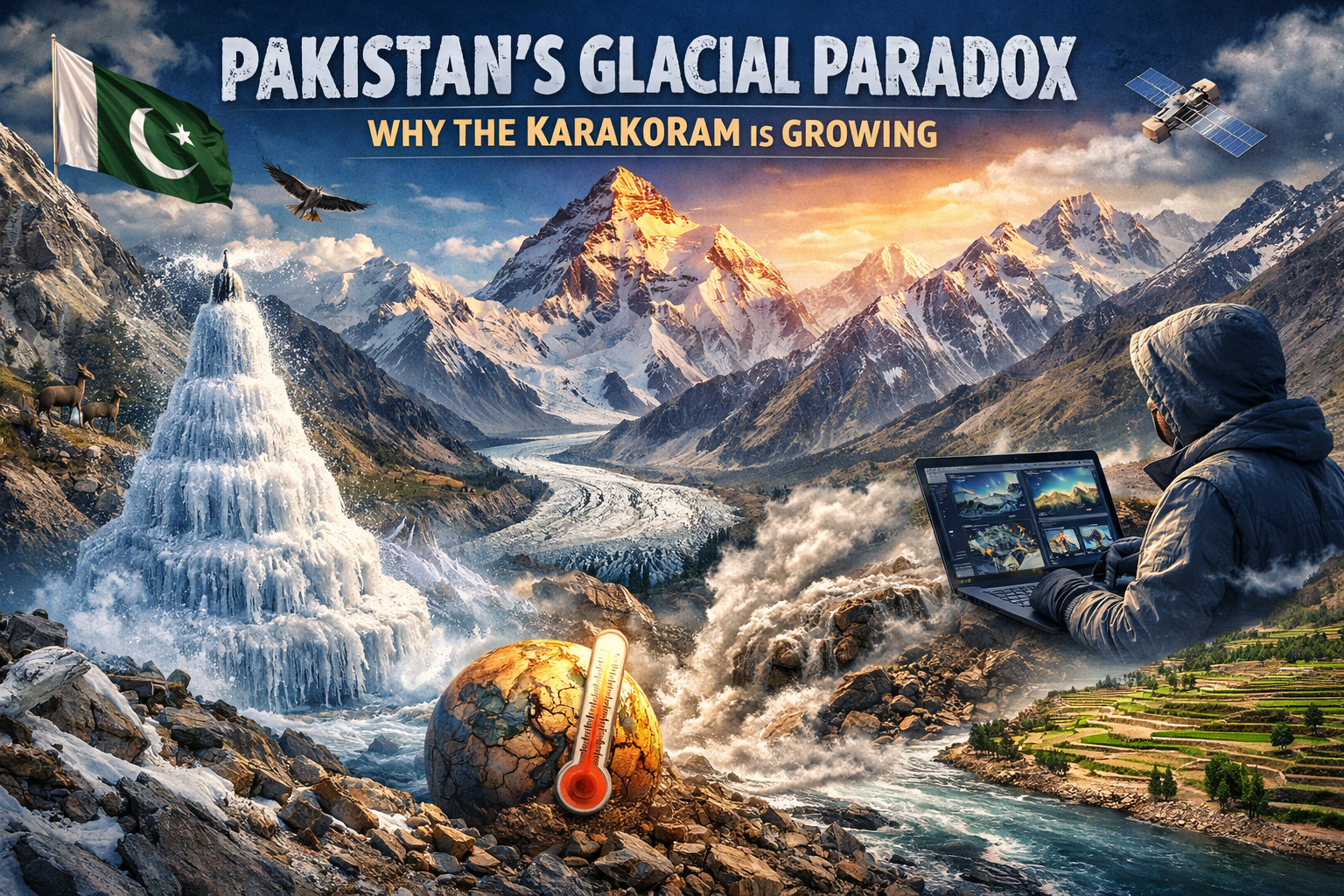
Karakoram Glaciers Growing: 9 Climate Mysteries Explained
Karakoram Glaciers Growing: 9 Climate Mysteries Explained
Introduction: The Pulse of the High Peaks
Pakistan is home to one of the world’s largest freshwater reserves outside the polar regions. The towering Karakoram, Hindu Kush, and Himalayas contain over 13,000 glaciers, often called “Water Towers.” These glaciers support the lives and economy of more than 240 million people. But the Karakoram Glaciers are growing rapidly, it’s amazing.
Major glaciers like the Siachen Glacier and the Baltoro Glacier feed the Indus River system, which is essential for agriculture and energy. As global temperatures rise, scientists are closely studying these glaciers, especially the unique “Karakoram Anomaly,” where some glaciers are still growing despite climate change.
Table of Contents
-
Introduction: The Pulse of the High Peaks
-
The Geography of Giants: Pakistan’s Glacial Wealth
-
The Karakoram Anomaly: Why Some Glaciers are Growing
-
The Phenomenon of Merging Ice
-
Key Factors: Debris Insulation & High-Altitude Snow
-
-
The Crisis in Azad Kashmir: Neelum Valley’s Rapid Thaw
-
The Ice Stupa Revolution: Engineering Hope in Gilgit-Baltistan
-
How Artificial Glaciers Work
-
Impact on Local Agriculture
-
-
The GLOF Menace: Understanding the Ticking Time Bomb
-
The Geopolitics of Ice: Impact on National Water Security
-
The Way Forward: Digital Twins and Green Diplomacy
-
Conclusion: A Legacy on Thin Ice
1. The Geography of Giants: Pakistan’s Glacial Wealth
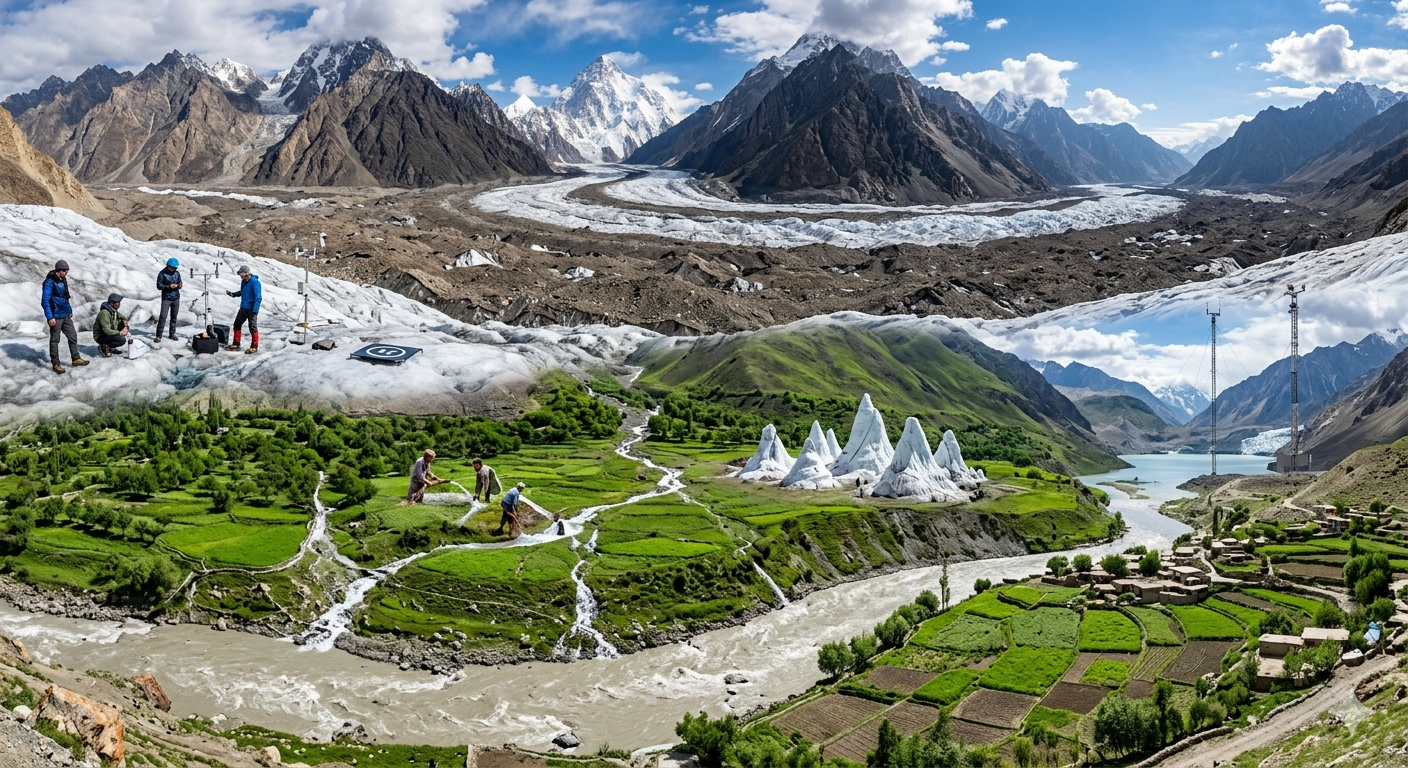
To understand the significance of recent discoveries, one must first grasp the scale of Pakistan’s glacial inventory. The northern territories of Gilgit-Baltistan (GB) and Khyber Pakhtunkhwa (KP) house a frozen empire.
-
The Siachen Glacier: Often called the “highest battlefield,” it is primarily one of the world’s longest non-polar glaciers, stretching over 76 kilometers.
-
The Baltoro Glacier: A 63-kilometer-long highway of ice that leads to the “Throne Room of the Mountain Gods,” surrounding K2.
-
The Batura and Passu Glaciers: These are critical regulators of the Hunza Valley’s ecosystem.
2. The Lifeblood of the Plains: Natural “Delayed-Release” Reservoirs
These glaciers essentially serve as massive, natural “delayed-release” reservoirs for the entire region. During the scorching heat of the plains in May and June, when rainfall is often scarce, these frozen giants begin their seasonal pulse. Consequently, these mountains provide up to 70% of the Indus River’s total flow through this predictable melting process.
Furthermore, this water supply is the primary reason the “breadbasket” of Punjab and the vast orchards of Sindh remain productive. Without them, these fertile lands would inevitably vanish into dust, leading to a national food security crisis. Therefore, the stability of these glaciers is not just an environmental concern but a fundamental necessity for Pakistan’s survival.
3. Engineering Hope: The Ice Stupa Revolution
Innovation often thrives where necessity is at its greatest. In the high-altitude deserts of Gilgit-Baltistan, where natural springs are drying up, a low-tech yet high-impact solution is changing lives: Artificial Glaciers, or Ice Stupas.
To understand how they work, one must look at the simple laws of physics. First, water is brought down from high-altitude streams via underground pipes. Subsequently, due to the natural pressure difference, the water sprays out of a vertical pipe during the freezing winter nights. As a result, the water freezes instantly as it falls, forming a giant cone of ice that mimics a Buddhist Stupa.
The impact of this innovation is profound. Because a cone has a very small surface area relative to its volume, it melts much more slowly than a flat ice sheet. Accordingly, by the time the planting season arrives in April, the stupa begins to release its water, providing a steady stream exactly when the farmers need it most.
4. The Karakoram Anomaly: A Scientific Paradox Defying Global Warming
While glaciers across the globe—from the European Alps to the South American Andes—are in a state of rapid and alarming retreat, a specific cluster in Pakistan is performing the “impossible.” This phenomenon is scientifically documented as the Karakoram Anomaly. However, unlike the general trend of melting ice, these glaciers are showing signs of growth and stability.
The Phenomenon of Merging Ice and Karakoram Glaciers Growing is Amazing.
Recent high-resolution data from NASA and European Space Agency (ESA) satellite sensors have revealed a fascinating development. For instance, massive glaciers such as the Siachen, Lolofond, and Teram Shehr are actually expanding and merging into one another. Consequently, instead of shrinking away from the valleys, their termini (the front edges of the ice) are actively advancing.
This anomaly occurs due to several unique factors:
-
Debris Insulation: First and foremost, these glaciers are covered by a thick layer of rock and sediment. As a result, this debris acts as a thermal shield, protecting the core ice from direct solar radiation.
-
Increased Precipitation: Furthermore, shifting climate patterns have led to higher snowfall at extreme altitudes. This additional snow mass effectively “recharges” the glaciers faster than the summer heat can melt them.
-
Localized Cooling: Ultimately, while lower altitudes are warming, the high-altitude Karakoram peaks are experiencing a unique micro-climate that sustains ice growth.
Why is this happening?
-
Debris Insulation: Unlike “clean” white glaciers, many Pakistani glaciers are “debris-covered.” A thick layer of rock and dust acts as a thermal shield, preventing the sun’s rays from reaching the core ice.
-
Increased High-Altitude Precipitation: Climate change has altered wind patterns, bringing more moisture to the Karakoram at heights above 5,000 meters, resulting in record-breaking snowfall that replenishes the ice faster than it melts.
-
Temperature Lag: While the valleys are warming, the extreme high-altitude zones are seeing a “cooling effect” due to increased cloud cover and moisture.
5. The Dark Side of the Thaw: Crisis in Azad Kashmir
2.1°C. The results are catastrophic:
-
The Vanishing 224: Small glaciers that once sustained local streams are disappearing at an alarming rate.
-
The “Water Poverty” Paradox: Too much water in the spring (floods) and zero water in the late summer (drought).
-
Ecosystem Collapse: The loss of ice is driving rare medicinal plants and mountain wildlife toward extinction.
6. Engineering Hope: The Ice Stupa Revolution
Innovation often thrives where necessity is greatest. In the high-altitude deserts of Gilgit-Baltistan, where natural springs are drying up, a low-tech, high-impact solution is changing lives: Artificial Glaciers, or Ice Stupas.
How a “Vertical Glacier” Works and Karakoram Glaciers Growing?
Based on the principles pioneered by Sonam Wangchuk and adapted by local GB engineers, these structures are a marvel of physics:
-
Gravity-Fed Pipes: Water is brought down from high-altitude streams via underground pipes.
-
The Fountain Effect: Due to the pressure difference, water sprays out of a vertical pipe during the freezing winter nights (-20°C).
-
The Cone Formation: The water freezes instantly as it falls, forming a giant cone of ice that looks like a Buddhist Stupa.
The Impact
In villages like Shigar and Ghulkin, these stupas store millions of liters of water. Because a cone has a small surface area relative to its volume, it melts much slower than a flat ice sheet. By the time the planting season arrives in April, the stupa begins to melt, providing a steady stream of water exactly when the farmers need it most.
7. The GLOF Menace: A Ticking Time Bomb
We cannot discuss Pakistani glaciers without addressing Glacial Lake Outburst Floods (GLOFs). As glaciers melt, they create massive lakes trapped behind fragile walls of loose rock (moraines).
-
Shisper Glacier Case Study: The Shisper GLOF recently destroyed the iconic Karakoram Highway bridge, showing how climate events can paralyze national infrastructure in minutes.
-
Monitoring Gaps: Pakistan currently has over 3,000 glacial lakes, with about 33 of them classified as “highly dangerous.”
8. The Geopolitics of Ice: Water Security
Glaciers are not just environmental assets; they are national security assets. Pakistan’s reliance on the Indus makes it one of the most water-stressed countries in the world.
-
Transboundary Water: The Indus Water Treaty depends on predictable flows. If glacial dynamics change, it could lead to regional tensions.
-
Hydropower: Projects like Diamer-Bhasha and Mohmand Dam rely on glacial melt. If the timing of the melt shifts, the national power grid could face seasonal collapses.
9. The Way Forward: Research and Resilience
To protect the “Land of Ice,” a multi-pronged strategy is required:
I. Digital Twin Technology
II. Community-Based Adaptation
The government must scale the “Ice Stupa” project to every drought-prone village in the North. Training locals as “Glacier Guardians” can help in early warning and conservation.
III. Green Diplomacy about Karakoram Glaciers Growing
Conclusion: A Legacy on Thin Ice
The glaciers of Pakistan are a testament to nature’s grandeur and fragility. While the Karakoram shows mysterious growth, the Himalayas face rapid melting. This contrast sends a clear message: the mountains are changing.
We are at a crossroads. We can either watch our “Water Towers” crumble or, alternatively, embrace the spirit of the Ice Stupa—combining ancient wisdom with modern science to safeguard our future. The melting clock is ticking; yet with innovation and global willpower, we can ensure that the “Land of Ice” remains a land of life for generations to come.
To know about Global Weather Click here.
Frequently Asked Questions (FAQs)
-
Pakistan mein kitne glaciers hain?
Pakistan mein 13,000 se zyada glaciers hain. Ye polar regions ke bahar duniya ka sabse bada glacial network hai. Zyada glaciers Karakoram, Himalaya aur Hindu Kush ranges mein hain. -
Karakoram Anomaly kya hai?
Karakoram Anomaly wo phenomenon hai jahan Pakistan ke Karakoram glaciers stable hain ya phail rahe hain, jabke duniya ke baaki glaciers pighal rahe hain. Ye zyada tar debris aur buland maqamaat ki wajah se hota hai. -
Ice Stupa ya Artificial Glacier kaise kaam karta hai?
Ice Stupa cone-shaped barf ka dher hai. Sardiyon mein pani ko pipes ke zariye spray karke banaya jata hai. Ye dheere dheere garmiyon mein pighal kar farmers ko pani deta hai. -
GLOF (Glacial Lake Outburst Flood) kya hota hai?
Jab glacier pighalta hai, to pani ek lake mein rukta hai. Agar lake ka barrier toot jaye, to achanak flood aata hai. Isay GLOF kehte hain. -
Glacier pighalne se agriculture par kya asar hoga?
Pakistan ki 60-70% agriculture Indus River par depend karti hai. Agar glaciers khatam ho gaye, to shuru mein floods aur baad mein pani ki kami se drought ka khatra barh jata hai.






One Comment