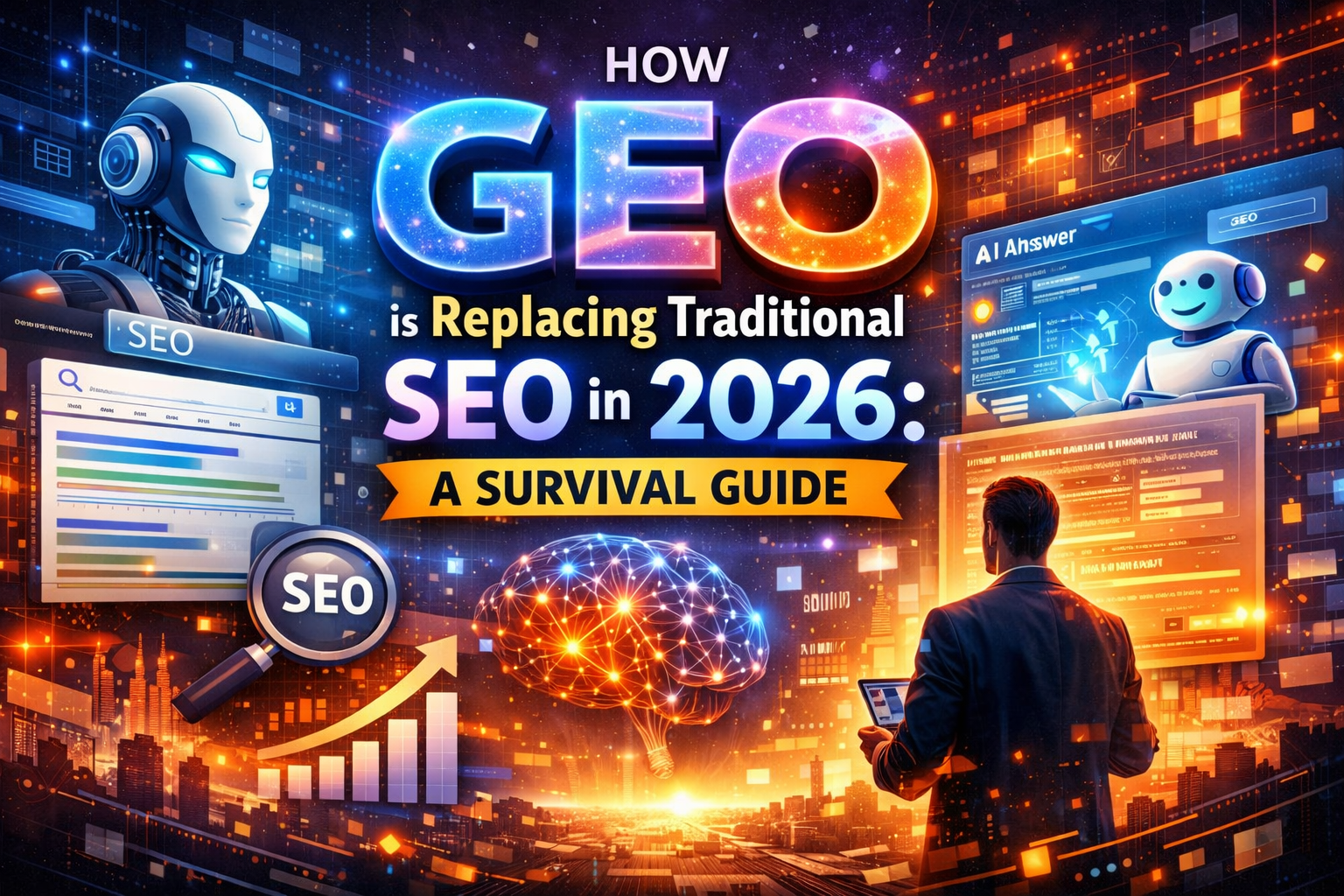
How GEO is Replacing Traditional SEO in 2026: A Survival Guide
How GEO is Replacing Traditional SEO in 2026: A Survival Guide
The digital landscape is undergoing its most radical transformation since the birth of the search engine. For over two decades, “SEO” (Search Engine Optimization) has been the bedrock of digital growth. We built websites for crawlers, chased blue links, and obsessed over domain authority. But in 2026, the search bar is no longer the final destination—it’s just the starting point.
Welcome to the era of GEO (Generative Engine Optimization).
Table of Contents
-
Introduction: The New Era of AI Discovery
-
The Death of the “Blue Link” Mentality
-
Why GEO is the Natural Evolution of SEO
-
5 Pillars of Your 2026 Survival Strategy
-
Concept Over Keywords
-
The E-E-A-T Explosion
-
Citations: The New Backlinks
-
Direct, Conversational Authority
-
Technical Structure for Machines
-
-
GEO in Action: A Case Study
-
Navigating the Future: Your Survival Checklist
-
The Human Element: Why You Still Win
-
Conclusion: Evolve or Become Invisible
If you are a business owner, a content creator, or a digital marketer, you are likely feeling the tremors. Your traffic patterns are shifting, and traditional keyword stuffing is yielding diminishing returns. This guide is your roadmap to not just surviving this shift but thriving in a world where AI-generated answers are the new “ranking.”
The Death of the “Blue Link” Mentality
For years, the goal of SEO was simple: get your website to rank in the top three results on Google so a human would click your link. But look at how we search today. We don’t just type keywords; we ask complex questions to AI models like Gemini, ChatGPT, and Perplexity.
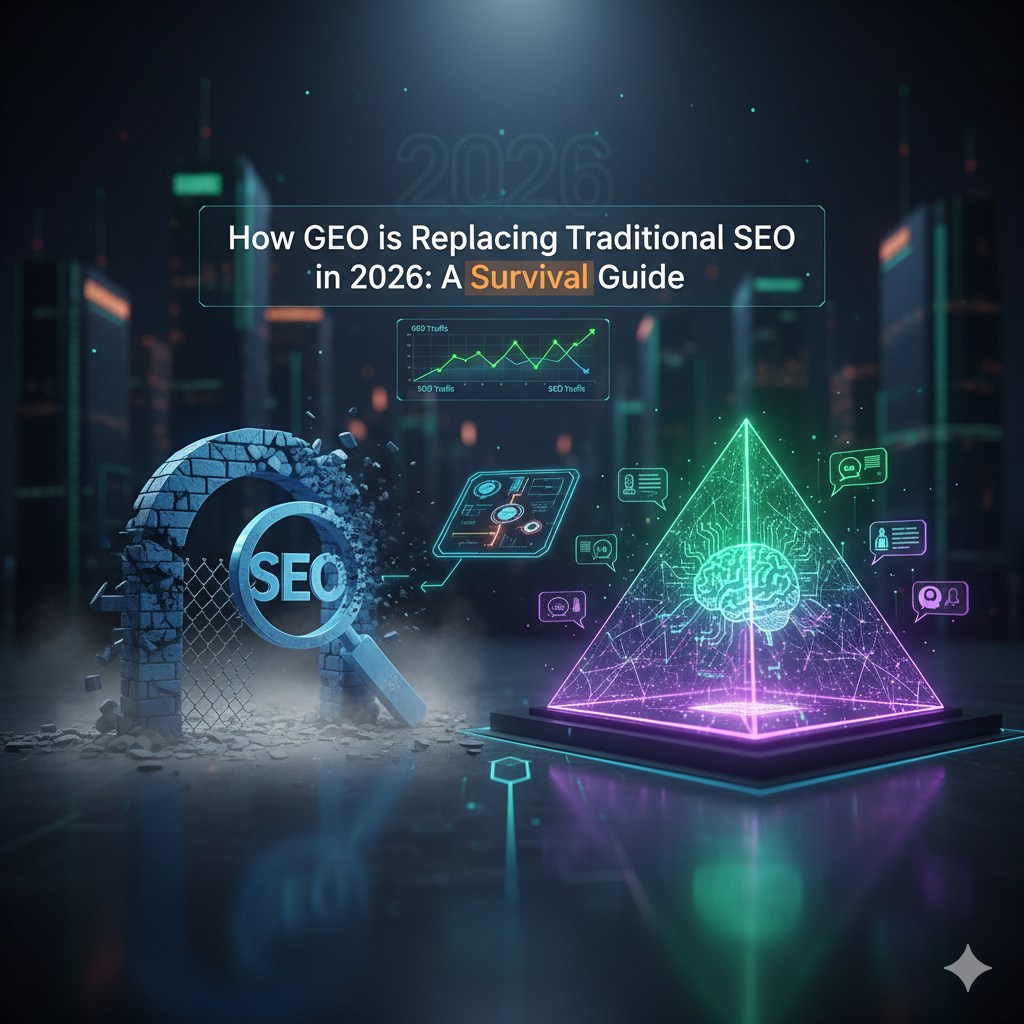
These systems don’t send users to a list of websites. They synthesize information and provide an immediate, structured answer. If your content is buried in a traditional SEO framework, you might be invisible to these models. GEO is the practice of optimizing your content to be the “source” that AI models cite.
Why GEO isn’t “Anti-SEO”
There is a dangerous misconception circulating that GEO is here to replace SEO entirely. Let’s set the record straight: GEO is an evolution of SEO, not its execution.
You still need a technically sound website. You still need quality backlinks. However, those are now the floor, not the ceiling. In 2026, you aren’t just optimizing for a machine to “read” your page; you are optimizing for a machine to “trust” your expertise enough to summarize it for a human user.
The 5 Pillars of Your 2026 Survival Strategy
To win in the GEO era, you must pivot your content strategy toward these five pillars:
1. Concept Over Keywords
Traditional SEO taught us to target high-volume keywords. GEO, however, thrives on Concept Mapping. An AI model needs to understand the “entity” of your topic. If you write about “Financial Planning,” don’t just repeat the phrase. Cover the tax implications, the psychological aspects, the historical context, and the current trends. The more comprehensive your concept, the more likely the AI is to view you as the ultimate authority.
2. The “E-E-A-T” Explosion
Google’s Experience, Expertise, Authoritativeness, and Trustworthiness (E-E-A-T) framework is no longer just a suggestion—it is the algorithm’s core. In 2026, AI models are programmed to prefer sources that have high credibility. If you are an individual creator, your personal story matters. If you are a brand, your citations from other reputable sources matter.
3. Citations are the New Backlinks
In the old days, a backlink was a vote of confidence. In the GEO world, being cited by name in an AI-generated answer is the new currency. To earn these citations, your content must be “quote-worthy.” Use original data, unique surveys, and bold, verifiable insights that an AI can easily pull and verify as a fact.
4. Direct, Conversational Authority
If your content reads as if a bot wrote it, the AI will ignore it. Why? Because the AI is already a bot. It is looking for the “human spark”—real-world anecdotes, specific examples from your niche, and a distinct voice. When you write, assume you are talking to a smart colleague over coffee. Avoid fluff; provide value immediately.
5. Technical Structure for Machines
Even though we are optimizing for “meaning,” the structure remains vital. Use Schema Markup to help AI engines understand exactly what your page is. If you have a table of data, ensure it is formatted clearly. If you are answering a question, put the direct answer in the first paragraph, followed by the supporting details. This “inverted pyramid” style is perfect for AI summarization.
GEO in Action: A Case Study
Imagine you are running a site about “Home Renovation.”
-
The SEO Approach: You write a 500-word post about “Cheap Kitchen Tiles” and try to rank for that keyword.
-
The GEO Approach: You write a 2,000-word comprehensive guide on “Modern Kitchen Remodeling Trends for 2026,” including a breakdown of material costs, sustainability ratings, and expert interviews.
When a user asks an AI, “How can I modernize my kitchen on a budget in 2026?”, the AI doesn’t just link to you—it uses your data to answer the user’s question. You become the helpful expert, not just another link in the stack.
Navigating the Future: A Survival Checklist
| Action Item | Why it Matters |
| Audit Content for Accuracy | AI models penalize outdated or inaccurate info. |
| Implement Advanced Schema | Helps AI map your content to search intent. |
| Diversify Your Traffic | Don’t rely solely on one search engine; build your brand ecosystem. |
| Write for “Follow-Up” Questions | Predict what the user will ask after they read your first point. |
| Highlight Your “Unique Value” | What can you provide that AI can’t? (Personal stories, physical testing). |
The Human Element: Why You Still Win
Here is the comforting reality: AI can synthesize facts, but it cannot create experience. It can summarize a thousand reviews about a restaurant, but it cannot share the specific emotional feeling of a meal eaten in a specific city.
As we move through 2026, the content that stands the test of time will be that which remains deeply human. Use AI to structure your research, but use your humanity to shape your perspective. Your audience in the UK, USA, Canada, and Europe is tired of AI-generated filler. They are craving authenticity. If you provide that, you will not only be cited by AI—you will be sought out by real people.
Conclusion
The shift from SEO to GEO is not a digital death sentence. It is a refinement process. We are moving toward a web that is cleaner, smarter, and more helpful. By embracing GEO, you are positioning your brand to be the foundation upon which the future of search is built.
Don’t panic. Evolve. Focus on being the expert, being the original source, and providing the insights that the machine needs to reference. The search bar is evolving—make sure your content evolves with it.
To learn more about the SEO Tips, Click Here.
YouTube video about GEO Vs. SEO
Frequently Asked Questions (FAQ)
1. What is Generative Engine Optimization (GEO)?
Generative Engine Optimization (GEO) is the practice of optimizing content so that AI-powered search engines can understand, summarize, and cite it in generated answers. Unlike traditional SEO, which focuses on ranking links in search results, GEO focuses on becoming a trusted source for AI-generated responses.
2. How is GEO different from traditional SEO?
Traditional SEO focuses on keyword rankings, backlinks, and search engine results pages. GEO focuses on concept authority, AI readability, and being cited in AI-generated answers by platforms like ChatGPT, Gemini, and Perplexity.
3. Why is GEO becoming important in 2026?
In 2026, more users are asking questions directly to AI assistants instead of clicking traditional search results. GEO helps websites remain visible by ensuring their content becomes the source that AI systems reference.
4. Can GEO replace SEO completely?
No, GEO does not replace SEO entirely. Instead, it builds on traditional SEO practices. Technical SEO, website speed, and backlinks still matter, but GEO adds a new layer of optimization for AI-driven search engines.
5. How can I optimize my content for AI search engines?
To optimize content for AI search engines:
-
Write comprehensive topic-focused articles
-
Use clear headings and structured data
-
Provide original insights and statistics
-
Follow E-E-A-T guidelines
-
Answer questions directly and clearly
6. What type of content performs best in GEO?
Long-form, well-researched, and authoritative content performs best in GEO. Articles that cover topics comprehensively and provide unique insights are more likely to be cited by AI engines.
7. Do backlinks still matter in the GEO era?
Yes, backlinks still play an important role in building website authority. However, in GEO, citations within AI-generated answers are becoming just as valuable as traditional backlinks.
8. Which AI search engines influence GEO the most?
Major AI-powered search systems influencing GEO include ChatGPT, Google Gemini, Perplexity AI, and other generative search assistants that provide summarized answers to user queries.
9. How can small websites compete in the GEO era?
Small websites can compete by focusing on niche expertise, producing unique content, sharing real-world experiences, and becoming a trusted authority within a specific topic area.
10. What is the future of SEO and GEO together?
The future of search will likely combine traditional SEO and GEO strategies. Websites that provide trustworthy, structured, and human-focused content will perform best in both traditional search results and AI-generated answers.