
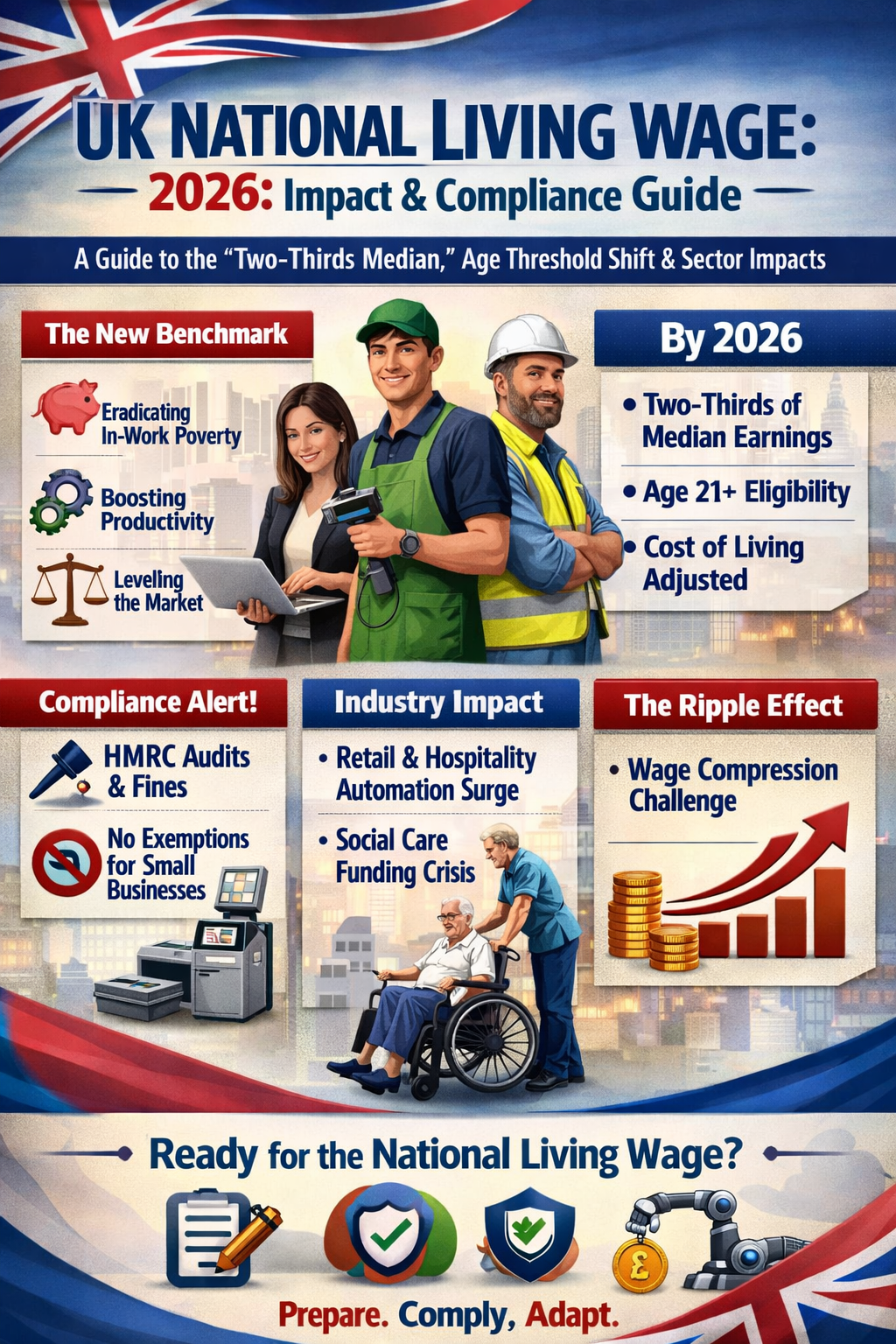
UK National Living Wage 2026: Impact & Compliance Guide
UK National Living Wage 2026: Impact & Compliance Guide
Executive Summary: In 2026, the National Living Wage (NLW) is more than a statutory requirement; The National Living Wage (NLW) in 2026 is more than a legal obligation—it represents a benchmark for social responsibility, fair pay, and economic stability. This guide explains the latest rates, age-threshold changes, sectoral impacts, compliance requirements, and how businesses are balancing rising labor costs with productivity in a post-inflationary economy. it is a benchmark for corporate social responsibility and economic stability. This guide explores the transition to the “Two-Thirds Median” target, the 2024 age-threshold shifts, and how businesses are balancing rising labor costs with productivity in a post-inflationary economy.
1. The Genesis: Why the National Living Wage Changed the UK Economy
The introduction of the National Living Wage in April 2016 marked a paradigm shift in UK labor policy. Unlike the traditional National Minimum Wage (NMW), which was purely an economic floor, the NLW was designed as a “stepped” progression toward a higher standard of living for mature workers.
The NLW was first introduced in April 2016 to improve the standard of living for adult workers. Unlike the National Minimum Wage (NMW), which acted as a simple wage floor, the NLW is designed to:
Triple-Aim Framework:
- Eradicate In-Work Poverty – Focuses on providing a sustainable wage rather than just employment. NLW reduces reliance on Universal Credit.
- Increase Productivity – Higher wages improve morale, reduce presenteeism, and enhance efficiency.
- Level the Market – Prevents wage suppression competition, pushing companies toward automation and innovation.
Insight: Businesses paying the NLW are not only complying legally but also investing in workforce stability and morale.
The Triple-Aim Framework:
-
Eradicating In-Work Poverty: In 2026, the focus has shifted from “having a job” to “having a job that pays for a life.” The NLW aims to decouple low-income households from a total reliance on Universal Credit.
-
Productivity Incentives: Higher wages theoretically lead to higher “efficiency wages.” When workers are paid more, their caloric intake, mental health, and job commitment improve, reducing the “presenteeism” (being at work but not productive) that plagues low-pay sectors.
-
Market Leveling: It prevents “bottom-feeding” where companies compete solely on the basis of suppressing wages, forcing innovation in automation and service quality instead.
2. Deciphering the Calculation: How the 2026 Rates are Set
The calculation of the NLW is a complex interplay between the Low Pay Commission (LPC) recommendations and government mandates.
The NLW is determined through recommendations by the Low Pay Commission (LPC) and government mandates. Key considerations include:
- Two-Thirds Median Target: By 2024, NLW reached two-thirds of median earnings for workers aged 21+. In 2026, this ratio is maintained while accounting for inflation in essential expenses like rent and energy.
- Consumer Price Index (CPI): Adjustments prevent real-term wage reductions.
- Productivity Gap: If wages rise faster than productivity for three consecutive years, a wage-price spiral may occur.
- Labour Market Tightness: Low unemployment means market rates often exceed the statutory NLW.
3. Eligibility and Legal Framework: Who is Entitled?
The biggest change in recent years is the Age Threshold Compression.
The 21+ Rule
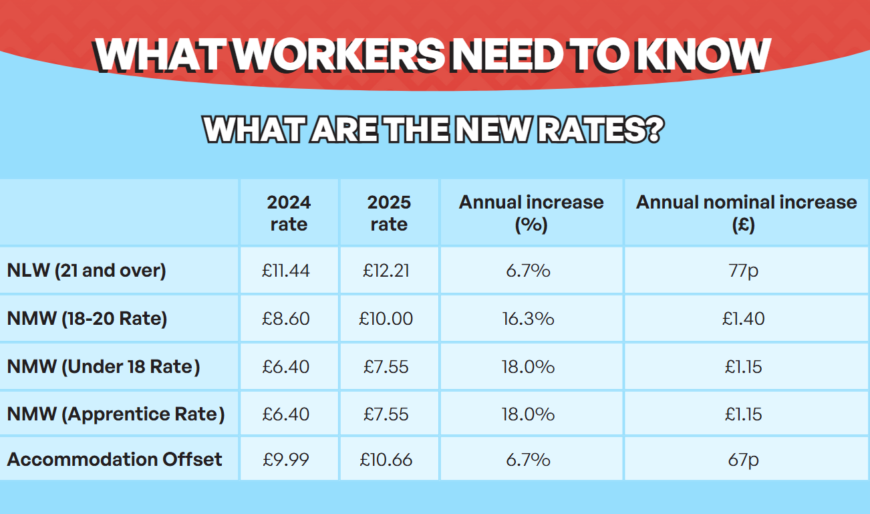
Previously, the NLW was reserved for those aged 25+, then 23+. As of 2024/2025, anyone aged 21 or older is legally entitled to the full National Living Wage. This recognizes that a 21-year-old often has the same living expenses (rent, bills, food) as a 30-year-old.
Worker Status Definitions:
To ensure your business stays compliant (or to check your rights as an employee), you must understand “Worker Status”:
-
Classed as a Worker: This includes casual laborers, agency staff, and those on zero-hour contracts. If you provide a service personally, you are likely covered.
-
The “Apprentice” Exception: Apprentices have a separate rate, but only if they are under 19 or in the first year of their apprenticeship. Once they hit 19 and finish Year 1, they move to the NMW/NLW age-appropriate rate.
Who is Exempt?
-
Truly Self-Employed: Those who set their own prices and work for multiple clients.
-
Voluntary Workers: Genuine volunteers for charities who receive no payment other than expenses.
-
Live-in Family Workers: Members of the employer’s family living in the family home who assist with household or business tasks.
4. Sector-Specific Impacts: From Retail to Tech
The NLW does not affect all industries equally. In 2026, we see a “Bifurcation” of the labor market.
Hospitality and Retail (High Impact)
These sectors operate on thin margins. The rise in NLW has forced a “Digital Transformation.” You will notice more self-service kiosks and AI-driven inventory management as businesses try to offset the higher cost per human hour.
Social Care (The Crisis Point)
The social care sector is the largest employer of NLW workers. Because social care is largely funded by local councils, wage increases without central government funding boosts create a “funding gap.” In 2026, this remains the most debated aspect of NLW policy.
5. National Living Wage vs. The “Real” Living Wage
This is where many businesses get confused.
| Feature | National Living Wage (Statutory) | Real Living Wage (Voluntary) |
| Who sets it? | UK Government / LPC | Living Wage Foundation |
| Is it legal? | Yes, it is the law. | No, it is a choice. |
| Basis? | Target % of median earnings. | Actual cost of a “basket of goods.” |
| London Weighting? | Same rate across UK. | Specific higher rate for London. |
2026 Insight: Over 15,000 UK employers are now “Living Wage Accredited.” They pay the higher voluntary rate because it drastically improves their Employer Brand, making it easier to recruit in a competitive market.
6. The “Ripple Effect” (Wage Compression)
A challenge for HR departments in 2026 is “Wage Compression.” When the NLW rises, the gap between an entry-level worker and a supervisor narrows.
Example: If a cleaner’s wage rises by 6%, the supervisor (who was earning 10% more) may demand a similar raise to maintain the “value” of their responsibility. This “ripple effect” means the true cost of an NLW increase is often double what it appears on paper.
7. Compliance and the Cost of Non-Compliance
HMRC is the enforcement body for the NLW. In 2026, they use AI-driven auditing to flag payroll discrepancies.
Common Compliance Mistakes:
-
Unpaid Trial Shifts: These are illegal if they are excessively long.
-
Deductions for Uniforms: If a worker has to buy a uniform and it brings their pay below the NLW, the employer is in breach.
-
Round-the-Clock Working: Failing to pay for “sleep-in” shifts or travel time between appointments (common in home care).
The Penalty: Fines of up to 200% of the arrears, plus public “naming and shaming” by the Department for Business and Trade.
8. 2026 and Beyond: The Future of Fair Pay
As we look toward 2027-2030, the debate is moving toward a “Universal Basic Income” (UBI) vs. a “Single Adult Rate.” There is pressure to abolish the lower “Youth Rates” for 18-20 year olds entirely, creating one single minimum wage for all adults.
The Role of Automation
Can the NLW go too high? Some economists argue that if the NLW reaches £15-£16 per hour, businesses will replace entry-level roles with robotics faster than the economy can create new “high-skill” roles.
9. Conclusion: A Balanced Perspective
The National Living Wage is a triumph for social justice, having lifted millions out of extreme poverty since 2016. However, for the UK economy to thrive in 2026, this wage growth must be matched by Capital Investment. Businesses must stop relying on “cheap labor” and start investing in the tools and training that make every hour worked more valuable.
The National Living Wage 2026 is a milestone for social justice, lifting millions out of poverty. Employees and employers alike must:
- Employees: Ensure pay meets legal entitlements.
- Employers: Invest in technology and training to maintain productivity.
The NLW is now a cornerstone of the modern British workplace, balancing fair pay with sustainable business practices.
Whether you are an employee ensuring you are paid what you are worth, or an employer navigating a complex P&L, the NLW is the cornerstone of the modern British contract.
Frequently Asked Questions (FAQs)
Q1: Does the NLW apply to remote workers?
- Yes. Location (home or office) does not change statutory rights.
Q2: Is the 2026 rate different for London?
- Statutory NLW is the same UK-wide. Voluntary Real Living Wage is higher for London.
Q3: Can small businesses opt out?
- No. All employers, including small businesses, must comply.
Q4: What if I turn 21 mid-year?
- NLW must apply from the first pay period after your birthday.